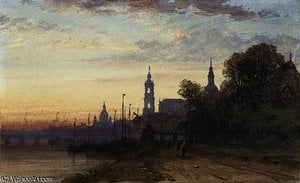
A Life Bridging Diplomacy, Commerce, and Artistic Vision
William Wyld, born in London in 1806, embodies a fascinating intersection of worlds – the refined circles of diplomacy, the bustling energy of commerce, and ultimately, the captivating realm of art. His journey was not one of immediate artistic dedication, but rather a gradual unfolding of passion nurtured by circumstance and opportunity. Inheriting drawing materials at the tender age of six following a family tragedy sparked an early inclination towards visual expression, yet his path initially led him away from formal training. Following his father’s death, connections secured Wyld a position as secretary to the British Consulate in Calais, immersing him in European culture and political landscapes. This formative period proved crucial, exposing him not only to international affairs but also to artistic influences that would shape his future style. It was in Calais that he came under the tutelage of François Louis Thomas Francia, a watercolourist deeply influenced by masters like Thomas Girtin and Richard Parkes Bonington – a mentorship that laid the groundwork for Wyld’s own distinctive approach.Early Influences and Artistic Beginnings
Wyld's formative years instilled in him a profound appreciation for observation and detail—qualities that would become hallmarks of his artistic style. The diplomatic role afforded him access to privileged environments, allowing him to absorb the nuances of European society and culture firsthand. However, it was Francia’s guidance that truly ignited Wyld’s creative spark. Francia's unwavering devotion to Bonington and Girtin served as a powerful catalyst, shaping Wyld’s stylistic sensibilities and fostering his understanding of tonalism—a technique prioritizing atmospheric effects over precise representation. This influence is palpable in Wyld’s early works, particularly “Venice at Sunrise,” where the hazy luminescence captures the ethereal beauty of the Venetian lagoon with remarkable accuracy.Champagne Exports and Artistic Exploration
A serendipitous encounter transformed Wyld's professional trajectory: his involvement in champagne export from Épernay to England. Between 1827 and 1833, he established a business that cultivated valuable connections within aristocratic circles and deepened his comprehension of French viticulture—a venture that simultaneously fueled his artistic pursuits and broadened his worldview. Despite prioritizing this commercial endeavor, Wyld consistently sketched and painted during his travels alongside Horace Vernet, honing his skills while patiently awaiting the opportunity to fully dedicate himself to art. This deliberate delay wasn’t driven by lack of ambition; rather, it reflected a thoughtful consideration of priorities—a commitment to securing his younger brother's future within the family business—demonstrating unwavering familial loyalty and responsibility.The Parisian Salon Years: Recognition and Royal Patronage
The year 1833 marked a pivotal moment in Wyld’s artistic development. A journey to Algiers, prompted by Baron de Vialar, exposed him to North African landscapes and culture, sparking an enduring fascination with Orientalist themes that would become central to his oeuvre. Simultaneously, encouragement from Vernet spurred him toward pursuing painting professionally—a suggestion he gratefully accepted, relocating to Rome where he drew inspiration from Michelangelo and Raphael. Within the Roman artistic milieu, Wyld swiftly gained acclaim, securing commissions for Orientalist paintings and refining his technique under the tutelage of influential masters. His breakthrough arrived at the Paris Salon of 1839 with “Venice at Sunrise,” a monumental watercolor that garnered him the prestigious first gold medal—a triumph that catapulted him into artistic prominence and secured the patronage of Queen Victoria herself. She commissioned paintings of Liverpool and Manchester to commemorate her visit in 1851; Wyld’s depiction of Manchester, specifically, became an iconic image of Victorian industrial life—a testament to his ability to capture the spirit of a transformative era.A Legacy of Detail and Atmospheric Skill
Throughout his prolific career, Wyld remained actively engaged with the artistic community, becoming a member of both the New Society of Painters in Watercolors and later the Royal Institute of Painters in Watercolour. His travels extended beyond France, encompassing Brittany where he forged friendships—particularly with Comtesse de Tromelin—to whom he dedicated “Chemin à Ploujean,” further enriching his artistic inspiration. Wyld continued exhibiting at various salons until his death in Paris in 1889. William Wyld’s work is characterized by its meticulous observation, masterful watercolour technique, and a compelling blend of Orientalist themes, Venetian landscapes, and evocative cityscapes—a distinctive style that cemented his place as a significant successor to Bonington, inheriting his unwavering dedication to tonalism and capturing the sublime beauty of natural vistas. His paintings offer not merely representations of places but immersive experiences—inviting viewers to contemplate the grandeur of nature and the dynamism of urban life. Wyld’s enduring legacy resides in his ability to synthesize diverse artistic influences and produce a body of work that reflects both the Romantic spirit of his time and the evolving panorama of Victorian Europe.Întrebări și răspunsuri
Unde pot fi găsite operele lui William Wyld, grupate pe mișcări artistice?
Pagina Toate mișcările de artă grupează operele lui William Wyld pe mișcări artistice.
Pot studia utilizarea culorii de către William Wyld în toate lucrările sale?
Modul în care William Wyld utilizează culoarea în lucrările enumerate pe acest site web poate fi explorat pe pagina Genoma Paletei a artistului.
Pot sorta operele lui William Wyld după culoare?
Indice Spectral lui William Wyld este o pagină care organizează operele de artă ale acestuia în funcție de culoare.