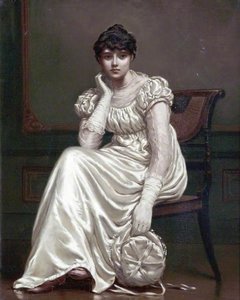
William Henry Longmaid: A Victorian Portraitist Capturing Essence
William Henry Longmaid (1835–1919) was a British artist and sculptor born in Tavistock, Devon, the son of a metallurgical chemist. His artistic journey began amidst a burgeoning Victorian fascination with realism and psychological depth—a period profoundly shaped by scientific advancements alongside an enduring appreciation for classical ideals. While overshadowed by contemporaries like Burne Jones and Alma Tadema, Longmaid nonetheless carved out a distinctive niche as a portrait painter, particularly renowned for his ability to convey subtle emotions and nuanced characterizations within meticulously rendered canvases.
- Early Life & Education: Little is known definitively about Longmaid’s formative years beyond his birthplace and familial profession. He pursued studies at Plymouth Art School, honing his skills in drawing and painting before embarking on a more ambitious artistic path.
- Move to London & Artistic Development: By the late 1860s, Longmaid had established himself in London’s artistic milieu, immersing himself in the vibrant studios of fellow artists and engaging with influential intellectual currents. This period witnessed significant stylistic evolution—away from purely academic conventions toward a more expressive approach informed by Impressionistic influences.
- Notable Commissions & Subjects: Longmaid gained considerable recognition for his portrait commissions, capturing likenesses of prominent figures across various professions – nobility, academics, and businessmen. His subjects were often presented with an emphasis on psychological realism, striving to portray not merely physical appearance but also inner temperament and spirit.
His artistic style exemplifies a fascinating blend of Victorian tradition and burgeoning Impressionism. He adhered to classical principles of composition and anatomic accuracy—a legacy of the Beaux Arts movement—yet skillfully incorporated techniques borrowed from Monet, Renoir, and Sisley. This resulted in paintings characterized by luminous color palettes, soft brushstrokes, and an atmospheric sense of immediacy. Longmaid’s meticulous attention to detail ensured that even these fleeting impressions were rendered with remarkable precision, capturing subtle nuances of light and shadow. His canvases often depict interiors bathed in diffused sunlight, conveying a palpable feeling for the textures and moods of everyday life.
Among Longmaid’s most celebrated works is “Portrait of an Unknown Woman Wearing a Cloak,” currently housed at Musée Thomas-Henry in Évreux, France. This evocative portrait exemplifies his mastery of psychological portrayal—a testament to his ability to distill complex emotions into a single image. Furthermore, Longmaid's sculptures gained acclaim for their grace and elegance, reflecting the Victorian penchant for idealized forms and refined craftsmanship. His contributions to British art history are underscored by his inclusion in the William Evans Bequest at Bangor University – a collection showcasing the artistic legacy of his era.
Longmaid’s work serves as a poignant reminder of the Victorian era's commitment to both intellectual rigor and artistic beauty—a stylistic duality that continues to inspire artists seeking to convey emotion and atmosphere within meticulously crafted compositions. He stands as an exemplar of Victorian portraiture—a genre that prioritized capturing the inner life alongside outward appearance. His legacy persists in the enduring appreciation for classical aesthetics combined with Impressionistic techniques—a stylistic fusion that solidified his place among Britain’s most respected visual artists.