Théodore Géricault, 1791 – 1824

The 100 Most Famous Paintings by Théodore Géricault

The painting that made Théodore Géricault famous is Raftul Meduzei (1818); it hangs in the Muzeul Luvru, Paris. Nymph and Satyr (Jupiter and Antiope) (1820) and The Oath of Brutus after the Death of Lucretia (1815) follow it in the hearts of collectors and museum visitors. Of the 183 works by Théodore Géricault in our catalogue, these 100 are the most admired, each presented with its date, its museum and what sets it apart.

Clasate în funcție de scorul nostru de popularitate, care combină numărul de căutări, vizite și comenzi pentru fiecare operă. Actualizat Octombrie 2026. Every masterpiece on this page can be ordered as a museum-quality, hand-painted oil reproduction or a fine art print, at the size you choose.

Portretul lui Théodore Géricault
Théodore Géricault · 1791 – 1824
Născut · Decedat
1791 – 1824, Rouen
Mișcare
Romantic painting
Lucrări din catalogul nostru
183
Cele mai celebre
Raftul Meduzei (1818)
Cele mai multe lucrări la
Muzeul Luvru

Théodore Géricault: the ten masterpieces

Raftul Meduzei (1818) de Théodore Géricault
1

Raftul Meduzei

1818 · Ulei pe pânză · Muzeul Luvru, Paris

Capodopera monumentală a lui Jean-Louis André Théodore Géricault este mult mai mult decât o simplă reprezentare a unui dezastru maritim; este o explorare viscerală a disperării umane, a scandalului politic și a puterii sublime a naturii. Finalizată în 1819, această pânză de dimensiuni colosale (491 x 716 cm) immortalizează consecințele terifiante ale naufragiului din 1816 al fregatului francez Méduse, o tragedie născută din neglijență și corupție care a șocat întreaga…

Nymph and Satyr (Jupiter and Antiope) (1820) de Théodore Géricault
2

Nymph and Satyr (Jupiter and Antiope)

1820 · Acrylic On Canvas · Musée des Beaux-Arts et de la Céramique, Rouen

The Allure of the Divine Encounter: Géricault’s *Nymph and Satyr* Jean-Louis André Théodore Géricault's *Nymph and Satyr*, painted in 1819, isn’t merely a depiction of a mythological scene; it’s a profound exploration of desire, transgression, and the inherent tension between innocence and primal instinct. Born amidst the tumultuous backdrop of post-revolutionary France, Géricault, already recognized for his dramatic intensity, sought to capture not just a narrative but an emotional truth—a…

Lions in a Mountainous Landscape (1818) de Théodore Géricault
4

Lions in a Mountainous Landscape

1818 · Acrylic On Canvas · Metropolitan Museum of Art, New York

This vigorous painting of six lions in a remote, spectrally illuminated lair—possibly intended to evoke the Atlas Mountains of Morocco—is an extraordinary example of Gericault’s spontaneous handling of paint. Rather than applying finishing touches to make a polished cabinet picture, the artist left the painting in a state known as an esquisse, or sketch, a work prized by fellow artists for its strength of directly capturing a subject or effect.…

The Kiss (1822) de Théodore Géricault
5

The Kiss

1822 · Acrylic On Canvas · Muzeul Thyssen-Bornemisza, Madrid

Théodore Géricault's "The Kiss," painted in 1816, isn’t merely a depiction of lovers entwined; it’s a visceral embodiment of the burgeoning Romantic movement’s fascination with raw emotion, dramatic intensity, and the sublime. This arresting work, housed within the Thyssen-Bornemisza Museum in Madrid, transcends simple representation to become a profound meditation on passion, vulnerability, and the very essence of human connection. Géricault, already a figure known for his unflinching portrayals of…

Wounded Soldiers Retrating from Russia (1814) de Théodore Géricault
6

Wounded Soldiers Retrating from Russia

1814 · Acrylic On Canvas · Musée des Beaux-Arts, Rouen

A Symphony of Suffering: Géricault’s “Wounded Soldiers Retrating from Russia” Jean-Louis André Théodore Géricault's "Wounded Soldiers Retrating from Russia" is not merely a painting; it’s a visceral embodiment of the horrors and human cost of war, rendered with an unprecedented level of realism and emotional intensity for its time. Completed in 1814, this monumental canvas—measuring a commanding 250 x 206 cm—captures a pivotal moment during Napoleon's disastrous invasion of Russia,…

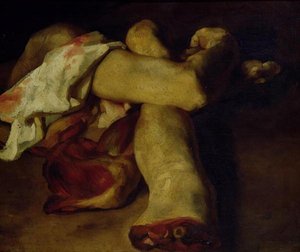
Study of Feet and Hands (1818) de Théodore Géricault
7

Study of Feet and Hands

1818 · Oil On Canvas · Musée Fabre, Montpellier

Jean-Louis André Théodore Géricault's "Study of Feet and Hands," painted in 1818, isn’t a grand statement of Romantic drama like his monumental “The Raft of the Medusa.” Instead, it offers a profoundly intimate glimpse into the artist’s meticulous process and a poignant meditation on the human form. This unassuming oil painting—measuring a modest 52 x 64 cm—is far more than just a preparatory sketch; it's a concentrated distillation of Géricault’s…

The Raft of the Medusa (detail) (1818) de Théodore Géricault
8

The Raft of the Medusa (detail)

1818 · Oil On Canvas · Muzeul Luvru, Paris

Jean-Louis André Théodore Géricault's "The Raft of the Medusa," a monumental detail from his 1818 painting, isn’t merely a depiction of shipwreck; it’s a visceral plunge into the depths of human suffering and political indictment. The scene, rendered with a dramatic intensity characteristic of Romanticism, captures the harrowing aftermath of the French frigate *Medusa*'s wreck off the coast of Mauritania in 1816. This disaster, largely attributed to the incompetence and…

The Wreck (1821) de Théodore Géricault
10

The Wreck

1821 · Oil On Canvas · Muzeul Luvru, Paris

Théodore Géricault's "The Wreck," painted in 1821, isn’t merely a seascape; it’s a visceral confrontation with the sublime—a raw depiction of humanity’s vulnerability against the overwhelming force of nature. Born amidst the turbulent currents of post-revolutionary France, Géricault, a figure both lauded and controversial within the burgeoning Romantic movement, channeled his own anxieties and the era's fascination with dramatic events into this monumental canvas. The painting immediately commands attention not…

More Théodore Géricault masterpieces, 11 to 100

The Horse Race (1816) de Théodore Géricault
#11

The Horse Race

1816 · Muzeul Thyssen-Bornemisza

Jean-Louis André Théodore Géricault's "The Horse Race," painted in 1816, isn’t merely a depiction of a sporting event; it’s a visceral embodiment of Romanticism’s core tenets – passion,…

Bring it home →
Swiss Guard and Wounded Veteran (1819) de Théodore Géricault
#12

Swiss Guard and Wounded Veteran

1819 · Muzeul Luvru

Jean-Louis André Théodore Géricault's "Swiss Guard and Wounded Veteran," painted in 1819, is not merely a historical depiction; it’s a profound meditation on duty, sacrifice, and the lingering…

Order a reproduction →
Mazeppa (1823) de Théodore Géricault
#13

Mazeppa

1823 · Castelul Chantilly

Théodore Géricault's "Mazeppa," painted in 1823, isn’t merely a depiction of a dramatic legend; it’s a visceral embodiment of Romantic turmoil—a raw exploration of suffering, resilience, and the…

Bring it home →
Two Horses (1809) de Théodore Géricault
#14

Two Horses

1809 · The Phillips Collection

Jean-Louis André Théodore Géricault's "Two Horses," painted in 1808-1809, isn’t merely a depiction of two magnificent animals; it’s a visceral exploration of movement, power, and the fleeting nature…

Bring it home →
A Turk (Mustapha) (1820) de Théodore Géricault
#15

A Turk (Mustapha)

1820 · Muzeul Luvru

Jean-Louis André Théodore Géricault's "A Turk (Mustapha)," painted in 1820, is not merely a portrait; it’s a carefully constructed tableau of exoticism, melancholy, and the burgeoning Romantic sensibility…

Order a reproduction →
A Carabinier with his Horse (1814) de Théodore Géricault
#16

A Carabinier with his Horse

1814 · Musée des Beaux-Arts

In the quiet intensity of Jean-Louis André Théodore Géricault’s 1814 masterpiece, "A Carabinier with His Horse," we encounter more than a mere military portrait; we witness a profound…

Order a reproduction →
Riderless Horse Races (detail) (1817) de Théodore Géricault
#17

Riderless Horse Races (detail)

1817 · Muzeul Luvru

A Moment Frozen in Time: Géricault’s “Riderless Horse Races” Jean-Louis André Théodore Géricault's "Riderless Horse Races (detail)" is not merely a depiction of a sporting event; it’s a…

Bring it home →
Boxers (1818) de Théodore Géricault
#18

Boxers

1818 · Castelul Chantilly

A Tempestuous Vision: Géricault’s “Boxers” Jean-Louis André Théodore Géricault's "Boxers," completed in 1818, isn’t merely a depiction of a boxing match; it’s a visceral embodiment of Romanticism’s fascination…

Order a reproduction →
The Epsom Derby (1821) de Théodore Géricault
#20

The Epsom Derby

1821 · Muzeul Luvru

Jean-Louis André Théodore Géricault's "The Epsom Derby," painted in 1821, isn’t merely a depiction of horse racing; it’s a visceral embodiment of Romanticism’s fascination with drama, movement, and…

Bring it home →
Three Lovers (1817) de Théodore Géricault
#22

Three Lovers

1817 · J. Paul Getty Museum

Théodore Géricault captured a private, feverish moment in Three Lovers. This small oil sketch, created about 1817–1820, offers a rare glimpse into the artist's more intimate preoccupations. It…

Order a reproduction →
Lion devouring a horse de Théodore Géricault
#26

Lion devouring a horse

Castelul Chantilly

Théodore Géricault's "Lion Devouring a Horse," painted in 1819, isn’t merely a depiction of predatory action; it’s a visceral exploration of power, mortality, and the primal instincts that…

Bring it home →
Untitled (ARJCHM) de Théodore Géricault
#28

Untitled (ARJCHM)

Muzeul Luvru

In the annals of art history, few works command the room with such visceral intensity as Théodore Géricault’s The Raft of the Medusa. This monumental oil on canvas…

Bring it home →
Portrait of a Young Man (1818) de Théodore Géricault
#32

Portrait of a Young Man

1818 · Minneapolis Institute of Art

A young man emerges from a deep, indistinct darkness, his presence felt through the sudden, sharp clarity of light hitting his features. He sits in a quiet, intimate…

Order a reproduction →
A study for a nude. (1801) de Théodore Géricault
#33

A study for a nude.

1801 · Muzeul Național din Varșovia

A study for a nude. emerges from the shadows as a powerful presence by Théodore Géricault. Created about 1801, this oil on canvas captures a singular moment of…

Bring it home →
Study of a Model (1818) de Théodore Géricault
#34

Study of a Model

1818 · J. Paul Getty Museum

This oil on canvas portrait study presents a close-up, three-quarter view of a Black man's head and shoulders. The subject is positioned slightly off-center, looking toward the viewer…

Commission a hand-painted copy →
The Martyrdom of Saint Peter (1814) de Théodore Géricault
#35

The Martyrdom of Saint Peter

1814 · Kunstmuseum Basel

The Martyrdom of Saint Peter is an oil on canvas by Théodore Géricault. Created about 1814, the work captures a moment of profound tension. The physical presence of…

Bring it home →
The Wreck (1824) de Théodore Géricault
#36

The Wreck

1824 · Muzeul Luvru

In the annals of French Romanticism, few works command the visceral attention of Théodore Géricault’s The Wreck as profoundly as this haunting seascape. Painted in 1824, a year…

Commission a hand-painted copy →
Mater dolorosa, Copy after Ribera (1811) de Théodore Géricault
#38

Mater dolorosa, Copy after Ribera

1811 · Kunstmuseum Basel

Mater dolorosa, Copy after Ribera is a religious oil painting by the French artist Théodore Géricault. Created about 1811–1815, the work reflects the artist's engagement with the traditions…

Bring it home →
Lion in Repose de Théodore Géricault
#39

Lion in Repose

Walters Art Museum

Jean-Louis André Théodore Géricault’s “Lion in Repose,” painted circa 1820-1823, isn’t merely a depiction of an animal; it’s a profound meditation on power, vulnerability, and the very nature…

Order a reproduction →
Portrait of a Negro (1800) de Théodore Géricault
#71

Portrait of a Negro

1800 · Palácio Nacional da Ajuda

Dating from 1800, Jean-Louis André Théodore Géricault’s “Portrait of a Negro” is more than just a depiction of an individual; it’s a poignant statement born from the turbulent…

Bring it home →
Portrait d'homme (1825) de Théodore Géricault
#73

Portrait d'homme

1825 · Musée Fabre

Portrait d'homme is an oil on canvas work attributed to the French Romantic painter Théodore Géricault. While historically categorized under various titles, including a mistaken identification as a…

Commission a hand-painted copy →
Horses of the Auvergne (1822) de Théodore Géricault
#76

Horses of the Auvergne

1822 · University of Michigan Museum of Art

In the quiet, monochromatic depths of Théodore Géricault’s 1822 lithograph, Horses of the Auvergne, we are transported to a rugged, mist-shrouded corner of France. This evocative work serves…

Commission a hand-painted copy →
A Prancing Grey Horse (1812) de Théodore Géricault
#77

A Prancing Grey Horse

1812 · Burrell Collection

A single light grey horse occupies the center of this oil painting, captured in a rearing pose. The animal's body is angled vertically, its muscular flanks and neck…

Bring it home →
Sheet of Figure Studies (1818) de Théodore Géricault
#78

Sheet of Figure Studies

1818 · Courtauld Gallery

To gaze upon Jean-Louis André Théodore Géricault’s "Sheet of Figure Studies" is not merely to look at painted forms; it is to witness the very act of human…

Bring it home →
The Plaster Kiln (1823) de Théodore Géricault
#82

The Plaster Kiln

1823 · Muzeul Luvru

In the quiet, brooding landscapes of nineteenth-century France, few works capture the raw, unvarnished essence of pastoral life as poignantly as Théodore Géricault’s “The Plaster Kiln.” Completed in…

Order a reproduction →

Théodore Géricault's paintings by period

The subjects Théodore Géricault painted most

The four subjects that return most often among these masterpieces, with the finest example of each.

Where to see Théodore Géricault's paintings

Cele 8 muzee care dețin cele mai multe dintre picturile de pe această pagină.

Muzeu Oraș Lucrări lui Théodore Géricault Picturi din această listă
Muzeul Luvru, ParisMuzeul Luvru Paris 20 Raftul Meduzei, The Raft of the Medusa (detail), Leda and the Swan
Castelul Chantilly, ChantillyCastelul Chantilly Chantilly 6 Mazeppa, Boxers, Lion devouring a horse
J. Paul Getty Museum, Los AngelesJ. Paul Getty Museum Los Angeles 3 Three Lovers, Study of a Model, The Race of the Riderless Horses
Muzeul Național din Varșovia, VarșoviaMuzeul Național din Varșovia Varșovia 3 Equestrian portrait of Wincenty Krasiński., A study for a nude., Study of a nude man
Burrell Collection, GlasgowBurrell Collection Glasgow 8 The Trumpeter of the Lancers of the Guard, A Prancing Grey Horse
Musée Fabre, MontpellierMusée Fabre Montpellier 4 Study of Feet and Hands, Portrait d'homme
Petit Palais, ParisPetit Palais Paris 3 The Scotsman, Italian Landscape with Tomb
Muzeul Thyssen-Bornemisza, MadridMuzeul Thyssen-Bornemisza Madrid 2 The Kiss, The Horse Race

Théodore Géricault, decade by decade: the defining painting of each

  1. 1800s
    Two Horses (1809) de Théodore Géricault
    Rank 14 / 100

    Two Horses

    Vârsta 9 – 18 · The Phillips Collection

    Jean-Louis André Théodore Géricault's "Two Horses," painted in 1808-1809, isn’t merely a depiction of two magnificent animals; it’s a visceral exploration of movement, power, and the fleeting nature…

  2. 1810s
    Raftul Meduzei (1818) de Théodore Géricault
    No. 1 of 100

    Raftul Meduzei

    Vârsta 19 – 28 · Muzeul Luvru

    Capodopera monumentală a lui Jean-Louis André Théodore Géricault este mult mai mult decât o simplă reprezentare a unui dezastru maritim; este o explorare viscerală a disperării umane, a…

  3. 1820s
    Nymph and Satyr (Jupiter and Antiope) (1820) de Théodore Géricault
    #2 of 100

    Nymph and Satyr (Jupiter and Antiope)

    Vârsta 29 – 33 · Musée des Beaux-Arts et de la Céramique

    The Allure of the Divine Encounter: Géricault’s *Nymph and Satyr* Jean-Louis André Théodore Géricault's *Nymph and Satyr*, painted in 1819, isn’t merely a depiction of a mythological scene;…

Théodore Géricault's masterpieces: questions and answers

Which painting is Théodore Géricault best known for?Show the answer

Raftul Meduzei (1818), Muzeul Luvru, Paris. Next come Nymph and Satyr (Jupiter and Antiope) (1820) and The Oath of Brutus after the Death of Lucretia (1815).

How old was Théodore Géricault when painting Raftul Meduzei?Show the answer

27 years old: Raftul Meduzei dates from 1818 and Théodore Géricault was born in 1791.

What are Théodore Géricault's ten greatest paintings?Show the answer

Raftul Meduzei, Nymph and Satyr (Jupiter and Antiope), The Oath of Brutus after the Death of Lucretia, Lions in a Mountainous Landscape, The Kiss, Wounded Soldiers Retrating from Russia, Study of Feet and Hands, The Raft of the Medusa (detail), Leda and the Swan și The Wreck. The ranking above gives the year and the museum of each.

How many works did Théodore Géricault paint?Show the answer

Our catalogue lists 183 works by Théodore Géricault, dated from 1800 to 1824.

In which museums can I see Théodore Géricault's masterpieces?Show the answer

Most of them are in Muzeul Luvru (Paris), Castelul Chantilly (Chantilly) și J. Paul Getty Museum (Los Angeles). The table above lists the museums one by one.

When did Théodore Géricault paint the masterpieces?Show the answer

In 1810s: 67 of the 100 works on this page date from then, among them Raftul Meduzei.

What are the first and last famous paintings of Théodore Géricault?Show the answer

The earliest on this page is Portrait of a Negro (1800), the latest The Wreck (1824).

What were Théodore Géricault's favourite subjects?Show the answer

Man (12), Portrait (9) și Horse (8), among the 100 works on this page.

Which technique did Théodore Géricault favour?Show the answer

Oil On Canvas: 25 of the 100 works on this page.

What art movement is Théodore Géricault part of?Show the answer

Romantic painting, as the paintings on this page show.

Which masterpieces by Théodore Géricault hang at the Muzeul Luvru?Show the answer

Raftul Meduzei, The Raft of the Medusa (detail) și Leda and the Swan are among the 14 works on this page held by the Muzeul Luvru, Paris.

Can I own a reproduction of a Théodore Géricault masterpiece?Show the answer

Yes. Every painting on this page can be ordered as a museum-quality, hand-painted oil reproduction or a fine art print, in the size you choose, from the painting's own page.

The life of Théodore Géricault

Jean-Louis André Théodore Géricault: Un Pionier al Romantismului Francez

Jean-Louis André Théodore Géricault, un nume care rezonează cu spiritul înfloritor al Romantismului francez, s-a născut într-o lume aflată la balanță, pe marginea unor schimbări dramatice. A ajuns în Rouen, Franța, în 1791, doi ani după izbucnirea Revoluției Franceze, un moment care a modelat profund viziunea sa asupra lumii și a artei. Deși a moștenit o existență confortabilă prin intermediul activităților sale legale și comerciale – inclusiv o afacere cu tutun –, destinul lui Géricault nu se afla în drept sau comerț, ci în domeniul expresiei artistice. Inițial, a fost antrenat de Carle Vernet, un maestru al artei sportive engleze, care i-a insuflat ochiuri acute pentru anatomie și mișcare, evidente în reprezentările sale ale cailor. Cu toate acestea, studiile sale ulterioare cu Pierre-Narcisse Guérin au oferit o bază în compoziția clasică, deși spiritul său neliniștit l-a condus curând să caute cunoștințe independent în sălile sacre ale Louvre.

Louvre-ul ca Academie: Un Dialog cu Maestrul

Între 1810 și 1815, Louvre-ul a devenit adevărata academie a lui Géricault. S-a scufundat în operele maeștrilor din trecut – Rubens, Titian, Velázquez și Rembrandt – nu doar copind tehnicile lor, ci și angajându-se într-un dialog profund cu filozofia artistică a acestora. Această perioadă a fost crucială pentru modelarea stilului său distinctiv, caracterizat de claroscuro dramatic, compoziții dinamice și o emoționalitate intensă care îl diferențiau de contemporanii săi. Nu se limita doar la reproducere; absorbea esența acestor maeștri, internalizând abordările lor privind lumina, umbra și forma umană. Această educație auto-dirijată a cultivat o voce artistică unică, care avea să sfideze în curând convențiile neoclasice predominante. Lucrările sale timpurii, precum *The Charging Chasseur* (1812), au sugerat deja această sensibilitate emergentă, prezentând o audacitate execuțională și o fascinație pentru mișcare reminiscentă de energia picturilor lui Rubens. A continuat să exploreze teme ecvestre, perfecționându-și abilitățile în reprezentarea puterii și grației cailor – un subiect care a rămas o temă recurentă pe parcursul carierei sale.

Raftul Meduzei: Un Monument al Suferinței Umane

Numele lui Géricault este inextricabil legat de *Raftul Meduzei* (1818-1819), o panzea monumentală care transcende simpla reprezentare istorică și devine o indictare puternică a erorii umane și a nedreptății sociale. Inspirată de povestea reală terifiantă a naufragierilor din fregata franceză *Méduse* în 1816, unde neglijența și incompetenta au dus la suferință inimaginabilă pentru pasageri, pictura este o reprezentare viscerală a disperării, speranței și disperării. Géricault a efectuat cercetări minuțioase, interviind supraviețuitori, studiind cadavre în spitale și chiar construind un model la scară a bărcii pentru a asigura acuratețea. Lucrarea rezultată nu este doar o reprezentare a tragediei; este o experiență imersivă care confruntă privitorii cu realitatea crudă a suferinței umane. Compoziția, construită în jurul a două structuri piramidale – una reprezentând disperarea și moartea, cealaltă embodyând speranța și potențialul de salvare – creează o tensiune dinamică care atrage privirea pe întregul tablou. *Raftul Meduzei* a fost controversat la expunerea sa la Salonul din 1819, declanșând dezbateri politice și consolidând reputația lui Géricault ca artist îndrăzneț și neconvențional. Impactul picturii s-a extins dincolo de lumea artei, devenind un simbol al incompetenței guvernamentale și al rezilienței umane în fața suferinței inimaginabile.

Dincolo de Tragedie: Tematici Militare și Moștenire Artistică

Deși *Raftul Meduzei* rămâne cea mai celebrată realizare a sa, producția artistică a lui Géricault s-a extins dincolo de această capodoperă unică. A continuat să exploreze teme militare, evidente în lucrări precum *Wounded Cuirassier* (1814) și *The Derby of Epsom* (1821), demonstrând o fascinație pentru dramă și forța expresivă. Aceste picturi dezvăluie explorarea sa continuă a emoțiilor umane sub presiune, concentrându-se adesea pe consecințele fizice și psihologice ale conflictului. A intrat și în portretizare și litografie, extinzând astfel repertoriul său artistic. Din păcate, viața lui Géricault s-a scurtat din cauza unei boli, la vârsta de 32 de ani, după ani de suferință cauzată de accidente cu calul și o infecție cronică pulmonară. Moartea sa prematură a privat lumea artei unui talent prodigios, dar influența sa asupra generațiilor ulterioare de artiști – în special Eugène Delacroix – a fost profundă. Este amintit ca pionier al Romantismului, un artist care a îndrăznit să confrunte adevăruri dificile și să imbue opera sa cu o rezonanță emoțională puternică care captivează încă astăzi privitorii. Statuia sa de bronz se odihnește pe mormânt la Cimitirul Père Lachaise din Paris, deasupra unui panou relief care reprezintă scena terifiantă din *Raftul Meduzei*, o onoare potrivită pentru un artist care s-a dedicat în întregime capturării complexităților și contradicțiilor condiției umane.

Caracteristici Cheie & Influențe

  • Romantism: Géricault este considerat unul dintre primii pictori francezi romantici, mutându-se dincolo de idealurile neoclasice către intensitatea emoțională și compoziția dramatică.
  • Compoziție Dramatică: Picturile sale sunt cunoscute pentru compozițiile lor dinamice, utilizând adesea linii diagonale și contraste de lumină și umbră pentru a crea un sentiment de mișcare și tensiune.
  • Realism & Cercetare: Géricault s-a angajat în realism, efectuând cercetări amănunțite – inclusiv studiind cadavre și intervievând supraviețuitori – pentru a asigura acuratețea și impactul emoțional al lucrărilor sale.
  • Influența maeștrilor din trecut: A fost inspirat de maeștrii barocați precum Rubens, Titian și Velázquez, adoptând tehnicile lor pentru iluminarea dramatică și expresia picturală.
  • Concentrare pe suferință umană: Arta sa adesea reprezintă scene de tragedie, disperare și aspectele mai întunecate ale condiției umane.

Toate cele 183 de lucrări ale lui Théodore Géricault →