Alexander Calder, 1898 – 1976

Picturi de Alexander Calder: Cele 98 de opere cele mai faimoase, clasificate

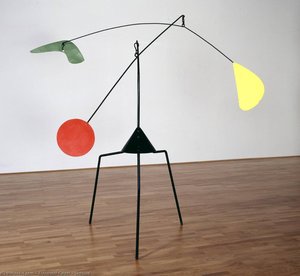
Cea mai celebră pictură a lui Alexander Calder este Untitled, din Biennale Internazionale dell'Antiquariato di Firenze, Florența. Alături de Mobile (1932) și Romulus and Remus (1928), acestea completează cele trei opere pe care toată lumea le recunoaște. Catalogul nostru include 98 lucrări ale lui Alexander Calder; cele 98 de mai jos sunt cele mai apreciate în lume, fiecare fiind însoțită de anul creației, muzeul care o păstrează și semnificația sa.

Clasate în funcție de scorul nostru de popularitate, care combină numărul de căutări, vizite și comenzi pentru fiecare operă. Actualizat Octombrie 2026.

Portretul lui Alexander Calder
Alexander Calder · 1898 – 1976
Născut · Decedat
1898 – 1976, Aberdeen
Mișcare
Abstract expressionism
Lucrări din catalogul nostru
98
Cele mai celebre
Untitled
Cele mai multe lucrări la
Biennale Internazionale dell'Antiquariato di Firenze

Cele mai 10 celebre picturi ale lui Alexander Calder

Romulus and Remus (1928) de Alexander Calder
3

Romulus and Remus

Alexander Milne Calder's "Romulus and Remus," crafted in 1928, isn’t merely a sculpture; it’s a distilled essence of myth rendered in delicate wire. This piece, a testament to the artist’s pioneering approach to three-dimensional form, transcends its subject matter – the legendary founders of Rome – to become a profound meditation on beginnings, brotherhood, and the very act of creation itself. Calder, deeply influenced by Constructivism and early Modernism, sought…

Red Lily Pads (Nénuphars rouges) (1956) de Alexander Calder
5

Red Lily Pads (Nénuphars rouges)

1956 · Acrylic · Muzeul Solomon R. Guggenheim, New York

Alexander Milne Calder's "Red Lily Pads (Nénuphars rouges)" isn’t merely a depiction of a serene pond; it’s an invitation to lose oneself in the delicate balance of form, color, and movement. Created in 1956, this captivating sculpture – captured through a masterful photograph – embodies Calder's signature approach: embracing chance and celebrating the ephemeral beauty of nature within a distinctly modern aesthetic. The piece resides within a contemporary architectural space,…

Black Sun (1953) de Alexander Calder
9

Black Sun

1953 · Acrylic On Canvas · Tate Britain, Londra

Alexander Milne Calder's "Black Sun," painted in 1953, isn’t merely a depiction of abstract forms; it’s an invitation to contemplate the interplay between chaos and order, darkness and light. Born in Aberdeen, Scotland, and later establishing himself as a pivotal figure in American sculpture alongside his son Alexander Stirling Calder and grandson Alexander ‘Sandy’ Calder, Milne Calder possessed a singular vision – one that sought to capture dynamic movement and…

Colored Spots (1970) de Alexander Calder
10

Colored Spots

1970 · Gouache

In Colored Spots, created in 1970, we encounter a moment of pure rhythmic energy. This gouache work moves away from the heavy permanence of sculpture to explore the lightness of color and shape. The composition is defined by a series of circles, varying in scale, that appear to drift across the surface. There is a specific tension in how these forms are placed; they do not sit static but seem…

Alexander Calder, picturi de la 11 la 98

Calder's Circus (1931) de Alexander Calder
#11

Calder's Circus

1931 · Whitney Museum of American Art

Alexander Milne Calder’s “Calder’s Circus,” created in 1931, is more than just a charming miniature scene; it’s a meticulously crafted meditation on movement, spectacle, and the enduring allure…

Red Sun (1968) de Alexander Calder
#12

Red Sun

1968 · Des Moines Art Center

Alexander Milne Calder’s “Red Sun” stands as a testament to the power of reductive art – a deceptively simple black and white linocut print that encapsulates the spirit…

Lobster Trap and Fish Tail (1939) de Alexander Calder
#13

Lobster Trap and Fish Tail

1939 · MoMA - Museum of Modern Art

Alexander Milne Calder's "Lobster Trap and Fish Tail," created in 1939, isn’t merely a depiction of marine life; it’s an embodiment of movement captured within a strikingly reductive…

Violin (1960) de Alexander Calder
#14

Violin

1960

In the evocative realm of mid-century graphic expression, Alexander Milne Calder’s "Violin" emerges as a mesmerizing dialogue between form and abstraction. Created in 1960, this striking screenprint transcends…

Untitled (1948) de Alexander Calder
#20

Untitled

1948 · The Phillips Collection
A R de Alexander Calder
#40

A R

The artwork titled "A R" is a metal piece featuring the letter A. Created by the sculptor Alexander Milne Calder, this work is crafted from a silver material.…

Untitled (1968) de Alexander Calder
#42

Untitled

1968 · Buffalo AKG Art Museum
Crosshatch de Alexander Calder
#55

Crosshatch

A Striking Encounter: "Crosshatch" by Alexander Milne Calder This captivating painting, currently residing within the esteemed Smithsonian American Art Museum, presents a unique and visually arresting depiction of…

Fish at Sunrise (1974) de Alexander Calder
#56

Fish at Sunrise

1974

The artwork 'Fish at Sunrise' by Alexander Milne Calder is a mesmerizing piece that showcases the artist's unique style and technique. Created in 1974, this gouache painting measures…

Nemo de Alexander Calder
#95

Nemo

Biennale Internazionale dell'Antiquariato di Firenze

Nemo by Alexander Calder presents an intricate arrangement of geometric forms. The composition is built upon a series of overlapping circles and squares. Large circles act as central…

Red, Yelloe and Blue Gongs de Alexander Calder
#96

Red, Yelloe and Blue Gongs

Ca' Pesaro - Galeria Internațională de Artă Modernă

Red, Yellow and Blue Gongs – Alexander Milne Calder Alexander Milne Calder’s “Red, Yellow and Blue Gongs” stands as a testament to the sculptor's pioneering exploration of kinetic…

Tache Bleu de Alexander Calder
#97

Tache Bleu

The painting Tache Bleu is a remarkable work of art created by the talented artist Alexander Milne Calder. This stunning piece is a tapestry, measuring 103 x 152…

Red Mobile de Alexander Calder
#98

Red Mobile

Galleria Civica di Arte Moderna e Contemporanea Torino

Between the 1920s and ‘30s, Calder regularly made long study and work trips to Paris, where he began to participate in the Abstraction-Création group. Finally, in 1932, at…

Picturile lui Alexander Calder pe perioade

Contemporary

3 lucrări în această listă

Subiectele pe care Alexander Calder le-a pictat cel mai des

Cele patru teme care se regăsesc cel mai des printre aceste capodopere, cu cel mai fin exemplu pentru fiecare.

Unde puteți vedea picturile lui Alexander Calder

Cele 8 muzee care dețin cele mai multe dintre picturile de pe această pagină.

Muzeu Oraș Lucrări lui Alexander Calder Picturi din această listă
Biennale Internazionale dell'Antiquariato di Firenze, FlorențaBiennale Internazionale dell'Antiquariato di Firenze Florența 2 Untitled, Nemo
Muzeul Solomon R. Guggenheim, New YorkMuzeul Solomon R. Guggenheim New York 2 Romulus and Remus, Red Lily Pads (Nénuphars rouges)
The Phillips Collection, Washington, D.C.The Phillips Collection Washington, D.C. 2 Untitled, Red Polygons
Tate Britain, LondraTate Britain Londra 1 Black Sun
Whitney Museum of American Art, New YorkWhitney Museum of American Art New York 1 Calder's Circus
Des Moines Art Center, Des MoinesDes Moines Art Center Des Moines 1 Red Sun
MoMA - Museum of Modern Art, New York CityMoMA - Museum of Modern Art New York City 1 Lobster Trap and Fish Tail
Metropolitan Museum of Art, New YorkMetropolitan Museum of Art New York 1 "Calder #1" Textile (Model No. 1-145)

Cea mai celebră pictură a lui Alexander Calder din fiecare deceniu

  1. 1920s
    Romulus and Remus (1928) de Alexander Calder
    Locul 3 din 98

    Romulus and Remus

    Vârsta 22 – 31 · Muzeul Solomon R. Guggenheim

    Alexander Milne Calder's "Romulus and Remus," crafted in 1928, isn’t merely a sculpture; it’s a distilled essence of myth rendered in delicate wire. This piece, a testament to…

  2. 1930s
    Mobile (1932) de Alexander Calder
    Nr. 2 din 98

    Mobile

    Vârsta 32 – 41
  3. 1940s
    Untitled (1948) de Alexander Calder
    Locul 20 din 98

    Untitled

    Vârsta 42 – 51 · The Phillips Collection
  4. 1950s
    Red Lily Pads (Nénuphars rouges) (1956) de Alexander Calder
    Nr. 5 din 98

    Red Lily Pads (Nénuphars rouges)

    Vârsta 52 – 61 · Muzeul Solomon R. Guggenheim

    Alexander Milne Calder's "Red Lily Pads (Nénuphars rouges)" isn’t merely a depiction of a serene pond; it’s an invitation to lose oneself in the delicate balance of form,…

  5. 1960s
  6. 1970s
    Colored Spots (1970) de Alexander Calder
    Nr. 10 din 98

    Colored Spots

    Vârsta 72 – 78

    In Colored Spots, created in 1970, we encounter a moment of pure rhythmic energy. This gouache work moves away from the heavy permanence of sculpture to explore the…

Întrebări despre picturile lui Alexander Calder

Care este cea mai celebră pictură a lui Alexander Calder?Afișează răspunsul

Untitled, Biennale Internazionale dell'Antiquariato di Firenze, Florența. Urmează Mobile (1932) și Romulus and Remus (1928).

Care sunt cele mai importante 10 picturi ale lui Alexander Calder?Afișează răspunsul

Untitled, Mobile, Romulus and Remus, Abstraction, Red Lily Pads (Nénuphars rouges), Orange and Black Composition, Puppet Man, Slanting Red Nose, Black Sun și Colored Spots. Clasamentul de mai sus indică anul și muzeul pentru fiecare.

Câte picturi a realizat Alexander Calder?Afișează răspunsul

Catalogul nostru include 98 lucrări ale lui Alexander Calder, datate între 1928 și 1975.

Unde se află cele mai celebre picturi ale lui Alexander Calder?Afișează răspunsul

Majoritatea acestora se află în Biennale Internazionale dell'Antiquariato di Firenze (Florența), Muzeul Solomon R. Guggenheim (New York) și The Phillips Collection (Washington, D.C.). Tabelul de mai sus enumeră muzeele pe rând.

Când a pictat Alexander Calder cele mai faimoase opere?Afișează răspunsul

În 1960s: 17 dintre cele 98 lucrări de pe această pagină datează de atunci, printre acestea Abstraction.

Care sunt cele mai vechi și cele mai recente picturi celebre ale lui Alexander Calder?Afișează răspunsul

Cea mai veche lucrare de pe această pagină este din Romulus and Remus (1928), iar cea mai recentă este din Pyramids (1975).

Ce a pictat cel mai des Alexander Calder?Afișează răspunsul

Sculpture (6), Geometric (5) și Geometric design (5), printre cele 98 opere de pe această pagină.

Ce tehnică a folosit cel mai des Alexander Calder?Afișează răspunsul

Acrylic On Canvas: 4 din cele 98 lucrări de pe această pagină.

Din ce mișcare artistică face parte Alexander Calder?Afișează răspunsul

Abstract expressionism, așa cum demonstrează picturile de pe această pagină.

Pe care dintre picturile lui Alexander Calder le pot vedea la Biennale Internazionale dell'Antiquariato di Firenze?Afișează răspunsul

Untitled și Nemo sunt printre cele 2 opere de pe această pagină păstrate de Biennale Internazionale dell'Antiquariato di Firenze, Florența.

Despre Alexander Calder

Introduction to Alexander Milne Calder

Alexander Milne Calder (MILL-nee) was a Scottish American sculptor born in Aberdeen, Scotland, on August 23, 1846. He is best known for his architectural sculpture of Philadelphia City Hall and both his son, Alexander Stirling Calder, and grandson, Alexander ‘Sandy’ Calder, became significant sculptors in the 20th century. His artistic journey began with a formative influence from his father, John Rhind, a sculptor who instilled in him an early appreciation for stone carving during his childhood years. Calder attended the Royal Academy in Edinburgh where he honed his skills and studied alongside fellow artists, shaping his understanding of classical sculpture traditions. He subsequently moved to London and collaborated on monumental projects like the Albert Memorial, demonstrating his versatility and ambition as a craftsman.
  • Early Life and Education: Calder’s upbringing in Aberdeen exposed him to the craft of stone carving from a young age, profoundly impacting his artistic sensibilities.
  • Royal Academy Training: His studies at the Royal Academy provided foundational knowledge in sculpture techniques and broadened his artistic horizons.
  • London Collaborations: Calder’s involvement with the Albert Memorial showcased his ability to execute large-scale architectural sculptures, cementing his reputation as a skilled artist.

Career Highlights

Calder's professional life unfolded in stages marked by pivotal commissions and collaborations. He secured a prominent role on the construction of Philadelphia City Hall, undertaking an ambitious project that demanded meticulous attention to detail and involved crafting over 250 pieces—primarily marble and bronze—spanning two decades. This monumental endeavor solidified his position as one of Scotland’s foremost sculptors. Furthermore, he was entrusted with creating William Penn, a colossal statue honoring Pennsylvania's founder atop City Hall’s tower, showcasing his mastery of sculptural form and symbolism. Calder’s artistic vision extended beyond architectural projects; he produced striking sculptures like *Indian Figure*, reflecting his engagement with indigenous cultures and artistic experimentation.
  • Philadelphia City Hall Commission: Calder’s dedication to this project resulted in a masterpiece of architectural sculpture, demonstrating his commitment to ambitious artistic endeavors.
  • William Penn Statue: The creation of William Penn exemplifies Calder's ability to convey historical significance through monumental sculptural representations.
  • *Indian Figure*: This sculpture embodies Calder’s exploration of cultural influences and innovative artistic techniques.

Notable Sculptures

Calder’s oeuvre encompasses a diverse range of artworks characterized by both static and kinetic forms. Among his most celebrated creations are the illuminated portals of Philadelphia City Hall, adorned with colored lights—a testament to Calder's meticulous craftsmanship and artistic flair. He also produced *Spirale*, a towering sculpture commissioned for UNESCO headquarters in Paris, reflecting his engagement with contemporary art trends and architectural innovation. His final masterpiece, *Flamingo*, stands proudly at Chicago’s Federal Center Plaza, symbolizing Calder’s enduring legacy as one of America's most influential sculptors.
  • Philadelphia City Hall Portals: Calder’s incorporation of colored lights into these portals exemplifies his artistic attention to detail and visual impact.
  • *Spirale*: This monumental sculpture commissioned for UNESCO headquarters demonstrates Calder’s ability to create impactful artworks that resonate with global audiences.
  • *Flamingo*: Calder's final sculpture at Chicago’s Federal Center Plaza represents his enduring contribution to American art history.

Legacy and Influence

Alexander Milne Calder’s impact on the artistic landscape extends beyond his own creations. His son, Alexander Stirling Calder, and grandson, Alexander ‘Sandy’ Calder, followed in his footsteps as sculptors, perpetuating a lineage of artistic excellence. Calder's pioneering approach to sculpture—particularly his exploration of kinetic art and chance—inspired generations of artists and continues to influence contemporary sculptural practices. He remains revered for his unwavering dedication to artistic innovation and his profound contribution to the visual arts. “Theories may be all very well for the artist himself, but they shouldn't be broadcast to other people.”

Toate cele 98 de lucrări ale lui Alexander Calder →