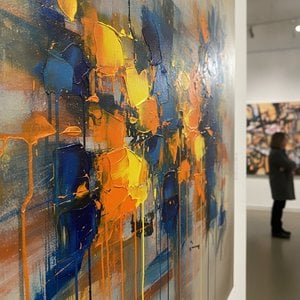
Theodoros Stamos: A Pioneer of Color Field Painting
Theodoros Stamos (1922-1997) stands as a cornerstone figure in the trajectory of American Abstract Expressionism, embodying its restless spirit of experimentation and its profound quest for new visual languages. Born on December 31st, 1922, in New York City to Greek immigrant parents—his mother hailing from Sparta, his father from Lefkada—Stamos’ artistic journey was profoundly shaped by both heritage and the vibrant dynamism of a burgeoning American art scene.
His formative years were marked by exposure to European avant-garde artists like Arshile Gorky and Fernand Léger through connections forged during these early explorations. This influence seeded his imagination with possibilities beyond traditional conventions, propelling him toward groundbreaking innovations that would define his distinctive style.
Early Influences and Artistic Formation
Stamos’ artistic education began at the American Artists School in 1936, where he honed his sculptural skills under Simon Kennedy and Joseph Konzal. This foundational training instilled a meticulous attention to form and texture—traits that would persist throughout his career.
Crucially, his mentorship by Joseph Solman, a member of “The Ten,” opened doors to the influential An American Place Gallery and introduced him to the pioneering works of Arthur Dove and Georgia O’Keeffe. These artists served as early touchstones, guiding Stamos's exploration of abstraction and organic form.
From Biomorphic Beginnings to Color Field Exploration
Stamos’ artistic evolution wasn’t instantaneous; it unfolded gradually, characterized by distinct phases of experimentation. His earliest canvases reflected a fascination with natural history—muted earth tones and biomorphic imagery suggestive of geological shapes or organic life. These paintings demonstrated an early sensitivity to form and texture.
Around 1950, Stamos embarked on *The Tea House Series*, a captivating exploration of East Asian aesthetics. Geometric forms overlaid with dark calligraphic brushwork created an atmosphere of serene contemplation—a deliberate departure from representational art that signaled his willingness to embrace minimalism.
Dominance of Color Field Painting and Lefkada Inspiration
However, it was in the mid-1950s onwards that Stamos truly cemented his signature style: Color Field painting. He progressively reduced compositions to vast expanses of color delineated by slim lines or shapes—a technique that prioritized emotional resonance over precise depiction.
The *Lefkada* sub-series, born from an unwavering connection to his ancestral homeland, exemplifies this approach. These paintings capture the essence of Lefkada’s landscape and atmosphere through layered pigments—a testament to Stamos's ability to translate experience into visual language.
Legacy and Recognition
Stamos’ contribution to Abstract Expressionism extended beyond stylistic innovation; he championed artistic independence and engaged in spirited dialogue with fellow artists like Barnett Newman and Mark Rothko. His unwavering commitment to pushing boundaries solidified his place within the movement—a legacy recognized by institutions such as the Art Students League and celebrated for its enduring beauty.
Throughout his prolific career, Stamos’ paintings continue to inspire admiration for their subtle elegance and profound contemplation—testaments to the transformative power of abstraction and its capacity to illuminate the human condition.
Întrebări și răspunsuri
În ce perioade este împărțită cariera lui Theodoros Stamos?
Cariera lui Theodoros Stamos se desfășoară perioadă cu perioadă pe pagina Cronica a artistului: o cronologie orizontală a operelor de artă, grupate în capitole reprezentative ale etapelor carierei.
Ce culori a folosit cel mai des Theodoros Stamos?
Utilizarea culorii de către Theodoros Stamos în lucrările enumerate pe acest site poate fi studiată pe pagina Genoma Paletei a artistului.
În ce perioadă istorică a activat Theodoros Stamos?
Theodoros Stamos a activat în perioada Era modernă. Această perioadă situează activitatea artistului în istorie.