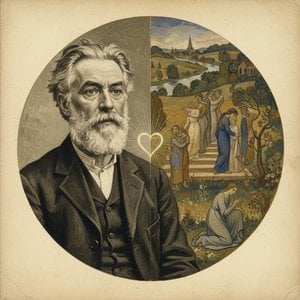
A Visionary of Cookham: The Life and Art of Sir Stanley Spencer
Sir Stanley Spencer was, without a doubt, one of the most distinctive and profoundly personal artists to emerge from Britain in the 20th century. His entire life and artistic output were inextricably linked to his birthplace – the small village of Cookham, Berkshire – transforming it into a living, breathing canvas upon which he painted biblical narratives, everyday scenes, and intensely felt spiritual experiences. Born on June 30th, 1891, into a large family deeply rooted in music and religion, Spencer’s early education was shaped by his sisters, Annie and Florence, who provided him with an unconventional yet stimulating home environment before he enrolled at the Slade School of Fine Art in London from 1908 to 1912. This formal training offered a foundation, but it was Cookham itself – which he famously described as “a village in heaven” – that truly became the wellspring of his artistic vision and the subject of countless paintings.Early Influences and the Pre-Raphaelite Spirit
Spencer’s unique style wasn't born in a vacuum; it was forged through a careful synthesis of diverse influences. The meticulous detail and reverence for nature characteristic of the Pre-Raphaelites – particularly artists like Millais and Rossetti – resonated deeply within his work, evident in his vibrant colors, intricate compositions, and fascination with medieval and Renaissance art. However, Spencer wasn’t simply replicating past masters. He absorbed elements of French Post-Impressionism, notably the expressive use of color championed by Paul Gauguin, and drew inspiration from early Italian painting, particularly the masterful storytelling and emotional depth found in Giotto's frescoes. Crucially, he developed a distinctly personal voice, blending these influences into a style that was both deeply rooted in tradition and remarkably innovative. His paintings weren’t didactic illustrations of religious stories; they were intensely subjective interpretations, populated by villagers he knew intimately – farmers, shopkeepers, churchgoers – cast as biblical figures or participants in everyday life. This deliberate blurring of the sacred and secular was revolutionary, inviting viewers to contemplate the divine within the familiar and the mundane.The Resurrection: Cookham - A Defining Masterpiece
Perhaps the most iconic example of Spencer’s unique approach is *The Resurrection, Cookham* (1924-1926), a monumental fresco housed at the Tate Gallery in London. Far from depicting a grand, ethereal resurrection scene, this painting presents a vibrant, earthy tableau unfolding in the fields surrounding Cookham churchyard. Local residents – including Spencer’s sister Florence and his father, William – are shown rising from their graves, bathed in golden light. The painting is not merely a religious depiction; it's a deeply personal meditation on life, death, and rebirth, rooted firmly in the landscape of Spencer’s childhood. Critics at the time hailed it as “the most important picture painted by any English artist in the present century,” recognizing its audacious blend of meticulous detail and modern freedom of form. The painting’s success cemented Spencer's reputation as a major artistic force and established his distinctive style – one that prioritized emotional truth over conventional representation.Wartime Reflections and the Sandham Memorial Chapel
Spencer’s artistic output wasn’t limited to idyllic landscapes and biblical scenes. His experiences during World War I profoundly shaped his work, leading him to serve as an Official War Artist. This experience culminated in a commission to create murals for the Sandham Memorial Chapel at Burghclere in Hampshire (1927-1932). These monumental paintings weren’t glorifications of war; they were honest, unflinching depictions of the lives of ordinary soldiers – their routines, anxieties, and quiet moments of contemplation. The arrangement of the murals consciously echoed Giotto's Arena Chapel in Padua, but Spencer infused it with a uniquely British sensibility and a deeply humanistic perspective. He deliberately avoided depicting violence or heroic battles, focusing instead on the collective effort and resilience of those contributing to the war effort. The *Dug-Out* scene, for example, captures the quiet desperation and camaraderie of soldiers awaiting battle, while the *Soldiers’ Rest* depicts a moment of respite amidst the horrors of war.Later Years and Legacy
In his later years, Spencer continued to explore themes of love, faith, and mortality in his paintings, often incorporating elements of eroticism and personal introspection. His portraits, particularly those depicting his second wife, Patricia Preece, are both strikingly beautiful and intensely revealing, offering a glimpse into the complexities of his personal life. Despite facing criticism for some of his more unconventional works, Spencer remained an independent artist until his death on December 14th, 1959. He was knighted in 1959, shortly before his passing, recognizing his significant contribution to British art. Today, Sir Stanley Spencer’s paintings are celebrated for their unique blend of spirituality, humanity, and artistic innovation – a testament to the enduring power of an artist who transformed a small village into a living masterpiece. His legacy continues to inspire artists and viewers alike, reminding us that beauty and meaning can be found in the most unexpected places.Întrebări și răspunsuri
Câte opere de artă ale lui Stanley Spencer pot fi vizualizate în catalog?
Puteți explora cele 370 de opere de artă de opere ale lui Stanley Spencer pe pagina Toate operele de artă.
Din ce epocă face parte Stanley Spencer?
Stanley Spencer a activat în perioada Era modernă. Această perioadă situează activitatea artistului în context istoric.
Cum pot găsi lucrările lui Stanley Spencer dintr-o anumită paletă de culori?
Operele lui Stanley Spencer pot fi explorate pe baza paletei cromatice în pagina de După paletă de culori a artistului.