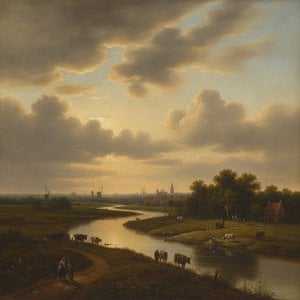
Samuel Dirksz van Hoogstraten: Unveiling the Secrets of Perception
Samuel Dirksz van Hoogstraten, a name inextricably linked to the brilliance and innovation of the Dutch Golden Age, was far more than just a painter. Born in Dordrecht in 1627, he embodied the era’s spirit of intellectual curiosity, artistic experimentation, and burgeoning mercantile power. He wasn't merely capturing reality on canvas; he was dissecting it, manipulating perception, and delving into the very essence of representation itself. Van Hoogstraten distinguished himself not only through his masterful brushwork but also as a poet, a keen observer of human nature, and a profound art theorist – leaving behind a legacy that extends far beyond the visual realm, permeating the world of ideas and artistic methodology. His journey began within the family workshop of his father, Dirk van Hoogstraten, providing him with an invaluable foundation in artistic principles before he ventured to Amsterdam—the vibrant heart of Dutch artistry during the 17th century. It was there that he entered the prestigious studio of Rembrandt van Rijn, an experience that profoundly shaped his early style and instilled within him a deep appreciation for the subtleties of light and shadow.Rembrandt’s Shadow and the Pursuit of Independence
The undeniable influence of Rembrandt is immediately apparent in Van Hoogstraten's initial works. A portrait from 1645, now housed in the Liechtenstein collection in Vienna, serves as a striking testament to this formative apprenticeship. However, unlike many students who remained firmly tethered to their master’s established style, Van Hoogstraten possessed an insatiable thirst for experimentation and a restless spirit that propelled him beyond mere imitation. He wasn't content to simply replicate Rembrandt’s characteristic *chiaroscuro*; he sought to deconstruct it, analyze its effects with meticulous precision, and ultimately forge his own unique artistic voice – one characterized by a daring interplay of light, color, and perspective. This relentless pursuit of originality led him on extensive travels throughout Europe—to Vienna, Rome, and London—exposing him to diverse artistic traditions, philosophical currents, and the evolving aesthetic sensibilities of each locale. These journeys weren’t merely superficial sightseeing expeditions; they were immersive studies in architecture, spatial relationships, and the nuances of visual perception, fueling his intellectual growth and broadening his artistic horizons. Upon returning to Dordrecht, he married in 1656 and assumed a civic role as provost of the mint, demonstrating a remarkable versatility that extended beyond the confines of the art world.Mastering Illusion: Trompe-l’œil, Perspective Boxes, and the Art of Deception
Van Hoogstraten's artistic prowess truly blossomed in his masterful command of *trompe-l’œil* – a technique designed to deceive the eye. His still lifes weren’t simply arrangements of objects; they were meticulously crafted illusions, imbued with symbolic depth and inviting viewers to contemplate the transient nature of life and the deceptive allure of material possessions. He skillfully manipulated light, shadow, and scale to create an astonishing sense of realism, blurring the boundaries between what was real and what was merely a representation. Simultaneously, he became renowned for his creation of “peepshows” or "perspective boxes"—ingenious devices that offered immersive three-dimensional views into miniature worlds. These weren’t mere novelties; they were sophisticated explorations of perspective and spatial illusion, demonstrating Van Hoogstraten's profound understanding of how the human eye perceives depth and dimension. One such box, currently housed at the National Gallery in London, recreates the interior of a typical Dutch house with astonishing realism when viewed through strategically placed peepholes – offering a captivating glimpse into domestic life. His architectural paintings, such as his 1652 view of the Vienna Hofburg, further showcased his technical skill and meticulous attention to detail, creating an illusion of vastness and grandeur within confined spaces.A Theorist’s Legacy: ‘Inleyding tot de hooge schoole der schilderkonst’
However, Samuel van Hoogstraten's contribution extends far beyond his paintings and perspective boxes. He was a dedicated art theorist who sought to codify the principles of painting in his magnum opus, *Inleyding tot de hooge schoole der schilderkonst: anders de zichtbaere werelt* (Introduction to the Academy of Painting, or The Visible World), published in 1678. This ambitious treatise stands as one of the most comprehensive and intellectually rigorous explorations of art theory produced in the Dutch Republic during the 17th century. Van Hoogstraten delved into complex issues of pictorial persuasion, illusionism, the moral responsibilities of the artist, and the intricate relationship between painting and philosophy – drawing upon a vast range of ancient and modern sources to construct a systematic framework for understanding and practicing the art of painting. He built upon the foundations laid by Karel van Mander in his earlier work, *Het Schilder-Boeck*, seeking to create a more structured and accessible guide for aspiring artists. His writings reflect both international influences gleaned from his travels and contemporary debates within Dutch artistic circles, demonstrating a remarkable intellectual breadth. The treatise wasn’t merely a theoretical exercise; it was a practical manual designed to equip artists with the knowledge and techniques necessary to achieve mastery in their craft.A Lasting Influence
Van Hoogstraten's influence resonated through subsequent generations of artists, notably through his pupils – including his brother Jan van Hoogstraten, Aert de Gelder, Cornelis van der Meulen, and Godfried Schalcken. His legacy is further preserved in the writings of Arnold Houbraken, one of his students who penned a biography of the artist that serves as a valuable primary source of information about his life and work. Samuel Dirksz van Hoogstraten was not simply a painter; he was a polymath—an artist, poet, theorist, and administrator – who embodied the intellectual ferment of the Dutch Golden Age. His innovative techniques, profound insights into perception, and dedication to articulating the principles of art continue to captivate and inspire audiences today, solidifying his position as a master of illusion and intellect whose work transcends time.Întrebări și răspunsuri
Ce culori a folosit cel mai des Samuel van Hoogstraten?
Profilul cromatic al lucrărilor lui Samuel van Hoogstraten este prezentat în pagina Genoma Paletei a artistului.
Unde pot fi găsite operele lui Samuel van Hoogstraten, organizate pe subiecte?
Pagina Atlas pe subiecte organizează operele lui Samuel van Hoogstraten pe teme.
Există o listă completă a operelor lui Samuel van Hoogstraten?
Toate lucrările lui Samuel van Hoogstraten de pe acest site pot fi vizualizate în pagina Toate operele de artă a artistului.