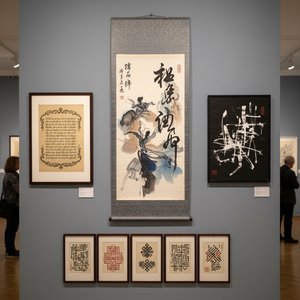
Salma Arastu: Bridging Cultures Through Line and Spirit
Salma Arastu (born 1950, Rajasthan, India) represents a singular voice in contemporary art—a woman artist whose globally informed perspective seamlessly blends the traditions of her Indian heritage with the contemplative ethos of Islamic spirituality. Her artistic journey commenced at Maharaja Sayajirao University in Baroda, where she cultivated her skills in fine arts, firmly establishing herself within both Hindu and Sindhi cultural contexts. This formative experience instilled a lifelong fascination for delving into the intersection of faith and creativity, shaping her distinctive approach to artmaking—one characterized by lyrical exploration and profound symbolic resonance.
Moving to the United States in 1986, Arastu embraced new landscapes while preserving her core artistic sensibilities. Raised amidst multicultural surroundings, she carries within her the echoes of diverse influences—from Persian miniatures imbued with intricate detail to Californian vistas bathed in golden light—enriching her visual vocabulary and informing her stylistic choices. Her unwavering dedication to fostering harmony and conveying universal human experience is palpable throughout her oeuvre, evident in her paintings, sculptures, calligraphy, and poetic explorations—each piece a testament to her belief that art possesses the power to transcend boundaries and illuminate shared values.
Arastu’s artistic practice has been marked by an unyielding pursuit of excellence and engagement with significant cultural dialogues. Exhibiting her work internationally for over forty-five years—spanning India, Iran, Kuwait, Germany, and the United States—she garnered recognition from esteemed institutions such as the State Museum of Art, Harrisburg; PA; Museum of Modern Art, Hyderabad; India; Museum of Contemporary Religious Art, St. Louis, Missouri; Triton Museum of Art, Santa Clara, CA; 9/11 Memorial Museum, New York, NY; Islamic Museum of Australia, Melbourne, Victoria, Australia; Stanford Art Spaces and Radford University—demonstrating a steadfast commitment to disseminating her artistic vision to audiences worldwide. Her exhibitions have graced notable venues like stanford art spaces, stanford university, art museum, radford university, showcasing the breadth of her artistic exploration and cementing her place as a pivotal figure in global art history.
Her work has garnered considerable acclaim for its originality and depth, culminating in prestigious awards including grants from the East Bay Community’s Fund for Artists (2012, 2014 & 2020) and the City of Berkeley’s Individual Artist Grant Award (2014, 2015 & 2016). These accolades underscore her unwavering dedication to artistic innovation and her contribution to fostering intercultural understanding—a reflection of her belief that art serves as a conduit for dialogue and empathy. Furthermore, Arastu's exploration of calligraphy—particularly its role in conveying spiritual concepts within the Islamic tradition—highlights her desire to connect artmaking with ethical considerations and cultural heritage.
Inspired by the imagery, sculpture, and writings of her Indian heritage and Islamic spirituality, she utilizes her artistic voice to dismantle barriers that divide, fostering peace and comprehension. Her method is a physical and meditative process that imbues each canvas with dynamic lines and layered textures—a deliberate technique designed to capture the essence of movement and transformation. Through contrasting elements within her art, Arastu seeks unity and balance—a core principle guiding her creative endeavors and informing her artistic vision. She has brought together Eastern spiritual principles and Western painting techniques learned over decades, resulting in a distinctive style that distinguishes her work from others. Her story begins with lines—lines representing the spiritual energy emanating from the soul—and she continues to refine her craft, driven by an unwavering passion for artistic expression.
Her journey began with a profound challenge—the absence of fingers on her left hand—which spurred her to contemplate the significance of imperfection and resilience within the human experience. Recognizing that beauty can emerge from unexpected circumstances, Arastu embraced this limitation as a catalyst for creative exploration—a testament to her unwavering belief in overcoming obstacles and transforming adversity into inspiration. She has achieved considerable success as an artist, securing recognition from prominent galleries and institutions across continents—a remarkable accomplishment reflecting her perseverance and dedication to artistic excellence. Her work is represented in more than one hundred private collections worldwide, demonstrating its enduring appeal and establishing her legacy as a visionary artist who championed harmony and universal human experience.
De către echipa editorială WahooArt.com
Chestionar de artă
Fiecare întrebare are un singur răspuns corect.
Întrebare 1:
În ce oraș s-a născut Salma Arastu?
Întrebare 2:
Ce universitate i-a oferit Salma Arastu diplome în arte frumoase?
Întrebare 3:
În ce țară și an a început Salma Arastu să lucreze în domeniul artei?
Întrebare 4:
Ce este unul dintre principalele teme explorate în operele lui Salma Arastu?
Descoperă WahooArt, destinația exclusivă pentru colecționari. Oferim reproducții de ulei pictate manual, de o calitate muzeală, transformând capodopere legendare în moșteniri personale unice. Calitate premium, transparență totală și livrare globală pentru arta dumneavoastră.
Embark on a profound journey through the soul of Chinese calligraphy. Explore the historical mastery of ink, brush, and script, from ancient Zhuanshu to elegant running script, and discover how this timeless art form reflects the enduring spirit of classical East Asian aesthetics.
Explore the profound beauty of calligraphy art. From the fluid running script of Chinese masters to historical ink masterpieces, discover how the elegance of line transforms spaces with timeless grace and scholarly sophistication.