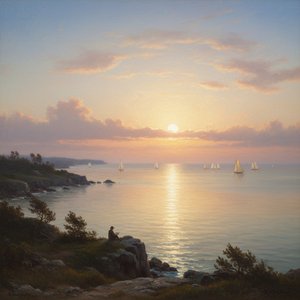
The Naturalist’s Eye: The Life and Legacy of Richard Whitford
In the heart of the Victorian era, a period defined by both rapid industrial expansion and an intense scientific curiosity about the natural world, Richard Whitford (1821–1890) emerged as a master of observation. A British artist whose work bridged the gap between romanticized landscape painting and the precise demands of zoological illustration, Whitford possessed a rare ability to marry aesthetic beauty with anatomical accuracy. His journey into the depths of nature was not merely an artistic choice but a lifelong vocation, deeply rooted in his formative years. As the son of a botanist, the intricacies of flora and fauna were woven into the fabric of his childhood, instigating a profound reverence for the living world that would later define his brushwork.
Before he became a celebrated painter of serene British vistas, Whitford’s technical foundation was laid in the meticulous discipline of engraving. This early training in fine lines and tonal precision proved indispensable when he eventually transitioned to oils. It gifted him with an engraver's eye for detail, allowing him to capture the subtle textures of a horse's coat or the delicate play of light through a forest canopy. His style evolved into a sophisticated blend of meticulous realism and an Impressionistic sensibility, where the structural integrity of his subjects was softened by a masterful command of atmosphere and ephemeral light.
A Symphony of Landscape and Life
Whitford’s oeuvre is a testament to the quiet dignity of the British countryside. His landscapes are rarely mere backdrops; instead, they are living, breathing environments imbued with a palpable sense of place. Whether depicting rolling hills, tranquil riverbanks, or picturesque village scenes, he utilized subtle tonal gradations to capture the fleeting qualities of daylight. In works such as "A Prize Cow in a Wooded River Landscape," one can witness his ability to render atmospheric conditions with remarkable precision, creating a sense of peace that invites the viewer into a pastoral dream.
However, it was perhaps in his equestrian and zoological subjects that Whitford truly found his most enduring voice. He possessed an uncanny ability to imbue animals with character and tranquility. His 1873 masterpiece, "Bay Horse in a Stable," serves as a pinnacle of nineteenth-century equestrian art. In this piece, the warmth of the wooden stall and the soft, filtering light work in harmony to celebrate the majestic presence of the horse. This talent for capturing the "quiet dignity" of rural life extended to his collaborations with scientific publishers, where his illustrations served as vital records of the era's zoological advancements.
Historical Significance and Artistic Mastery
The significance of Richard Whitford lies in his role as a visual chronicler of a changing world. While many of his contemporaries focused on the dramatic or the purely decorative, Whitford sought the truth within the details. His work stands at the intersection of art and science, reflecting the Victorian era's obsession with classification and natural history. Through his canvases, the scientific rigor of his botanical upbringing met the burgeoning artistic movements of his time, resulting in a body of work that is both intellectually stimulating and emotionally resonant.
Today, Whitford’s legacy continues to inspire collectors and historians alike. His ability to convey serenity, texture, and light ensures that his paintings remain timeless windows into the nineteenth-century landscape. To study his work is to experience a period where the boundaries between the observer and the observed were blurred by a shared passion for the wonders of the natural world.
Întrebări și răspunsuri
Unde pot fi explorate operele lui Richard Whitford, organizate pe subiecte?
Operele lui Richard Whitford pot fi explorate pe temă în pagina Atlas pe teme a artistului.
Unde pot fi explorate operele lui Richard Whitford organizate pe culori?
Indice Spectral lui Richard Whitford este o pagină care organizează operele de artă ale acestuia în funcție de culoare.
Pot vizita un muzeu virtual al lucrărilor lui Richard Whitford?
O vizită virtuală este disponibilă: pagina Galerie 3D lui Richard Whitford prezintă lucrările artistului într-o galerie tridimensională.