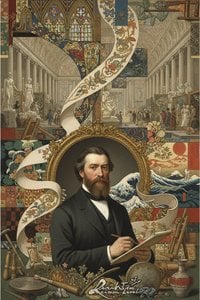
A Life Etched in Light: The World of Richard Thomas Moynan
Richard Thomas Moynan, a name perhaps less celebrated than some of his Victorian contemporaries, nevertheless occupies a significant niche within the landscape and military art of 19th-century Britain. Born into a world steeped in tradition and undergoing rapid change, Moynan’s life was one of quiet dedication to his craft, a commitment that resulted in a body of work characterized by meticulous detail, atmospheric sensitivity, and a profound connection to the scenes he depicted. While biographical details remain somewhat sparse, piecing together fragments from exhibition records, auction catalogs, and anecdotal accounts reveals an artist deeply influenced by both the Romantic legacy and the burgeoning realism of his time. He wasn’t a flamboyant figure seeking public acclaim; rather, Moynan was a painter who allowed his canvases to speak for him, offering glimpses into the lives of soldiers, dockworkers, and the evocative landscapes that shaped their existence. His early life is shrouded in some mystery, but it's known he received formal artistic training, likely in London, developing a skill for watercolor painting which would become a hallmark of his style.
From Irish Roots to British Shores: Artistic Development & Influences
Moynan’s artistic journey was profoundly shaped by his Irish heritage and his subsequent relocation to Britain. Born in Ireland, he carried with him a deep appreciation for the natural beauty of his homeland – a quality that frequently surfaces in his landscapes, even those depicting scenes far removed from the Emerald Isle. However, it was upon settling in Liverpool that Moynan’s artistic focus began to crystallize. The bustling port city, a gateway to the world and a melting pot of cultures, provided an inexhaustible source of inspiration. He became particularly fascinated by the lives of the sailors, dockworkers, and soldiers who frequented the area. This fascination is evident in his early works, which often depict scenes of maritime activity and military life with striking realism.
David Cox, a master of English landscape watercolor, appears to have been a significant influence on Moynan’s technique, particularly his ability to capture atmospheric effects and the play of light. The influence of the Pre-Raphaelites can also be detected in his meticulous attention to detail and his narrative approach to painting. He wasn't merely recording scenes; he was telling stories through visual means, imbuing his work with a sense of drama and emotional resonance. His early paintings often featured detailed depictions of uniforms and equipment, suggesting a keen interest in historical accuracy – a trait that would become increasingly prominent throughout his career.
The Canvas of Conflict: Military Paintings & Historical Narratives
While Moynan painted a variety of subjects, he is perhaps best known for his military paintings. These works are not grand depictions of heroic battles; instead, they offer intimate glimpses into the everyday lives of soldiers – moments of rest, preparation, and quiet contemplation amidst the rigors of war. He frequently depicted scenes from the Crimean War, the Indian Mutiny, and other conflicts of the Victorian era.
What sets Moynan’s military paintings apart is his ability to humanize the soldiers he portrays. They are not idealized figures; they are men grappling with fear, fatigue, and the harsh realities of conflict. His attention to detail – the wear and tear on uniforms, the expressions on their faces, the subtle nuances of their body language – creates a sense of authenticity that is both compelling and moving. He often focused on quieter moments: soldiers mending equipment, sharing stories around a campfire, or simply gazing into the distance. These scenes offer a poignant counterpoint to the more bombastic depictions of war prevalent in Victorian art. His commitment to historical accuracy extended beyond uniforms and equipment; he meticulously researched the locations and events he depicted, striving for a level of realism that was uncommon at the time.
Beyond the Battlefield: Landscapes & The Everyday World
Although celebrated for his military scenes, Moynan’s artistic output extended far beyond the canvas of conflict. He painted numerous landscapes, often depicting rural scenes in England and Wales. These works showcase his mastery of watercolor technique, capturing the subtle nuances of light and atmosphere with remarkable skill. His landscapes are not merely picturesque views; they are imbued with a sense of tranquility and emotional depth.
- He frequently depicted scenes of farms, villages, and woodlands, offering glimpses into the lives of rural communities.
- His use of color is particularly noteworthy, employing a muted palette that evokes a sense of nostalgia and melancholy.
- Moynan also painted genre scenes depicting everyday life – portraits of working-class people, interiors of homes, and street scenes.
These works demonstrate his ability to capture the dignity and resilience of ordinary people. He wasn’t interested in portraying grand narratives or idealized visions; he was focused on capturing the beauty and complexity of the world around him. His genre paintings are particularly revealing, offering insights into the social conditions of Victorian Britain.
A Lasting Legacy: Historical Significance & Artistic Impact
Richard Thomas Moynan’s work offers a valuable window into the Victorian era – its military conflicts, its social complexities, and its artistic sensibilities. While he may not be a household name, his paintings are increasingly recognized for their historical accuracy, emotional depth, and technical skill. His meticulous attention to detail provides invaluable insights into the lives of soldiers and working-class people during this period.
His ability to humanize his subjects sets him apart from many of his contemporaries. He wasn’t interested in glorifying war or romanticizing poverty; he was focused on capturing the realities of life with honesty and compassion. His landscapes, though less well-known than his military paintings, demonstrate his mastery of watercolor technique and his deep appreciation for the natural world. Today, Moynan's works are held in numerous public and private collections, serving as a testament to his enduring artistic legacy. He represents a quieter voice within the Victorian art scene – a voice that speaks volumes about the lives and experiences of those often overlooked by history. His paintings continue to resonate with viewers today, offering a poignant reminder of the human cost of conflict and the beauty and complexity of everyday life.