René-Antoine Houasse (1645 - 1710): A Brush With Grandeur
René-Antoine Houasse, a name perhaps less immediately recognized than some of his Baroque contemporaries, nevertheless occupies a significant place in the artistic landscape of 17th-century France. Born in Paris in 1645, Houasse’s career unfolded against the backdrop of Louis XIV’s opulent reign, an era defined by a relentless pursuit of magnificence and a fervent patronage of the arts. His journey began under the tutelage of Charles Le Brun, the preeminent figure of French Baroque painting and first painter to the King. This formative period at the Manufacture des Gobelins proved crucial, immersing Houasse in the creation of grand tapestries and decorative schemes that would shape his aesthetic sensibilities and technical prowess. The Gobelins wasn’t merely a workshop; it was an incubator for artistic talent, fostering a collaborative spirit and demanding meticulous execution – qualities that became hallmarks of Houasse's own work. He absorbed Le Brun’s emphasis on dramatic composition, vibrant color palettes, and narrative clarity, but would ultimately forge his own distinct path within the Baroque tradition.Versailles and the Cultivation of Myth
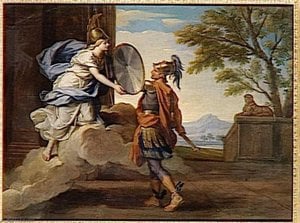
Houasse swiftly ascended through the ranks, becoming deeply involved in the ambitious decoration projects at the Château de Versailles. This was more than just painting walls; it was contributing to a carefully constructed image of royal power and divine right. His contributions weren’t limited to any single style or subject matter. He deftly moved between mythological scenes, allegorical compositions, and historical narratives, each imbued with a sense of grandeur befitting the Sun King's palace. However, a recurring motif in Houasse’s oeuvre is his fascination with the Greco-Roman goddess Athena – known as Minerva to the Romans. He repeatedly returned to this figure, exploring her multifaceted nature through various myths and attributes. Paintings like Minerve Donne Son Bouclier A Persee showcase not only his technical skill in depicting classical forms but also a deeper engagement with the intellectual currents of the time – the revival of interest in classical learning and its integration into contemporary artistic expression. His depictions weren’t simply illustrations of ancient tales; they were carefully considered statements about wisdom, strategy, and divine favor, qualities Louis XIV actively sought to embody. Other notable works from this period include Antoine et Cléopâtre, a dramatic rendering of the historical encounter, and La Terreur, la crainte et l’épouvante s'emparant des puissances de la terre, an allegorical exploration of powerful emotions.A Roman Interlude: Directing the French Academy
In 1699, Houasse’s artistic standing and leadership qualities were formally recognized with his appointment as director of the French Academy in Rome. This prestigious position placed him at the heart of the artistic community in Italy, responsible for overseeing the training of aspiring French artists. The Académie de France wasn't merely a school; it was an embassy of French art, designed to expose young talents to the rich heritage of Italian Renaissance and Baroque masters. Houasse’s role extended beyond pedagogy. He served as a cultural liaison, reporting back to Paris on artistic trends and significant events in Roman life, ensuring that France remained at the forefront of European artistic innovation. This period allowed him to further refine his own style, absorbing influences from Italian painting while simultaneously imparting French techniques and aesthetic principles to the next generation of artists.Style, Legacy, and Enduring Influence
Houasse’s artistic style is characterized by a compelling blend of elegance, dynamism, and meticulous detail. He masterfully synthesized classical principles with Baroque exuberance, creating compositions that were both visually striking and intellectually engaging. While deeply indebted to Charles Le Brun – his mentor's influence is evident in Houasse’s approach to composition, color, and narrative storytelling – he developed a distinctive artistic voice. His work possesses a refined gracefulness that sets it apart, a subtle sophistication that avoids the sometimes-overwrought drama of other Baroque painters. He achieved renown for his monumental ceiling paintings adorning the Salon de l’Abondance at Versailles, demonstrating unparalleled skill in achieving depth and luminosity. Furthermore, his son, Michel Ange Houasse, followed in his footsteps, becoming a painter specializing in genre scenes and continuing the family’s artistic tradition. Though perhaps not as widely celebrated today as some of his contemporaries, René-Antoine Houasse played a vital role in shaping the artistic landscape of 17th-century France. His contributions to Versailles and the French Academy in Rome cemented his place as a significant figure in the history of French Baroque art, offering valuable insights into the cultural values, political ideologies, and artistic tastes of his time. His paintings weren’t merely decorative embellishments; they were powerful statements about royal authority, religious devotion, and the enduring power of classical learning.Întrebări și răspunsuri
Unde pot vedea toate operele lui René Antoine Houasse?
Toate lucrările lui René Antoine Houasse de pe acest site web pot fi explorate în pagina Toate operele de artă a artistului.
Pot să explorez lucrările lui René Antoine Houasse pe categorii de mișcări artistice?
Pagina Toate mișcările de artă grupează operele lui René Antoine Houasse pe mișcări artistice.
Unde pot fi găsite lucrările lui René Antoine Houasse, grupate pe tehnici?
Pagina Toate tehnicile grupează operele lui René Antoine Houasse pe tehnici.