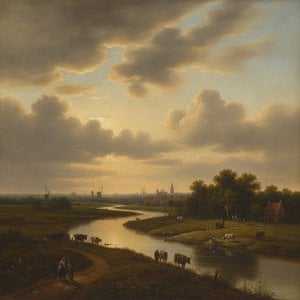
A Refined Vision of the Dutch Golden Age: Pieter van der Werff
Pieter van der Werff, a name perhaps less immediately recognized than those of Rembrandt or Vermeer, nevertheless occupies a significant and fascinating niche within the pantheon of Dutch Golden Age painters. Born in The Hague in 1665 and passing away in Rotterdam in 1722, his career unfolded during a period of immense artistic flourishing in the Netherlands, yet he carved out a distinctive style characterized by elegance, meticulous detail, and an early embrace of innovative pigments. His life was deeply intertwined with that of his brother, Adriaen van der Werff, who served as both mentor and foundational influence, shaping Pieter’s trajectory from its earliest stages. While Adriaen achieved considerable renown – even securing a prestigious position at the court of the Elector Palatine – Pieter established himself primarily in Rotterdam, becoming the favored portraitist of the city's affluent citizenry and leaving behind a legacy that offers invaluable insights into the social fabric and aesthetic sensibilities of his time.Early Life and Artistic Training
Pieter’s formative years were steeped in artistic tradition. Growing up alongside Adriaen van der Werff – a celebrated painter himself – instilled within him an unwavering dedication to mastering the craft of painting. Adriaen's influence extended beyond mere instruction; he fostered a profound appreciation for Baroque aesthetics and championed a commitment to realism, qualities that would become central to Pieter’s artistic philosophy. Recognizing his brother’s talent, Adriaen proactively nurtured Pieter’s abilities, ensuring he received comprehensive training in technique and composition. This familial bond proved instrumental in shaping Pieter's artistic development, propelling him toward excellence from the outset of his career. The brothers’ shared passion for art created an environment conducive to innovation and refinement—a crucible where Pieter’s distinctive style was forged.Style and Technique: Embracing Baroque Elegance
Pieter van der Werff’s artistic style is undeniably rooted in the Baroque movement, yet he tempered its grandeur with a distinctly Dutch sensibility. Like many artists of his era, he employed dramatic compositions, rich color palettes—particularly favoring hues like crimson and ochre—and heightened emotional intensity to convey profound narratives. However, unlike some contemporaries who succumbed to excessive ornamentation, Pieter prioritized meticulous detail and psychological nuance, achieving remarkable likenesses that captured not only physical appearance but also the inner character of his subjects. His portraits were meticulously crafted studies in observation, reflecting a deep understanding of human anatomy and expression. He skillfully utilized chiaroscuro—the dramatic interplay of light and shadow—to sculpt form and imbue his paintings with palpable atmosphere. This masterful technique distinguishes Pieter’s work from many others produced during the Golden Age, elevating it to a level of artistic sophistication rarely matched.Notable Works and Artistic Achievements
Pieter van der Werff's oeuvre encompasses a diverse range of subjects—portraits, mythological scenes, historical narratives, and genre paintings—demonstrating his versatility as an artist. Among his most celebrated achievements are “Expulsion of Adam and Eve,” a monumental depiction of biblical drama imbued with emotional fervor; “Granida and Diafilo,” a captivating portrayal of Greek mythology that showcases Pieter’s ability to convey complex emotions through visual storytelling; “Bubble Blowing,” a charming genre scene capturing the innocence and spontaneity of everyday life; and “Johan de Vries portrait,” an exquisite likeness reflecting Pieter's unparalleled skill in capturing psychological depth. These paintings stand as testament to his artistic prowess and underscore his enduring legacy within Dutch Baroque art history. His meticulous attention to detail—particularly evident in the rendering of fabrics, textures, and facial expressions—established him as one of the foremost portraitists of his time.The Pioneer’s Palette: Prussian Blue and Artistic Innovation
Pieter van der Werff's contribution to artistic innovation extends beyond stylistic considerations; he was among the first Dutch painters to embrace Prussian blue—a newly synthesized pigment—with unprecedented enthusiasm. Recognizing its transformative potential, he incorporated this vibrant hue into numerous canvases, elevating his paintings with luminosity and depth. This bold experimentation signaled a departure from conventional color palettes and cemented Pieter’s reputation as a visionary artist who dared to push boundaries. The use of Prussian blue not only enhanced the aesthetic impact of his works but also reflected a broader intellectual curiosity—a willingness to explore new artistic possibilities—that distinguished him from many of his peers. His pioneering spirit continues to inspire artists today, reminding us that true creativity lies in embracing innovation and challenging established norms.Legacy and Historical Significance
Pieter van der Werff’s enduring legacy resides not merely in the beauty of his paintings but also in their profound historical significance. He served as a visual recorder of Rotterdam's elite during the Golden Age, capturing portraits of prominent citizens—including Paulus Verschuur—and documenting significant events—such as visits by dignitaries like Peter the Great—with remarkable accuracy and sensitivity. His works offer invaluable insights into the social customs, fashions, and intellectual currents of his time, enriching our understanding of Dutch Baroque culture. Furthermore, Pieter’s artistic achievements stand as a beacon of excellence within the broader context of Dutch art history, securing his place among the most revered masters of his generation. His paintings continue to captivate audiences worldwide, demonstrating the timeless appeal of masterful technique and evocative storytelling—a testament to Pieter van der Werff's enduring contribution to the artistic heritage of the Netherlands.Întrebări și răspunsuri
Unde pot vedea operele lui Pieter van der Werff în ordine cronologică?
Există o cronologie a lucrărilor lui Pieter van der Werff: pagina Cronologia operelor de artă a artistului ordonează operele în funcție de data creației.
Cum pot găsi lucrările lui Pieter van der Werff pe o temă specifică?
Operele lui Pieter van der Werff pot fi explorate pe baza cuvintelor cheie, în pagina de După cuvinte cheie a artistului. Fiecare cuvânt cheie grupează operele aferente.
Câte opere de artă ale lui Pieter van der Werff pot fi vizualizate?
Puteți vizualiza 64 opere de artă de opere ale lui Pieter van der Werff pe pagina Toate operele de artă.