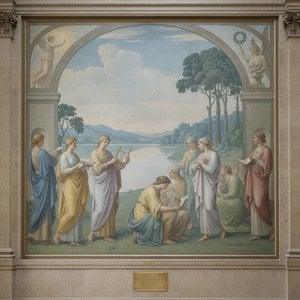
Philippe de Levis Mirepoix: A Master of Gothic Illumination
Philippe de Levis Mirepoix (c. 1460 – Paris, 1539) stands as a singular figure in the annals of French manuscript illumination during the fifteenth century. His work transcends mere decoration; it embodies the spiritual fervor and artistic sophistication characteristic of the Burgundian court and reflects profound engagement with theological discourse. Born into noble lineage, Mirepoix’s early life remains shrouded in obscurity, yet his ascent to prominence as a scribe and illuminator is undeniably remarkable—a testament to unwavering dedication and exceptional talent.
Early Influences & Artistic Training
Mirepoix's artistic journey commenced under the watchful eye of Jean Bourdieu, a celebrated illuminator whose workshop served as a crucible for stylistic innovation within Burgundian art. Bourdieu’s influence instilled in Mirepoix a meticulous approach to technique—a cornerstone of Gothic illumination—and fostered an appreciation for the expressive potential inherent in intricate geometric patterns and vibrant color palettes. Bourdieu championed realism alongside symbolic representation, shaping Mirepoix's understanding of how visual artistry could convey profound spiritual truths. This formative period cemented Mirepoix’s commitment to mastering the craft of manuscript illumination, preparing him for his future endeavors as a visionary artist.
The Antiphonaire de Mirepoix: A Monumental Achievement
Mirepoix’s magnum opus is undeniably the Antiphonaire de Mirepoix—a lavish liturgical manuscript commissioned by Jean Crespin, Bishop of Amiens. This monumental work exemplifies the Burgundian aesthetic at its zenith and showcases Mirepoix’s unparalleled mastery of illumination—a feat that solidified his reputation as one of France's foremost artistic figures. Comprising twelve exquisitely rendered sheets adorned with scenes depicting saints and biblical narratives—a deliberate selection reflecting Crespin’s theological convictions—the Antiphonaire embodies Mirepoix’s profound grasp of symbolic language and his ability to transform parchment into radiant expressions of faith. The meticulous detail evident in every illuminated panel speaks volumes about Mirepoix's unwavering dedication to artistic perfection.
Stylistic Innovations & Techniques
Mirepoix distinguished himself from prevailing trends through several groundbreaking innovations—techniques that elevated manuscript illumination beyond mere ornamentation and cemented his place as a pioneer of Gothic art. Notably, he embraced ‘lettrine,’ wherein the initial letters of each page are embellished with elaborate geometric designs—a stylistic hallmark of Burgundian art deeply rooted in humanist intellectual currents. Furthermore, Mirepoix skillfully integrated gold leaf into his compositions—creating shimmering surfaces that heighten visual impact and convey spiritual radiance—a technique perfected by Bourdieu himself. This masterful manipulation of color and texture underscored Mirepoix’s unwavering commitment to artistic excellence and established him as a visionary artist who pushed the boundaries of medieval illumination.
Legacy & Influence
Mirepoix's influence extended far beyond his lifetime, shaping the stylistic trajectory of French manuscript art throughout the sixteenth century—a legacy that continues to inspire artists today. His meticulous technique and expressive vision served as a beacon for subsequent illuminators, fostering a tradition of artistic excellence characterized by realism alongside symbolic representation. The Antiphonaire de Mirepoix stands as an enduring testament to his genius—a masterpiece that embodies the zenith of Burgundian art and affirms the transformative power of creative endeavors. Philippe de Levis Mirepoix’s contribution to the history of manuscript illumination remains unparalleled, securing his place among France's most celebrated artistic figures.