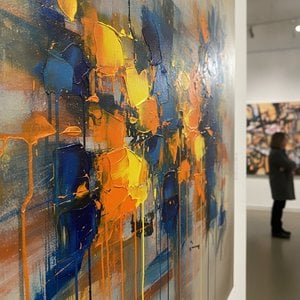
Peggy Trotman: Bridging Tradition and Innovation in Color Field Painting
Peggy Trotman (born 1935) stands as a singular figure within the landscape of British abstract painting, renowned for her distinctive Venetian influence and unwavering commitment to exploring the expressive potential of color. While initially trained in watercolor, Trotman swiftly transitioned to oil paint, establishing herself as a prolific artist whose canvases bear witness to decades of artistic evolution.
Her formative years were marked by exposure to Surrealist ideas through André Breton’s encouragement during her studies at Chelsea School of Art. This initial encounter instilled a fascination with subconscious imagery and challenged conventional perceptions of reality – influences that would subtly permeate her later compositions. Trotman's early explorations embraced experimentation, delving into techniques like collage and mixed media, reflecting the broader artistic currents of her time.
However, Trotman’s artistic trajectory took an unexpected turn when she embarked on a residency in Venice in 1967, coinciding with the burgeoning Venetian art scene championed by Peggy Guggenheim. This pivotal moment proved transformative, sparking a dialogue between Trotman’s innate sensitivity to color and the profound cultural heritage of the city. The breathtaking mosaics of Saint Mark's Basilica and the grandeur of Palazzo Ducale captivated her imagination, prompting her to delve into the stylistic vocabulary of Byzantine and Renaissance art.
It was during this Venetian period that Trotman began to develop her signature style—characterized by expansive fields of color derived from the lagoon waters—that shimmered with luminosity. Rejecting geometric abstraction, she favored organic forms inspired by botanical specimens and geological formations. Her meticulous brushwork captured subtle tonal variations, creating surfaces that invited contemplation and conveying deep emotional resonance.
Throughout her prolific career spanning over three decades, Trotman produced more than 300 paintings, showcasing a remarkable stylistic range despite maintaining a consistent core aesthetic. Notable exhibitions included solo presentations at Tate Britain (1985), Yorkshire Sculpture Park (1992), and the Dulwich Picture Gallery (1997)—affirming her status as one of Britain’s foremost color field painters.
Her work garnered critical acclaim for its lyrical beauty, intellectual depth, and masterful execution. Trotman's paintings continue to inspire audiences today, serving as a testament to the enduring power of abstraction and the transformative impact of artistic encounters. She remains an artist whose legacy embodies the harmonious fusion of tradition and innovation—a beacon illuminating the path toward expressive exploration.