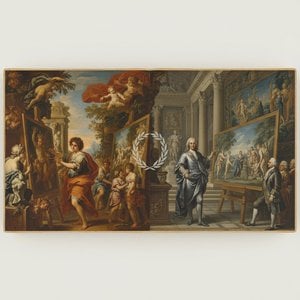
Nicolas Dipre: The Avignon Visionary
Nicolas Dipre (c. 1495 – 1532) stands as one of the most prominent figures within the vibrant artistic milieu of Avignon, France—a period indelibly marked by papal relocation and a fervent embrace of humanist ideals. Born in Paris, though his precise familial origins remain shrouded in obscurity, Dipre’s life was inextricably interwoven with the burgeoning Renaissance spirit that swept across Europe, particularly its southern reaches. His formative years were spent absorbing artistic traditions rooted in Gothic grandeur yet increasingly attuned to the stylistic innovations emanating from Florence and Rome. This dual influence would profoundly shape his oeuvre, resulting in paintings imbued with both solemn piety and breathtaking visual splendor.- Early Life & Training: Precise details regarding Dipre’s formal education are scarce, suggesting he honed his craft through apprenticeship—likely under the tutelage of established Parisian artists—rather than attending prestigious universities. Nevertheless, his innate talent shone brightly from an early age, foreshadowing a career dedicated to elevating religious art.
- Avignon & The Papal Court: Dipre’s artistic trajectory took its decisive turn when he relocated to Avignon in 1508, becoming a favored painter for the papal court under Pope Julius II. This patronage afforded him unparalleled access to resources and commissions—a golden age for Avignon’s artistic community—allowing him to produce monumental altarpieces that cemented his reputation as a master of color and composition.
- Notable Works: Dipre's artistic legacy rests upon several iconic paintings, most notably Jacob's Ladder and Gideon's Fleece. These biblical narratives exemplify the humanist preoccupation with allegory and symbolism—a hallmark of Renaissance art—capturing divine grace amidst earthly struggles. The meticulous detail and luminous palette characteristic of his style underscore his mastery of technique.
- Technique & Style: Dipre’s artistic approach was defined by a masterful command of fresco painting, utilizing tempera pigments mixed with lime to achieve vibrant hues and remarkable durability. His compositions are characterized by balanced symmetry and dramatic lighting—elements borrowed from classical sculpture—creating immersive visual experiences for viewers.
- Legacy & Historical Significance: Dipre’s contribution to Avignon’s artistic heritage transcends mere stylistic innovation; he embodies the spirit of humanist inquiry that propelled the Renaissance forward. His paintings continue to inspire admiration and scholarly study, serving as tangible reminders of a pivotal moment in European art history—a testament to the enduring power of faith and beauty.
Exploring Dipre’s Artistic Vision: Jacob's Ladder & Gideon's Fleece
Dipre’s biblical masterpieces – Jacob’s Ladder and Gideon’s Fleece – stand as unparalleled achievements in Renaissance iconography. These works are not merely depictions of sacred stories; they are carefully crafted visual allegories designed to convey profound theological concepts. Dipre skillfully employs pyramidal compositions—a technique favored by artists like Piero della Francesca—to emphasize the central figures and create a sense of stability and grandeur. The luminous colors—particularly blues and golds—evoke divine radiance, mirroring the spiritual aspiration inherent in both narratives.The Influence of Florentine Art
Dipre’s artistic sensibilities were undeniably shaped by the artistic fervor emanating from Florence under Lorenzo de Medici. Artists like Piero della Francesca and Andrea Mantegna championed geometric precision and harmonious proportions—principles that found their way into Dipre's compositions. Furthermore, Dipre embraced the humanist emphasis on human dignity and intellectual contemplation—a cornerstone of Florentine culture—reflecting in his portrayal of biblical figures as individuals grappling with moral dilemmas.A Painter’s Patronage: The Papal Court
Dipre's association with Pope Julius II represents a pivotal moment in his artistic career. The papal court provided him with invaluable resources and commissions—allowing him to undertake ambitious projects that showcased his technical prowess and imaginative vision. This patronage fostered an environment conducive to experimentation and innovation, propelling Dipre’s artistic development toward new heights of excellence.Rediscovering Dipre's Art
Today, fragments of Dipre’s paintings—primarily surviving in the Saint-Nicolas du Chardonnet church in Paris—offer tantalizing glimpses into his artistic genius. Ongoing research and conservation efforts aim to reconstruct his oeuvre and illuminate the complexities of his creative process—a continuing endeavor that underscores the enduring fascination with this Avignon visionary.Întrebări și răspunsuri
Cum pot găsi toate lucrările lui Nicolas Dipre dintr-un anumit tip de tehnică?
Operele lui Nicolas Dipre pot fi explorate pe baza mediului utilizat în pagina de Toate tehnicile a artistului.
Din ce epocă face parte Nicolas Dipre?
Nicolas Dipre a activat în perioada Renaissance. Această perioadă situează activitatea artistului în context istoric.
Există o prezentare generală a tuturor subiectelor pictate de Nicolas Dipre?
Pagina Atlas pe teme clasifică operele lui Nicolas Dipre pe teme.