Early Life and Artistic Foundations
Miki Suizan, born Miki Saiichirō on July 15, 1887, in the small town of Kinashi, Hyogo Prefecture, northwest of Osaka, emerged from a Japan undergoing rapid transformation. The Meiji Restoration had irrevocably altered the nation’s social and artistic landscape, blending traditional aesthetics with burgeoning Western influences. While details surrounding his early upbringing remain somewhat scarce, it is known that Suizan demonstrated an aptitude for art at a young age, leading him to Kyoto in 1903 to begin formal studies under the esteemed nihonga painter Takeuchi Seihō. This mentorship proved pivotal; Seihō, a staunch advocate of traditional Japanese painting techniques and subject matter, instilled in Suizan a deep respect for the past while encouraging innovation within its established frameworks.
A Master of Bijin-ga and Sumi-e
Suizan quickly distinguished himself as a painter specializing in bijin-ga, portraits of beautiful women. However, his approach wasn’t merely replication of existing styles. He infused his depictions with a delicate lyricism and psychological depth that set him apart. His women weren't simply objects of beauty; they were imbued with personality, often captured in moments of quiet contemplation or graceful activity. Beyond bijin-ga, Suizan also excelled in sumi-e, monochrome ink wash painting—a discipline demanding both technical precision and profound artistic sensibility. His tiger paintings, for example, showcase a remarkable command of brushwork, conveying the animal’s power and majesty with expressive lines and atmospheric shading. This versatility allowed him to navigate diverse themes while maintaining a consistent aesthetic vision.
Exhibition Success and Recognition
From 1913 onward, Suizan consistently exhibited his work at prestigious government-sponsored exhibitions like Bunten, Teiten, and Shin-Bunten—venues that served as crucial platforms for establishing an artist’s reputation. A significant milestone arrived in 1932 when he was granted mukansa status at the 13th Teiten exhibition. This coveted designation reserved for artists who had made substantial contributions to contemporary painting, allowed Suizan to exhibit freely without undergoing the usual vetting process—a testament to his growing recognition and artistic merit.
Themes and Techniques
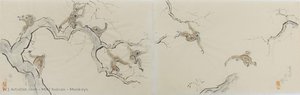
Suizan’s art is characterized by a harmonious blend of traditional Japanese aesthetics and subtle modern sensibilities. His bijin-ga often depict women engaged in everyday activities – preparing tea, arranging flowers, or simply lost in thought. These scenes are rendered with meticulous attention to detail, showcasing the elegance of kimono patterns, the delicate texture of hair ornaments, and the nuanced expressions on his subjects’ faces. His sumi-e works, such as the dynamic ‘Monkeys’ triptych, demonstrate a mastery of ink wash techniques, utilizing varying shades of grey to create depth, movement, and atmosphere. He skillfully employed both color and monochrome palettes, adapting his approach to suit the specific subject matter and desired emotional effect.
Legacy and Historical Significance
In 1952, Suizan embarked on a period living in the United States, holding individual exhibitions focused primarily on his bijin-ga. This exposure introduced his art to a Western audience, further solidifying his international reputation. While he returned to Japan in 1957, his passing that same year marked the end of a prolific career. Today, Miki Suizan is remembered as a significant figure in early 20th-century Japanese painting—a master of bijin-ga and sumi-e who successfully bridged tradition and modernity. His works are held in the collections of major museums worldwide, including the Tokyo Museum of Modern Art, the Kyoto Museum of Modern Art, and the Boston Museum of Fine Arts, ensuring his enduring legacy for generations to come.