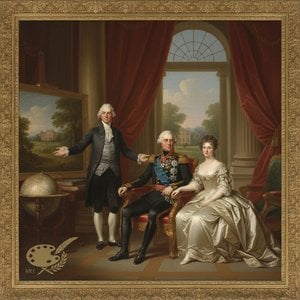
Margaret Lindsay Williams: A Life in Portraiture
Margaret Lindsay Williams (1888-1960) was a celebrated Welsh artist renowned for her striking portraits of British royalty, European nobility, and American presidents. Though highly successful during her lifetime, her work experienced a period of relative obscurity before being rediscovered as an important figure in 20th-century portraiture.
Early Life and Education
Born in Cardiff, Wales, Margaret Lindsay Williams was the eldest daughter of Samuel A. Williams, a shipbroker, and Martha Margaret Lindsay, of Scottish descent. From the age of nine, she resided at 9 Windsor Road, Barry. Her artistic talent became evident early on, winning a gold medal for art at Cardiff School of Art in 1904. She continued her studies at the Pelham Street School of Painting in Kensington (1905), preparing for entry into the prestigious Royal Academy.
Royal Academy and Early Career
Williams enrolled at the Royal Academy School in 1906, quickly distinguishing herself. In 1911, she achieved a remarkable feat – winning a gold medal for her painting The City of Refuge , becoming both the youngest artist and the first from Wales to receive this honor. Supported by her father, she established her own studio at Eaton Terrace in St John's Wood that same year. A travel scholarship followed in 1912, allowing her to study in Italy and Holland under the guidance of John Singer Sargent .
Artistic Development and Style
Williams’ style evolved from early academic training towards a distinctive approach to portraiture. She skillfully captured not only physical likeness but also the personality and status of her sitters. Her work demonstrates a mastery of technique, with meticulous attention to detail and a refined use of color. While primarily known for portraits, she also explored religious themes and imaginative compositions during and after World War I.
Wartime Experiences and Commissions
At the outbreak of World War I, Williams actively sought an appointment as an official war artist with the Welsh Division in France. Despite support from David Lloyd George , her request was denied due to prevailing societal norms regarding women’s roles during wartime. She contributed illustrations for a prose anthology supporting Welsh troops and later undertook large-scale commissions, including depictions of scenes at Cardiff Royal Infirmary and Cardiff City Hall.
Major Achievements and Notable Works
- Welsh National Service at Westminster Abbey (1918): Her most ambitious work – a 20x16 foot canvas featuring approximately 150 portraits, including Queen Alexandra and Princess Victoria.
- Portraits of Royalty: She painted numerous portraits of Queen Alexandra, Queen Mary, Princess Margaret, and at least five portraits of Queen Elizabeth II .
- Presidential Portrait: Commissioned to paint a near life-size portrait of President Warren Harding in 1922.
- St Paul's Cathedral Thanksgiving Service (1933): A large group portrait including King George V and Queen Mary, commemorating the cathedral’s re-opening.
Later Life and Legacy
Williams continued to receive commissions from prominent families in Wales and London throughout the mid-20th century. She painted portraits of figures like Henry Ford and Field Marshal Slim. Although celebrated during her lifetime, her work faded from prominence after her death in 1960. Today, there is a growing recognition of her talent and contribution to British portraiture, with renewed interest in her life and artistic achievements.
Influences
Margaret Lindsay Williams was significantly influenced by John Singer Sargent’s approach to portraiture. Her work also reflects the academic traditions of the Royal Academy and a broader engagement with contemporary artistic trends.
Întrebări și răspunsuri
Unde pot vizualiza operele lui Margaret Lindsay Williams într-o galerie 3D?
Pagina Galerie 3D a lui Margaret Lindsay Williams prezintă operele de artă ale artistului într-o galerie virtuală tridimensională.
Cum pot urmări evoluția creațiilor lui Margaret Lindsay Williams, an de an?
Pagina Cronologia operelor de artă a artistului prezintă lucrările lui Margaret Lindsay Williams ordonate cronologic, an de an.
Unde pot vedea toate operele lui Margaret Lindsay Williams?
Toate lucrările lui Margaret Lindsay Williams de pe acest site web pot fi explorate în pagina Toate operele de artă a artistului.