Mabel Victoria MacGeorge (1884–1960): A Painter of Woodland Tranquility
Mabel Victoria MacGeorge, born in Melbourne, Australia, in 1885, was a prolific landscape painter who dedicated her life to capturing the beauty and serenity of the Australian bush. Her artistic journey began with early training in watercolour painting, fostering a lifelong fascination for observing nature’s subtleties—a passion that would define her entire creative output. Despite facing societal limitations typical of Victorian women's roles during her time, MacGeorge persevered in pursuing her artistic aspirations, establishing herself as one of Australia’s most respected Impressionist painters and securing a prominent place within the annals of Australian art history.
Early Life and Training
MacGeorge received a robust education at Melbourne Girls’ Grammar School, equipping her with foundational skills in mathematics and English alongside invaluable artistic pursuits. This formative experience instilled in her a disciplined approach to learning—a characteristic that would translate seamlessly into her meticulous observation of the natural world and her masterful execution on canvas. Her instructors recognized her innate talent for visual representation, nurturing her burgeoning interest in capturing fleeting moments of light and color—the very essence of Impressionist art.
Influences: Embracing the Impressionist Vision
Her artistic sensibilities were profoundly shaped by the Impressionist movement spearheaded by luminaries like Claude Monet and Pierre-Auguste Renoir. These masters championed a revolutionary technique—one that prioritized capturing ephemeral sensations rather than striving for photographic realism. MacGeorge wholeheartedly embraced this paradigm shift, immersing herself in the stylistic innovations of her time and adopting brushstrokes characterized by looseness and spontaneity—a deliberate departure from academic conventions. Notably, she drew inspiration from William Morris’s Arts and Crafts Movement, whose ethos emphasized handcrafted beauty and reverence for natural materials—values that resonated deeply within MacGeorge's artistic worldview.
The Artistry of Observation: MacGeorge’s Technique
MacGeorge’s distinctive style revolved around painstaking attention to detail—translating her perceptions onto canvas with remarkable accuracy. She favored watercolour paints combined with oil glazes—a method that allowed for layering colors and achieving luminous effects—a technique honed through years of dedicated practice. Her brushstrokes were loose yet purposeful, conveying a palpable sense of movement and atmosphere while preserving the integrity of the landscape’s contours—a testament to her unwavering commitment to artistic precision. The artist skillfully employed muted earth tones—greens, browns, ochres—to evoke the mood of woodland scenes and rural landscapes—creating compositions imbued with profound emotional resonance. Furthermore, she expertly rendered sunlight filtering through foliage, generating dappled patterns of light that heightened the visual richness of her paintings—a hallmark of Impressionist artistry.
Notable Works and Recognition
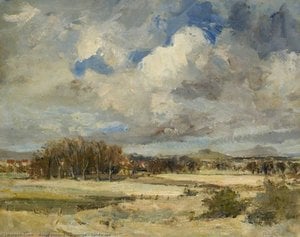
Throughout her illustrious career, MacGeorge produced over 300 paintings—primarily landscapes depicting Australian flora and fauna—capturing the grandeur and tranquility of the bush with unparalleled grace. Her artwork garnered considerable acclaim during her lifetime, securing exhibitions at prestigious institutions like Victoria Memorial Hall and the National Gallery of Victoria—a testament to her artistic merit and contribution to Australian art history. Among her most celebrated pieces is “Farmyard Through Trees,” an evocative depiction that exemplifies MacGeorge’s ability to convey both visual detail and emotional depth—a masterpiece embodying the spirit of Impressionist landscape painting. Similarly, “Landscape” presents a serene panorama of rolling hills bathed in golden sunlight—a quintessential example of Impressionist aesthetic ideals. Her membership in the Royal Society of Artists underscored her artistic stature and cemented her legacy as a pivotal figure within Victorian art traditions.
Legacy and Historical Significance
Mabel Victoria MacGeorge’s enduring legacy resides in her unwavering devotion to artistic integrity and her masterful portrayal of Australia's natural splendor—a contribution that continues to inspire admiration for its beauty, subtlety, and technical prowess. Her paintings stand as timeless emblems of Impressionist art—reflecting the values and sensibilities of a bygone era while simultaneously captivating audiences with their enduring visual appeal. She remains an important artist whose work embodies the spirit of its time—a testament to her artistic vision and unwavering commitment to capturing the essence of the Australian landscape.