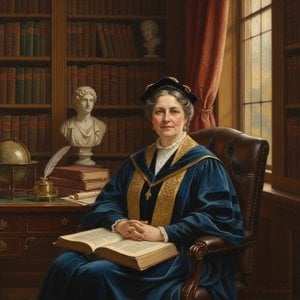
A Life Etched in Portraits: The World of Lowes Cato Dickinson
Lowes Cato Dickinson, born in Kilburn, London, in 1819, was a figure deeply embedded within the artistic and social currents of Victorian England. Coming from a family intimately connected to the art world—his father, Joseph Dickinson, being a respected lithographer and publisher on Bond Street—Dickinson’s path seemed preordained. Yet, his journey wasn't merely one of inheritance but of active engagement with the evolving aesthetic sensibilities and progressive social movements of his time. One of eleven siblings, he received his early education at Topsham School and Dr Lord's School in Tooting, grounding him in a solid foundation before fully immersing himself within the family business following his father’s death in 1849. He then joined forces with his brothers, Gilbert Bell Dickinson and William Robert Dickinson, to continue the legacy of Dickinson Brothers on Bond Street, a firm that quickly became synonymous with quality art publishing and photography. This early exposure wasn't simply about commerce; it was an apprenticeship in visual culture, shaping his eye for detail and composition—qualities that would define his later work as a portraitist.The Pre-Raphaelite Circle and the Call of Social Reform
Dickinson’s artistic development took a significant turn with a three-year sojourn in Italy around 1850. This period proved formative, exposing him to the masterpieces of the Renaissance and influencing his evolving style. He absorbed the stylistic principles championed by Dante Gabriel Rossetti and John Ruskin—a fervent desire for truth to nature combined with an emotional intensity that would become hallmarks of his oeuvre. The Pre-Raphaelite Brotherhood’s emphasis on rejecting academic conventions and celebrating medieval art profoundly impacted Dickinson's artistic vision. Beyond aesthetics, however, was a burgeoning sense of social responsibility. He became deeply involved in the Christian socialist movement, recognizing the urgent need for moral reform amidst the rapid industrialization of Victorian Britain. This conviction fueled his dedication to establishing the Working Men’s College in London—a pioneering institution committed to providing accessible education to underprivileged individuals and embodying his belief in the transformative potential of knowledge. The collaboration with fellow Pre-Raphaelites like Frederic Denison Maurice solidified Dickinson's position within this influential artistic milieu, fostering dialogues about art’s role in shaping societal values.A Portraitist of Victorian Society
Lowes Cato Dickinson distinguished himself as a remarkably skilled portrait painter during the Victorian era—a period characterized by social stratification and burgeoning industrial growth. Unlike many artists preoccupied with grand historical narratives or mythological themes, Dickinson focused on capturing the essence of his subjects—prominent figures who exerted considerable influence over British society. His technique was particularly noteworthy: he eschewed elaborate backgrounds, concentrating instead on meticulously rendering the faces of his sitters with painstaking detail. This approach allowed him to convey personality and character through subtle shading and nuanced expressions—a testament to his artistic sensitivity. He achieved renown for his distinctive method – often completing portraits solely by focusing on facial features, entrusting the depiction of clothing and accessories to other artists. This collaborative strategy maximized Dickinson’s ability to communicate inner life and psychological depth. Among his celebrated commissions were portraits of Queen Victoria herself—a symbol of imperial grandeur—members of Parliament representing diverse political viewpoints, and luminaries from science and literature like Arthur Cayley and James Clerk Maxwell. He also undertook significant projects for charitable organizations and educational institutions, reflecting his unwavering commitment to social betterment. His most iconic portrait remains that of Mr. Gladstone—captured within the hallowed halls of Downing Street—a masterpiece embodying both formal elegance and psychological insight. Dickinson’s enduring legacy resides not only in the beauty of his artworks but also in their contribution to documenting Victorian society—preserving memories of individuals who shaped Britain's cultural landscape.Legacy and Enduring Influence
Dickinson’s influence extended far beyond the canvases he adorned with faces. His meticulous attention to detail and profound understanding of human psychology established him as a singular figure within Victorian portraiture. The Working Men’s College continues to honor his memory through the annual Lowes Dickinson Award—a prestigious prize recognizing excellence in student art endeavors. Furthermore, his children bequeathed funds for establishing a travel scholarship—promoting artistic exploration and fostering connections between cultures. His papers—carefully archived at Princeton, Oxford, and Cambridge Universities—provide invaluable insights into Victorian art history and social thought. Lowes Cato Dickinson’s life exemplifies the harmonious convergence of artistic talent, intellectual curiosity, and unwavering devotion to humanitarian ideals—a testament to his enduring contribution to British culture and a beacon for future generations striving to capture the spirit of their own time.Întrebări și răspunsuri
Câte opere de artă ale lui Lowes Cato Dickinson pot fi vizualizate în catalog?
Puteți explora cele 76 de opere de artă de opere ale lui Lowes Cato Dickinson pe pagina Toate operele de artă.
Unde pot vedea profilul cromatic al lucrărilor lui Lowes Cato Dickinson?
Genoma Paletei lui Lowes Cato Dickinson este o pagină care prezintă profilul cromatic al întregii creații a artistului.
Pot explora operele lui Lowes Cato Dickinson în funcție de spectrul de culori?
Operele lui Lowes Cato Dickinson pot fi explorate pe criterii de culoare în pagina Indice Spectral a artistului.