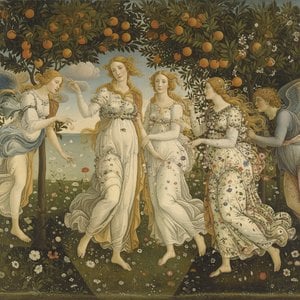
Lorenzo Tancini: Bridging Neoclassicism and the Dawn of Modernity
Lorenzo Tancini, born August 10, 1802, in Caorso, a small town within the province of Piacenza in Italy, was an artist whose career spanned nearly eight decades. His life’s work reflects a fascinating evolution—a gradual shift from the rigid structures of Neoclassicism to a more expressive and nuanced approach that foreshadowed elements of early Modernism. Tancini's journey began with formal training at the Istituto Gazzola di Fine Arts in Piacenza, where he first apprenticed under Giuseppe Gherardi, laying the groundwork for his artistic development. This initial period instilled in him a solid understanding of classical techniques and composition, which would later inform his style. He subsequently moved to Rome, immersing himself in the vibrant art scene and studying at the prestigious Accademia di San Luca under Gaspare Landi – an institution renowned for its rigorous training and emphasis on anatomical accuracy and historical narrative. This period proved crucial, allowing him to hone his skills and develop a refined artistic sensibility.Early Career and Milanese Commissions
Following his studies in Rome, Tancini established himself in Milan, a bustling center of commerce and culture during the 19th century. It was here that he began to gain recognition for his ability to capture historical events with dramatic intensity and technical skill. A significant commission came from Count Prospero Frissino of Lodi, who tasked him with painting “The Death of the Duke Farnese.” This monumental work, a testament to Tancini’s mastery of composition and rendering human emotion, cemented his reputation as a skilled historical painter. The scene depicted not just a physical death but also conveyed the profound grief and political ramifications of the event, showcasing a level of psychological depth that was increasingly valued in 19th-century art. Further commissions followed, including “Madonna di Caravaggio and San Carlo Borromeo before those afflicted with the Plague” for the church of Borgotrebbia – a poignant depiction of faith amidst suffering, demonstrating Tancini’s ability to imbue his works with moral and spiritual significance.Teaching and Portraiture: Shaping Artistic Talent
Beyond his commissioned work, Tancini played an important role in the artistic education of Italy. He returned to Piacenza and was appointed as a professor of painting at the Istituto Gazzola di Piacenza by 1840, continuing until his death. This position allowed him to nurture young talent, shaping the next generation of Italian artists. His influence extended beyond simply imparting technical skills; he instilled in his students a deep appreciation for historical accuracy and dramatic storytelling. Furthermore, Tancini maintained an active practice as a portrait painter, producing works such as “Portrait of Count Antonio Parma,” commissioned by the Istituto Gazzola itself. These portraits were not merely likenesses but carefully constructed representations that revealed the subject’s character and social standing – reflecting the conventions of the era while subtly hinting at individual personality.Key Works and Artistic Style
Tancini's artistic output encompassed a diverse range of subjects, including historical scenes, religious narratives, and portraits. Notable works include “The Wounded Gladiator,” which powerfully depicted the vulnerability and resilience of the human form; “Roman Soldier pursued in Rome,” a dramatic portrayal of conflict and pursuit; and “Resurrection of Christ,” a scene brimming with spiritual intensity and carefully rendered detail. These paintings demonstrate his ability to seamlessly blend classical techniques with emerging stylistic trends. While rooted in Neoclassicism—characterized by clear lines, balanced compositions, and idealized figures—Tancini’s work gradually incorporated elements of Romanticism, such as heightened emotion, dramatic lighting, and a greater emphasis on individual experience. His use of color was particularly noteworthy – often employing rich, warm tones to create a sense of atmosphere and drama.Legacy and Influence
Lorenzo Tancini’s legacy extends beyond his own artistic creations. He profoundly influenced the work of his pupils, including Francesco Ghittoni and Giovanni Bernardino Pollinari, both of whom went on to establish successful careers as artists in their own right. Pollinari even published a posthumous biography of Tancini, ensuring that his life and work would be remembered. His commitment to artistic excellence and his ability to bridge the gap between classical tradition and emerging modern styles left an indelible mark on the Italian art scene of the 19th century. While he may not be as widely celebrated as some of his contemporaries, Tancini’s paintings continue to offer a valuable glimpse into the cultural and artistic landscape of his time – a testament to his skill, dedication, and enduring influence. His work serves as a bridge between the formal elegance of Neoclassicism and the expressive potential that would define the art of the coming decades.Întrebări și răspunsuri
Unde pot vedea profilul cromatic al lucrărilor lui Lorenzo Tancini?
Genoma Paletei lui Lorenzo Tancini este o pagină care prezintă profilul cromatic al întregii creații a artistului.
De unde este Lorenzo Tancini?
Lorenzo Tancini s-a născut în Italy.
Ce pseudonime sau alte nume este cunoscut Lorenzo Tancini?
Lorenzo Tancini este cunoscut și sub numele de Lorenzo Toncini.