A Life Immersed in Color and Culture
Lois Mailou Jones, a name synonymous with groundbreaking artistry and unwavering dedication to African American representation, was born in Boston, Massachusetts, on November 3, 1905. From her earliest years, she was nurtured in an environment that valued creativity; her parents, Thomas Vreeland Jones, a lawyer, and Carolyn Adams Jones, a cosmetologist, encouraged her innate talent for drawing and painting, particularly with the fluid grace of watercolors. Summers spent on Martha's Vineyard proved formative, introducing young Lois to a constellation of influential figures – sculptor Meta Warrick Fuller, composer Harry T. Burleigh, and novelist Dorothy West – who would subtly shape her artistic sensibilities. This early exposure instilled in her not only an appreciation for art but also a sense of cultural pride and the importance of mentorship, values she would carry throughout her life. Her formal education began at the High School of Practical Arts in Boston (1919-1923), followed by night classes at the Boston Museum of Fine Arts, secured through a hard-earned scholarship. A pivotal apprenticeship with costume designer Grace Ripley further broadened her artistic horizons, sparking an early fascination with African masks and their potential for symbolic expression. Even as a teenager, Jones demonstrated remarkable ambition, holding her first solo exhibition on Martha’s Vineyard at the age of seventeen. She continued to hone her skills at the School of the Museum of Fine Arts in Boston (1923-1927), consistently winning the Susan Minot Lane Scholarship, and supplemented her studies with courses at the Boston Normal Art School, culminating in a graduate degree in design from the Design Art School of Boston in 1928.From Textile Design to Artistic Independence
Jones’s initial professional path led her into the world of textile design, working for both F. A. Foster Company in Boston and Schumacher Company in New York City. However, a transformative summer at Harvard University in 1928 ignited a deeper desire – to fully dedicate herself to painting. This decision coincided with the burgeoning Harlem Renaissance, an intellectual and artistic movement that profoundly impacted her work. The influence of artist Aaron Douglas became particularly significant; his stylized depictions of African American life and incorporation of African motifs resonated deeply with Jones’s own emerging aesthetic vision. Her seminal work, The Ascent of Ethiopia, stands as a testament to this period, reflecting both Douglas's stylistic influence and her growing commitment to celebrating African heritage. She explored the interplay between geometric abstraction and organic forms, mirroring the dynamism of Caribbean landscapes and the richness of African traditions. This exploration would continue throughout her career, resulting in paintings that are characterized by bold color palettes and intricate textural surfaces.Exploring Diverse Influences and Artistic Evolution
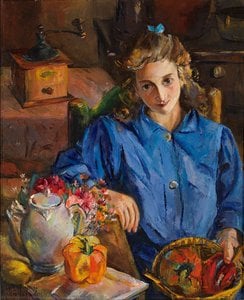
Jones’s artistic journey was marked by constant experimentation and adaptation. Initially drawn to Impressionism's luminous qualities, she gradually embraced Cubist techniques, incorporating fragmented perspectives and multiple viewpoints into her compositions. This stylistic shift reflected not only her evolving understanding of visual representation but also her engagement with broader intellectual currents—particularly Surrealism—which encouraged her to delve into the subconscious realm and explore dreamlike imagery. Her travels throughout Europe, Africa, and the Caribbean provided invaluable inspiration for her artistic endeavors. She meticulously documented landscapes, cultures, and traditions, translating these observations into canvases brimming with color and texture. The vibrant hues of Haitian art, particularly those found in textiles and decorative arts, became a recurring element in her paintings, demonstrating her willingness to embrace new aesthetic vocabularies and challenge conventional artistic boundaries.A Dedicated Educator and Advocate for Artistic Recognition
Beyond her prolific output as an artist, Lois Mailou Jones played a crucial role in fostering the development of African American art and artists. She established the art department at Palmer Memorial Institute in North Carolina in 1928, demonstrating remarkable versatility by also coaching basketball, teaching folk dancing, and providing musical accompaniment for church services. Her unwavering belief in the transformative power of education fueled her passion for nurturing young talent and empowering aspiring artists to overcome obstacles. At Howard University in Washington, D.C., she served as Professor of Design and Watercolor Painting from 1930 until her retirement in 1977, shaping generations of students and advocating tirelessly for greater visibility within the art world. She championed the importance of cultural heritage and artistic expression as tools for social justice, reminding audiences that “art is not merely decoration; it’s a way of seeing.”A Legacy Enduring Through Vibrant Color and Bold Vision
Lois Mailou Jones's enduring legacy rests on her unwavering commitment to artistic integrity and her profound contribution to African American art history. Her paintings continue to captivate viewers with their expressive color palettes, intricate textural surfaces, and evocative depictions of cultural landscapes. She challenged conventions, embraced innovation, and championed the voices of artists from marginalized communities—a testament to her vision as an artist and a humanist. Her work remains a vibrant celebration of beauty, culture, and the enduring power of artistic expression.Întrebări și răspunsuri
Pot să explorez lucrările lui Lois Mailou Jones pe categorii de mișcări artistice?
Operele lui Lois Mailou Jones pot fi explorate pe baza stilului artistic în pagina Toate mișcările de artă a artistului.
În ce oraș și țară s-a născut Lois Mailou Jones?
Lois Mailou Jones s-a născut în Boston, în Statele Unite ale Americii.
Ce culori a folosit cel mai des Lois Mailou Jones?
Genoma Paletei lui Lois Mailou Jones este o pagină care prezintă profilul cromatic al întregii creații a artistului.