Liu Deliu (Zihe): A Master of Serene Landscapes and Vibrant Figures
Born in Wujiang, Jiangsu province, China, in 1806 – a year traditionally associated with auspiciousness – Liu Deliu, also known by his courtesy name Zihe, emerged as a significant figure within the vibrant landscape of 19th-century Chinese painting. His life coincided with a period of profound transformation for China, marked by the waning influence of the Qing Dynasty and increasing Western interaction. While details surrounding his early life remain somewhat sparse, it’s known that he was apprenticed to Xia Zhiding, a prominent painter within the Qingshan School, an artistic movement characterized by its emphasis on naturalistic depictions of flora and fauna, particularly birds and flowers. This formative period instilled in him a deep appreciation for meticulous observation and skillful brushwork – qualities that would become hallmarks of his distinctive style.
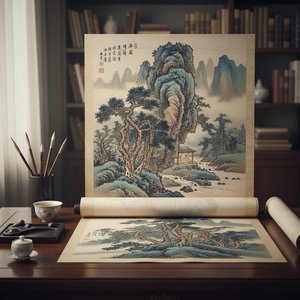
Liu Deliu’s artistic journey truly blossomed during the mid-19th century. He quickly established himself as a master of *shan shui* (mountain and water) painting, a genre deeply rooted in Chinese philosophy and aesthetics. Unlike earlier iterations of *shan shui*, which often prioritized dramatic, imposing landscapes, Liu favored a more serene and contemplative approach. His compositions typically feature gently rolling hills, meandering rivers, and sparse vegetation – elements arranged to evoke a sense of tranquility and harmony with nature. He wasn’t simply depicting scenery; he was conveying an emotional response to it, reflecting the Daoist ideals of balance and interconnectedness.
A pivotal work in understanding Liu Deliu's artistic development is his iconic “Squirrel and Grape” (松鼠葡萄), a folding fan painting executed in 1868. This piece exemplifies his signature style: a seemingly simple scene – a squirrel playfully reaching for a luscious grape – is rendered with remarkable detail and sensitivity. The composition is carefully balanced, utilizing subtle color variations to create depth and atmosphere. Notably, Liu’s inscription on the artwork references Lu Shouping (Lu Zhi), a Ming dynasty painter renowned for his depictions of flowers and birds. By imitating Lu Shouping's style, Liu demonstrates an awareness of artistic tradition while simultaneously forging his own unique voice. The painting is not merely a representation of nature; it’s a meditation on the relationship between man and the natural world, imbued with a quiet sense of wonder.
The Influence of Tradition and Innovation
Liu Deliu's artistic practice was deeply informed by the rich tradition of Chinese landscape painting. He skillfully absorbed techniques from his master, Xia Zhiding, including meticulous brushwork and an understanding of *qi* (vital energy) within the natural world. However, he wasn’t a mere imitator; Liu demonstrated a remarkable ability to synthesize traditional elements with innovative approaches. He frequently employed a limited palette – primarily consisting of ink washes in shades of black, gray, and brown – to create atmospheric effects and suggest subtle variations in texture and tone. This restrained use of color allowed the viewer's eye to focus on the intricate details of the composition.
Furthermore, Liu’s work reflects a growing interest in depicting human figures within landscapes. Unlike earlier *shan shui* paintings that largely excluded human subjects, Liu frequently included small figures – often scholars or farmers – engaged in quiet activities amidst the natural setting. These figures served not as focal points but rather as subtle reminders of humanity's place within the larger cosmos. This integration of human and landscape elements aligns with broader trends in Chinese art during this period, reflecting a shift towards greater realism and a more nuanced understanding of the relationship between humans and their environment.
Technique and Materials
Liu Deliu’s mastery lay not only in his compositional skills but also in his technical proficiency. He was particularly adept at utilizing ink wash techniques – a method that involves applying varying densities of black ink to create tonal variations and textures. He employed a range of brushstrokes, from delicate washes to bold, expressive marks, to convey the nuances of light, shadow, and surface quality. The use of *qiang* (a type of paper) was also crucial to his work, providing a textured surface that enhanced the visual impact of his paintings.
His choice of materials further contributed to the distinctive character of his art. He primarily used alum paper – a thin, absorbent paper treated with alum – which allowed for greater control over ink diffusion and facilitated the creation of subtle tonal gradations. The limited color palette—primarily consisting of black, brown, and muted greens—allowed him to focus on capturing the essence of the landscape through careful observation and skillful brushwork.
Legacy and Historical Significance
Liu Deliu’s work holds a significant place in the history of Chinese painting. He represents a bridge between traditional *shan shui* aesthetics and emerging artistic trends, demonstrating an ability to both honor the past and forge a new path for future generations of artists. His serene landscapes and evocative depictions of human figures continue to resonate with viewers today, offering a glimpse into the beauty and tranquility of the natural world.
His “Squirrel and Grape” remains one of his most celebrated works, exemplifying his signature style and artistic vision. The painting’s enduring appeal lies in its ability to evoke a sense of quiet contemplation and appreciation for the simple pleasures of life. Liu Deliu's legacy extends beyond individual artworks; he embodies a broader cultural sensibility – a deep respect for nature, a commitment to artistic tradition, and a profound understanding of the human condition.