A Vision of Korean Rural Landscape
Lee Jong-gu stands as a prominent figure in contemporary Korean painting, recognized for his masterful depictions of the serene beauty and enduring traditions of rural Korea. Born in Seosan, South Korea, in 1954, he embarked on an artistic journey shaped by a profound engagement with the cultural heritage of his homeland—a connection that deeply informs his distinctive style and technique. His formative years were marked by a dedication to scholarly pursuits at Chungang University in Seoul, followed by advanced studies at Inha University in Incheon, where he earned an M.F.A. in Arts Education. This rigorous academic grounding instilled within him a meticulous approach to observation and representation, providing the foundation for a career dedicated to capturing the essence of Korean folk life with unwavering commitment.The Artistry of Texture and Atmosphere
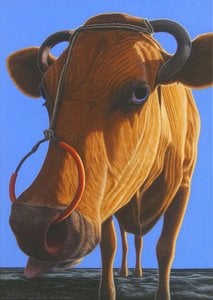
Lee Jong-gu’s artistic signature lies in his innovative use of acrylic paint combined with collage techniques, a dual approach that creates textured surfaces and layered visual narratives. Rather than mere imitation, he strives to convey the spirit and atmosphere of his subjects through a tactile medium. His technique allows for vibrant colors and luminous effects, while the introduction of collage elements—fragments of paper or fabric—enriches the overall composition with a sense of materiality and narrative depth. This method is perhaps most breathtakingly realized in his monumental painting Black Grassland (2008). Measuring an immense 1120 x 1620 cm, this work exemplifies his ability to use scale to capture not just visual details but the profound emotional resonance of the natural world. In this piece, the viewer is invited into a moment of profound stillness, encountering a large, horned cow whose steady gaze meets our own, creating an intimate tension between the grounded reality of the animal and the infinite, ethereal sky.Symbolism and the Echo of Tradition
Beyond the striking visual impact of his works, Lee Jong-gu’s paintings serve as poignant meditations on the changing landscape of Korean life. His imagery often draws upon deep-seated cultural symbols; for instance, the cow frequently appears in his work as a sentinel of tradition, representing strength, patience, and the foundational rhythms of an agricultural society facing rapid modernization. Through his lens, the pastoral scenes are not merely nostalgic retreats but visceral encounters with the enduring spirit of Korea. His work is subtly informed by the Suiboku ga style, reflecting a command over texture and atmosphere that bridges traditional ink wash sensibilities with modern acrylic application. In pieces like Black Grassland, the "black" of the grassland is more than a color; it is a mood—a deep, evocative tone suggesting the fertile, shadowed earth of his birthplace in Seosan.Legacy and Cultural Significance
The historical significance of Lee Jong-gu’s work lies in his ability to document a vanishing way of life with both intimacy and grandeur. As rural existence has faced the pressures of economic and social shifts, Lee’s paintings remain vital records of the Korean countryside's soul. His achievements are marked by his ability to elevate the humble subjects of agrarian life—cattle, bells, and quiet fields—into the realm of high contemporary art. By blending meticulous academic training with an experimental, textured approach, he has created a body of work that resonates both as a personal tribute to his roots and as a universal exploration of the relationship between humanity, memory, and the natural world. His contributions continue to inspire a deep appreciation for the quiet dignity found within the rhythmic, pastoral traditions of the Korean landscape.Întrebări și răspunsuri
În ce mișcări artistice a activat Lee, Jong Gu?
Pagina Toate mișcările de artă grupează operele lui Lee, Jong Gu pe mișcări artistice.
Pot vizita un muzeu virtual al lucrărilor lui Lee, Jong Gu?
Pagina Galerie 3D a lui Lee, Jong Gu prezintă operele de artă ale artistului într-o galerie virtuală tridimensională.
Unde pot vedea toate operele lui Lee, Jong Gu?
Toate lucrările lui Lee, Jong Gu de pe acest site web pot fi explorate în pagina Toate operele de artă a artistului.