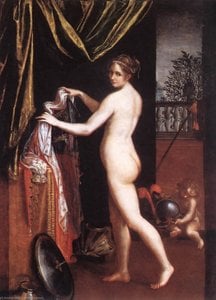
A Bolognese Trailblazer: The Life and Art of Lavinia Fontana
Lavinia Fontana, born in Bologna on August 24, 1552, stands as a monumental figure in the history of art—a Renaissance woman who defied societal expectations and carved an extraordinary path for herself within a field historically dominated by men. Her story isn’t simply one of artistic talent; it's a testament to resilience, determination, and a profound ability to challenge the constraints imposed upon women during her era. Born into a family deeply rooted in the art world—her father, Prospero Fontana, was a respected painter himself—Lavinia received an early education that laid the foundation for her remarkable career. This familial connection provided her with invaluable access to artistic knowledge and techniques, fostering a passion that would ultimately blossom into a legacy of innovation and influence.Early Influences and Artistic Training
Prospero Fontana’s workshop in Bologna served as Lavinia's initial classroom, where she honed her skills under his tutelage. Crucially, he recognized her innate talent—a gift that extended beyond mere imitation; it was an ability to imbue her paintings with a unique sensibility and emotional depth. Lavinia’s artistic journey wasn’t confined solely to her father’s guidance, however. Bologna at the time was a vibrant hub of artistic exchange, drawing in influences from across Italy and beyond. She had access to masterpieces by renowned masters like Raphael and Correggio—works that hung prominently in private collections and public spaces throughout the city. These encounters exposed her to the latest trends and techniques, shaping her evolving style and broadening her artistic horizons. The influence of Denis Calvaert’s school in Bologna was particularly significant, introducing her to a more dynamic and expressive approach to painting – a departure from the rigid formality often associated with the time. This exposure fostered an evolution within her work, incorporating elements of the Carracciesque style—characterized by its dramatic compositions and vibrant coloring—and a quasi-Venetian richness that added depth and luminosity to her paintings.The Portraiture Revolution: A New Role for Women
Lavinia’s artistic career gained momentum after she married Paolo Zappi d'Imola in 1577. This union, while providing her with stability and support, was also strategically significant—it allowed her to pursue her art more actively than might otherwise have been possible. Her husband, recognizing her talent, became her agent, managing her commissions and expanding her network of patrons. It was through portraiture that Lavinia truly established herself as a successful artist. She quickly gained renown for her ability to capture the personalities and status of her subjects—primarily wealthy noblewomen from Bologna’s upper class. These weren't merely likenesses; they were carefully constructed representations designed to celebrate wealth, beauty, and social standing. Lavinia possessed an exceptional eye for detail, meticulously rendering fabrics, jewelry, and hairstyles with remarkable accuracy – a skill that elevated her portraits beyond simple depictions of appearance. She skillfully captured not only the physical appearance but also the inner character of her sitters, forging unusually warm relationships with many of them. This intimate connection translated into paintings that felt remarkably alive—portraits imbued with personality and grace.Breaking Barriers: A Career Forged Against the Grain
Lavinia Fontana’s achievements extended far beyond her artistic skill; she was a true trailblazer, widely regarded as the first woman artist to operate independently within the established art world—outside the confines of a court or convent. This was an extraordinary feat in an era when women were largely excluded from professional life. Her success wasn't simply about talent; it was also about shrewd business acumen and the support of her husband, Paolo Zappi, who served as her agent and managed their growing family—they had eleven children together. The marriage agreement itself was unconventional, acknowledging Lavinia’s earning potential and negating the need for a traditional dowry. Her rising reputation eventually attracted the attention of powerful patrons, including Pope Gregory XIII and his family, leading to commissions for portraits of prominent individuals. This patronage propelled her career to new heights, culminating in her move to Rome in 1604 where she became a sought-after portraitist at the papal court. In 1611, she received further recognition with a bronze portrait medallion cast by Felice Antonio Casoni, and was elected into the Accademia di San Luca—an honor rarely bestowed upon women artists of the time.A Legacy of Innovation and Inspiration
Lavinia Fontana’s impact on the art world is profound and enduring. Her work represents not only a remarkable artistic achievement but also a pivotal moment in the history of women's roles in art. She demonstrated that women could achieve professional success as independent artists, challenging prevailing societal norms and paving the way for future generations. While debates continue among art historians regarding whether she was truly among the first women to paint nudes—as evidenced in works like “Judith with the Head of Holofernes” (1600)—her willingness to explore a wider range of subjects, including mythological and religious themes, further solidified her position as a versatile and innovative artist. Her ability to balance a thriving artistic career with the demands of motherhood—raising eleven children while maintaining a rigorous painting schedule—is a testament to her resilience, dedication, and unwavering commitment to her craft. Lavinia Fontana’s legacy extends beyond her paintings; she remains an icon of female empowerment in the art world – a reminder that talent knows no gender and that perseverance can overcome even the most formidable obstacles.Întrebări și răspunsuri
Există o cronologie a operelor lui Lavinia Fontana?
Operele lui Lavinia Fontana pot fi vizualizate în ordine cronologică pe pagina Cronologia operelor de artă a artistului.
În ce perioadă istorică a activat Lavinia Fontana?
Lavinia Fontana a activat în perioada Renașterea. Această perioadă situează activitatea artistului în istorie.
Există o listă completă a operelor lui Lavinia Fontana?
Toate lucrările lui Lavinia Fontana de pe acest site pot fi vizualizate în pagina Toate operele de artă a artistului.