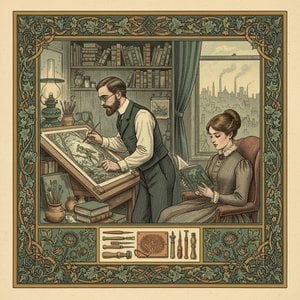
Keith Henderson (1883–1982): A Scottish Visionary Bridging War and Landscape
Keith Henderson OBE RP RSW RWS ROI was a prolific Scottish painter who carved out a remarkable career spanning both the formative years of the 20th century and its tumultuous conflicts. Born in Scotland, specifically Aberdeenshire, in 1883, he descended from a family steeped in legal tradition – his father, George Macdonald Henderson, practiced law at Lincoln’s Inn—a lineage that instilled in him a disciplined intellect alongside an innate artistic sensibility. Alongside his formal education at Orme Square School and Marlborough College, Henderson pursued his passion for art rigorously at Slade School of Art before furthering his studies at the Académie de la Grande Chaumière in Paris, where he fostered a collaborative relationship with fellow artist Maxwell Armfield. This Parisian immersion proved pivotal, shaping his artistic vision and establishing him within a vibrant artistic milieu. Henderson’s artistic journey began with an early fascination for landscape painting, capturing the rugged beauty of Scotland's Highlands with meticulous detail and atmospheric perspective. Initially influenced by Romanticism, he sought to convey emotion through dramatic compositions and expressive brushstrokes—a stylistic approach that would characterize much of his oeuvre. His dedication to realism was tempered by a subtle exploration of tonal harmonies, reflecting his belief in the power of color to evoke psychological responses. Early works showcased Henderson’s mastery of watercolor techniques, capturing fleeting moments of Highland light and shadow with remarkable accuracy. However, his career took an unexpected turn during World War I when he enlisted as a captain with the Royal Wiltshire Yeomanry on the Western Front. Driven by a profound desire to document the realities of war—a courageous undertaking that resonated deeply within him—Henderson produced several paintings depicting the trenches. These images weren’t merely representations of physical space; they were attempts to grapple with the psychological trauma experienced by soldiers, conveying a palpable sense of anxiety and vulnerability. The resulting memoir “Letters to Helen: Impressions of an Artist on the Western Front,” published in 1917, served not only as a personal chronicle but also as a powerful artistic statement reflecting the artist’s unwavering commitment to portraying truthfulness—a principle that underpinned his entire artistic practice. His marriage to Helen Knox-Shaw in 1917 provided him with enduring support throughout his creative endeavors and fueled his desire to capture human experience with sensitivity and nuance. Between the wars, Henderson embarked on extensive travels across Africa and South America, enriching his artistic repertoire with observations of exotic flora and fauna. These experiences profoundly influenced his subsequent work, particularly his book illustrations—most notably collaborations with W. H. Hudson and Eric Rücker Eddison, including “The Worm Ouroboros,” and alongside Norman Wilkinson, an edition of Geoffrey Chaucer’s “The Canterbury Tales.” He meticulously documented landscapes and cultures, translating his observations into vibrant watercolor paintings that celebrated the diversity of human experience. His artistic versatility extended to poster design, where he created striking visuals for London Transport and the Empire Marketing Board—a commission that sent him to Cyprus for over a year to capture the essence of the island landscape. Henderson’s exhibitions at the Royal Academy and a solo show featuring Cypriot paintings at Bruton Place cemented his reputation as a respected artist and solidified his contribution to British art history. Henderson's artistic style evolved throughout his life, embracing abstraction alongside realism. He achieved particular renown for his geometric depictions of Cyprus mountains and villages—a stylistic choice that reflected his interest in exploring visual harmony and conveying emotion through simplified forms. His enduring legacy resides not only in his celebrated paintings but also in his unwavering dedication to capturing the spirit of his time—from the horrors of war to the wonders of the natural world—leaving behind a body of work that continues to inspire admiration and scholarly study. He was awarded an OBE for his reconnaissance during the war, recognizing his contribution to national defense and furthering his artistic pursuits. His final years were spent in London, where he continued to paint until his death in 1982, leaving behind a remarkable testament to a life devoted to art and observation.Întrebări și răspunsuri
Există o listă completă a operelor lui Keith Henderson?
Toate lucrările lui Keith Henderson de pe acest site web pot fi explorate în pagina Toate operele de artă a artistului.
Pot să explorez lucrările lui Keith Henderson în funcție de tehnică?
Operele lui Keith Henderson pot fi explorate pe baza mediului utilizat în pagina de Toate tehnicile a artistului.
Există un tur virtual 3D al operelor lui Keith Henderson?
Pagina Galerie 3D a lui Keith Henderson prezintă operele de artă ale artistului într-o galerie virtuală tridimensională.