A Life Immersed in Light and Landscape
Karel Dujardin, a name resonating softly within the pantheon of Dutch Golden Age masters, was born in Amsterdam in 1626 – though some records suggest 1622. His life unfolded during a period of unprecedented artistic flourishing in the Netherlands, yet his path wasn’t one of immediate acclaim but rather a gradual unfolding of talent nurtured by careful study and extensive travel. Details surrounding his early years remain somewhat elusive, shrouded in the mists of time, however it is widely accepted that he received foundational training under Nicolaes Berchem, a painter celebrated for his idyllic landscapes populated with animals. This mentorship proved pivotal, instilling in Dujardin a deep appreciation for naturalism and a keen eye for capturing the subtle nuances of light and atmosphere. He diligently absorbed Berchem’s techniques—particularly his masterful use of atmospheric perspective—which would become hallmarks of Dujardin's own artistic style.The Bentvueghels and Roman Influences
But Dujardin’s artistic journey wasn’t confined to the studios of Amsterdam; he possessed an adventurous spirit that led him to Rome, where he became a member of the *Bentvueghels*, a society of predominantly Dutch and Flemish painters who embraced a bohemian lifestyle and often adopted satirical nicknames. In Rome, he was known as “Barba di Becco” or "Goat-Beard," a moniker likely referencing his distinctive facial hair, and it was here that his artistic voice truly began to mature. The Bentvueghels fostered an environment of intellectual curiosity and playful experimentation, encouraging Dujardin to push boundaries and challenge conventions. This Roman experience profoundly impacted his artistic sensibilities, exposing him to the grandeur of Italian architecture and the vibrancy of its cultural landscape—influences that would subtly permeate his later works. He embraced the society’s penchant for caricature and theatrical presentation, honing his skills in capturing expressive gestures and conveying emotion with remarkable accuracy.Painting Landscapes with Soul
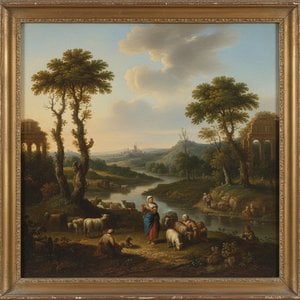
Dujardin's artistic style is characterized by meticulous detail and a remarkable ability to depict scenes of everyday life – rural landscapes brimming with animals, peasants engaged in their daily routines, and tranquil pastoral settings. He possessed an exceptional talent for capturing the play of light and shadow, imbuing his canvases with a sense of warmth and realism. Unlike many artists of his time who focused on grand historical narratives or idealized portraits, Dujardin prioritized observation—capturing the beauty of the natural world and portraying human figures with compassion and dignity. His landscapes are not merely decorative; they are imbued with psychological depth, conveying moods and emotions as effectively as any portrait. Consider Farm Animals in the Shade of a Tree – the artist’s careful rendering of light filtering through foliage creates an atmosphere of serenity and invites contemplation. He achieved this remarkable feat by meticulously studying the effects of weather conditions on color and texture—a testament to his dedication to artistic craftmanship.Notable Works and Artistic Legacy
Among Dujardin's most celebrated paintings are Woman Milking a Red Cow, which exemplifies his masterful depiction of rural life; *Rest at an Italian Inn*, showcasing the influence of Roman landscapes; and The Regents of the Spinhuis and Nieuwe Werkhuis, Amsterdam—a group portrait demonstrating his skill in capturing individual likenesses within a larger composition. These works stand as enduring symbols of the Dutch Golden Age’s artistic achievements—testaments to Dujardin's unwavering commitment to realism and his ability to convey profound emotion through visual imagery. His influence can be seen in subsequent generations of artists who sought to emulate his technique and capture the essence of the natural world. Karel Dujardin remains a pivotal figure in Dutch art history, embodying the spirit of observation, craftsmanship, and artistic sensitivity—a legacy that continues to inspire admiration and scholarly study today. He solidified his place as one of the most important landscape painters of his era, securing his reputation for capturing light and emotion with unparalleled precision.Întrebări și răspunsuri
De unde este Karel Dujardin?
Karel Dujardin s-a născut în Țările de Jos.
Pot vizita un muzeu virtual al lucrărilor lui Karel Dujardin?
O vizită virtuală este disponibilă: pagina Galerie 3D lui Karel Dujardin prezintă lucrările artistului într-o galerie tridimensională.
Pot studia utilizarea culorii de către Karel Dujardin în toate lucrările sale?
Genoma Paletei lui Karel Dujardin este o pagină care prezintă profilul cromatic al întregii creații a artistului.