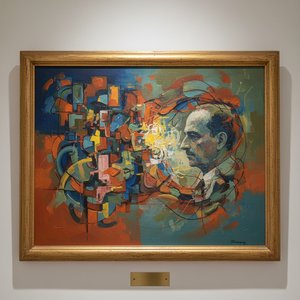
Jorge Oteiza: Life and Legacy
Early Life and Education
- Born: Jorge de Oteiza Embil on October 21, 1908, in Orio, Gipuzkoa, Spain.
- Oteiza’s early life was marked by a strong connection to his Basque heritage and the surrounding landscape. This would profoundly influence his artistic vision.
- He initially pursued studies in architecture but soon gravitated towards sculpture and painting.
Years in South America (1935-1948)
- Exile and Artistic Development: In 1935, anticipating the Spanish Civil War, Oteiza moved to Buenos Aires, Argentina. This period was crucial for his artistic development.
- He experimented with various materials and techniques, moving away from traditional representational sculpture towards more abstract forms.
- His time in South America allowed him to develop a unique artistic voice, free from the constraints of European academic traditions.
Return to Spain and Artistic Maturity (1948-1975)
- Post-War Spain: Oteiza returned to Spain in 1948, a country still recovering from the Civil War and under Franco’s dictatorship.
- He became a leading figure in the Spanish avant-garde movement, challenging artistic norms and exploring new forms of expression.
- ‘Quosque tandem!’ (1963): This seminal essay articulated Oteiza’s aesthetic philosophy, rooted in Basque prehistoric art and anthropology. It explored the “soul” of the Basque people through their artistic heritage.
- He co-founded the artistic group Gaur in 1966, dedicated to promoting modern Basque art and culture.
Artistic Style and Influences
- Abstract Sculpture: Oteiza is best known for his abstract sculptures, often constructed from wood, stone, or steel. These works are characterized by their minimalist forms, geometric shapes, and empty spaces.
- Influences: His work draws inspiration from Basque mythology, prehistoric art, Constructivism, and the work of artists like Constantin Brâncuși and Henry Moore.
- He often employed a technique of “emptying” forms, creating sculptures that suggest both presence and absence. This reflects his philosophical interest in the relationship between being and nothingness.
Major Achievements and Recognition
- International Acclaim: Oteiza’s work gained international recognition through exhibitions in São Paulo, Paris, and London.
- He received numerous awards throughout his career, including the Prince of Asturias Prize for the Arts (1988) and the Gold Medal for Fine Arts (Spain).
- The Oteiza Museum: Following his death in 2003, a museum dedicated to his work was opened in Alzuza, Navarre, fulfilling his wish to create a space for preserving and studying his artistic legacy.
Historical Significance
- Pioneer of Basque Modern Art: Oteiza is considered one of the most important figures in 20th-century Spanish art, particularly for his role in defining a modern Basque artistic identity.
- His work challenged traditional notions of sculpture and explored profound philosophical themes.
- He left behind a vast body of work that continues to inspire artists and scholars today.
Întrebări și răspunsuri
Ce pseudonime sau alte nume este cunoscut Jorge Oteiza Enbil?
Jorge Oteiza Enbil este cunoscut și sub numele de Jorge Oteiza.
Cum pot găsi lucrările lui Jorge Oteiza Enbil pe o temă specifică?
Pentru a găsi lucrări realizate de Jorge Oteiza Enbil pe o temă specifică, utilizați pagina După cuvinte cheie a artistului, care grupează operele de artă pe cuvinte cheie.
De unde este Jorge Oteiza Enbil?
Jorge Oteiza Enbil s-a născut în Spain.