Mutter mit Heiligem Buch Diamantener Perlenkette von Colonel Kurtz (verso)
Dr. Seefang's Quizz
Mai multe…
Museums on APS: Albertina Klosterneuburg
Art period: Contemporary
Works on APS: 7
Nationality: Japan
A Provocative Journey: The Life and Art of Jonathan Meese
Born in Tokyo in 1970 to a German father and Welsh mother, Jonathan Meese’s artistic trajectory has been anything but conventional. His early life was marked by cultural displacement; returning to Germany as a child who spoke only English created an initial barrier, a sense of otherness that perhaps subtly informed his later willingness to challenge norms and provoke reaction. This peripatetic beginning – including time spent in Scotland – fostered a unique perspective, one unburdened by rigid adherence to tradition. Though initially encouraged towards economics by family, Meese’s path irrevocably shifted toward art, a decision that would ultimately position him as one of contemporary Germany's most controversial and compelling figures. The untimely death of his father while living in Japan cast a long shadow, adding another layer of complexity to the artist’s formative years.
Formative Years and Artistic Development
Meese’s formal artistic education began at the University of Fine Arts in Hamburg during the mid-1990s. He studied under an impressive roster of influential artists, including Franz Erhard Walther, Daniel Richter, Martin Kippenberger, Horst Janssen, Vicco von Bülow (the celebrated Loriot), and Otto Waalkes. However, despite this exposure to established masters, Meese ultimately left the university without a degree, suggesting a restless spirit unwilling to be confined by academic structures. A pivotal moment arrived when Daniel Richter recommended him to Contemporary Fine Arts gallery in Berlin – a connection that proved instrumental in launching his career. Early exhibitions, such as his participation in a group show at Frankfurter Kunstverein and his first solo exhibition, “Glockengeschrei nach Deutz” at Galerie Buchholz in Cologne, began to establish his presence on the art scene. It was during this period that Meese’s distinctive style – raw, expressive, and often unsettling – started to coalesce. His involvement with the film *Sonnenallee* (1999), where he designed backdrops and even took on an acting role as a “crazy artist,” further broadened his creative horizons and public profile.
Themes, Style, and Provocations
Jonathan Meese’s work is characterized by its multimedia approach, seamlessly blending painting, sculpture, collage, drawing, writing, performance art, and installation. Recurring motifs populate his oeuvre: historical figures, primordial myths, and heroic archetypes are frequently revisited, often presented in a deliberately provocative manner. He doesn't shy away from controversial subjects; indeed, he actively seeks them out. Perhaps most famously, Meese’s performances have directly addressed the figure of Adolf Hitler, sometimes employing the Nazi salute – an act intended not as endorsement but as a deliberate provocation designed to spark debate and challenge societal taboos. This willingness to confront uncomfortable truths has made him a polarizing figure, attracting both fervent admirers and harsh criticism. Self-portraiture and the adoption of disguised personas are also central to his artistic practice, blurring the boundaries between artist and subject, reality and representation. Stylistically, Meese’s work is deeply rooted in Neo-Expressionism, characterized by thick impasto, swirling patterns, and a chaotic visual language that reflects the turbulent emotions and complex ideas he explores.
Recognition and Lasting Impact
Meese's breakthrough moment arrived with his installation “Ahoi der Angst” at the Berlin Biennale in 1998. This ambitious work – a collage of images featuring politicians, actors, musicians, alongside music, poetry, and video art – immediately established him as a force to be reckoned with. The piece was both lauded for its audacity and criticized for its unsettling imagery. Since then, Meese has exhibited extensively internationally, including at Stuart Shave/Modern Art in London, Galerie Daniel Templon in Paris, and Centro Cultural Andratx in Mallorca. A major solo exhibition at the Museum of Contemporary Art (MOCA) North Miami in 2014 showcased the breadth of his artistic output, encompassing paintings, installations, performances, and sculptures. His collaborative spirit is also evident in projects like “Fräulein Atlantis,” created with composer Karlheinz Essl and shown at the Essl Museum in Vienna/Klosterneuburg. Jonathan Meese remains a vital and challenging voice in contemporary art, pushing boundaries and forcing viewers to confront uncomfortable truths about history, power, and identity. His work is not easily categorized or dismissed; it demands attention, provokes thought, and leaves an indelible impression on all who encounter it. He continues to live and work between Ahrensburg and Berlin, relentlessly pursuing his artistic vision.
De către echipa editorială WahooArt.com
Chestionar de artă
Fiecare întrebare are un singur răspuns corect.
Întrebare 1:
Where was Jonathan Meese born?
Întrebare 2:
Which university did Jonathan Meese attend, though he left without a degree?
Întrebare 3:
What is a recurring theme in Jonathan Meese's work, often presented provocatively?
Întrebare 4:
In what film did Jonathan Meese design backdrops and play a role?
Întrebare 5:
What artistic style is often used to describe Jonathan Meese's work?
Delve into the visceral world of German Expressionism. Explore the history, key artists like Kirchner and Kandinsky, and the movement's profound emotional impact through an expert art-history lens. Discover how bold colors and distortion redefined modern aesthetics.
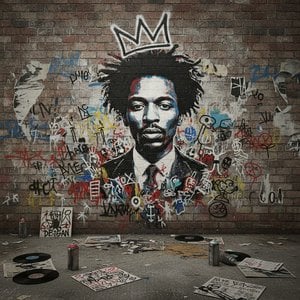
Explore the raw energy of Jean-Michel Basquiat and Neo-Expressionism. Discover how urban rebellion redefined modern art through a lens of luxury, identity, and profound emotional intensity for the discerning collector.
Explore the raw emotion of German Expressionism through a definitive guide to Ernst Ludwig Kirchner. Discover how his bold colors and distorted forms redefined modern art history, from Berlin street scenes to iconic masterpieces.