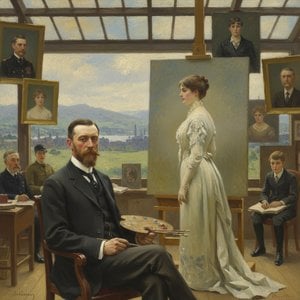
John Thomas Hamilton Macallum: A Highland Visionist
Born in the rugged landscapes of Argyllshire, Scotland, in 1841, John Thomas Hamilton Macallum’s life and art were inextricably linked to the dramatic beauty of his native Highlands. His early life, dictated by his father's ambition for an Indian commercial career, initially steered him towards a conventional path, but a burgeoning passion for painting ultimately led him to London in 1864, where he enrolled at the Royal Academy schools and began to forge his distinctive artistic identity. Macallum’s journey wasn’t one of grand salons or established academic circles; it was a deeply personal exploration of the natural world, particularly the wild, windswept coasts and dramatic mountain ranges of Scotland and beyond.
Macallum's artistic development can be understood as a gradual refinement of his observational skills and an increasing confidence in capturing the essence of light and atmosphere. Initially influenced by the luminist movement prevalent in America, he quickly moved beyond mere representation to imbue his canvases with a palpable sense of drama and emotion. His early works, often depicting scenes from the Scottish Highlands – lochs shrouded in mist, rugged mountains battered by storms, and solitary crofters battling the elements – demonstrate a remarkable ability to convey both the physical grandeur and the psychological intensity of these landscapes. He wasn’t simply painting what he saw; he was translating the spirit of the Highlands onto canvas.
The Coastal Explorer: Scenes from Devon, Heligoland, and Beyond
As his career progressed, Macallum expanded his subject matter beyond Scotland, embarking on extensive voyages that exposed him to a diverse range of coastal environments. He spent considerable time in Devon, capturing the dramatic cliffs and crashing waves of the south coast, while his travels to Heligoland and the Netherlands provided him with opportunities to paint harbors teeming with activity – bustling fishing fleets returning laden with their catch, the intricate details of shipbuilding yards, and the vibrant energy of port life. These voyages weren’t merely excursions; they were crucial periods of artistic growth, allowing him to hone his technique and develop a broader understanding of light, color, and composition.
His depictions of fishing scenes are particularly noteworthy. Macallum possessed an extraordinary ability to capture the movement of water and the energy of the fishermen themselves. “Beer Trawlers Going out to Sea,” for example, is not just a depiction of boats on the water; it’s a dynamic portrayal of human endeavor against the backdrop of a turbulent sea. The brushstrokes are loose and expressive, conveying both the power of nature and the resilience of those who dared to challenge it. Similarly, “The Return of the Lance Fishers, Heligoland” showcases his mastery of capturing fleeting moments – the anticipation on the faces of the fishermen as they await their catch, the spray of seawater against the hulls of the boats, and the dramatic interplay of light and shadow.
A Highland Palette: Color, Light, and Technique
Macallum’s distinctive style is characterized by a bold use of color and an innovative approach to capturing atmospheric effects. He favored a palette dominated by blues, greens, and greys – colors that perfectly reflected the mood and character of the landscapes he depicted. However, he wasn't afraid to introduce vibrant accents of red, yellow, and orange to create visual drama and highlight key elements within his compositions. His technique involved layering thin washes of paint to build up color gradually, creating a sense of depth and luminosity that was remarkably effective in conveying the atmospheric conditions of his chosen subjects.
He employed a loose, expressive brushstroke – a hallmark of Impressionism – which allowed him to capture the fleeting effects of light and shadow. Rather than meticulously rendering every detail, he focused on capturing the *feeling* of a place, imbuing his paintings with an emotional resonance that transcended mere representation. This approach is particularly evident in his depictions of Highland weather – swirling mists, driving rain, and dramatic sunsets – which are rendered with a remarkable sense of immediacy and intensity.
Legacy and Recognition
John Thomas Hamilton Macallum’s career spanned over three decades, during which he exhibited extensively at the Royal Academy and other prestigious galleries. While he never achieved widespread fame during his lifetime, his work is now recognized as a significant contribution to British landscape painting. His evocative depictions of the Scottish Highlands and coastal scenes continue to resonate with viewers today, offering a glimpse into a bygone era and a profound appreciation for the beauty and power of the natural world. His paintings are held in several prominent collections, including those of the Tate Gallery and the National Galleries of Scotland, ensuring that his artistic legacy will endure for generations to come.
Further research can be found on websites such as Art UK (https://artuk.org/discover/artists/macallum-john-thomas-hamilton-18411896) and Wikipedia (https://en.wikipedia.org/wiki/Hamilton_Macallum).