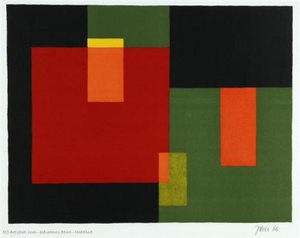
Johannes Itten: A Pioneer of Color and Form
Johannes Itten, born in Suedern Linden, Switzerland (1888), stands as a pivotal figure in the history of modern art education—a visionary who fundamentally altered how artists approached their craft. His artistic journey began with an early fascination for painting, fueled by influences from Eugène Gilliard and Adolf Hölzel, whose explorations into abstract forms profoundly shaped his aesthetic sensibilities. He embraced Hölzel’s conviction that lines, planes, circles, and spirals constituted the bedrock of visual perception, preparing him for his groundbreaking theoretical work on color and form.Early Influences and Pedagogical Beginnings
Itten's formative years were marked by a deep engagement with Friedrich Fröbel’s kindergarten philosophy—a belief in fostering intuitive development through play and sensory experience. This conviction would permeate his teaching methodology throughout his career, prioritizing experimentation over formal instruction. Recognizing the limitations of traditional art academies, he briefly pursued training at Geneva’s École des Beaux-Arts but swiftly abandoned it, returning to Bern where studies with Ernst Schneider solidified his commitment to collaborative critique and nurturing creative impulses—a radical stance that mirrored Schneider's own pedagogical approach. These experiences instilled in him a profound understanding of the learning process and cemented his conviction that artistic creativity flourished when liberated from restrictive conventions.The Bauhaus Revolution: Shaping Artistic Education
Itten’s arrival at Walter Gropius’ newly established Bauhaus in Weimar in 1919 irrevocably transformed his life and career, propelling him to the forefront of art education innovation. Appointed as a Master alongside Lyonel Feininger and Gerhard Marcks, he was tasked with devising a foundational course—the *Vorkurs*, or preliminary course—that would become legendary. This wasn’t merely an introductory class; it was a complete reimagining of artistic training. Itten championed the idea that artists should begin by stripping away preconceived notions and exploring the fundamental properties of materials, composition, and, crucially, color. He theorized seven distinct types of color contrast – hue, value, temperature, complements (neutralization), simultaneous contrast, saturation, and extension—and devised exercises designed to unlock an intuitive grasp of these principles. His “color sphere,” encompassing twelve foundational colors, became a cornerstone of Bauhaus curriculum. Furthermore, Itten insisted on gymnastic exercises, believing physical relaxation was essential for stimulating creativity and fostering self-expression.Theoretical Contributions and Artistic Legacy
Itten’s theoretical explorations extended beyond color theory; he investigated the psychological impact of artistic mediums and techniques on human perception. His meticulous research into Mazdaznan—a Zoroastrian fire cult—influenced his spiritual worldview and informed his artistic practice, emphasizing harmony between mind and body. He established a small art school in Berlin in 1926 alongside Ernst Neufert, continuing to disseminate his innovative pedagogical methods. Itten’s influence resonated deeply with the work of Op Art pioneers like Josef Albers, Max Bill, and Bridget Riley—artists who harnessed visual illusions to create mesmerizing canvases that captivated audiences worldwide. His legacy persists today as a testament to the transformative power of holistic learning and the enduring significance of color in artistic expression. Johannes Itten’s contribution to art education remains unparalleled, inspiring generations of artists to embrace experimentation and unlock their creative potential.Întrebări și răspunsuri
Din ce epocă face parte Johannes Itten?
Johannes Itten a activat în perioada Era modernă. Această perioadă situează activitatea artistului în context istoric.
În ce oraș și țară s-a născut Johannes Itten?
Johannes Itten s-a născut în Suedern Linden, în Elveția.
Pot să explorez lucrările lui Johannes Itten în funcție de tehnică?
Pentru a găsi toate lucrările lui Johannes Itten dintr-un anumit mediu, accesați pagina Toate tehnicile a artistului.