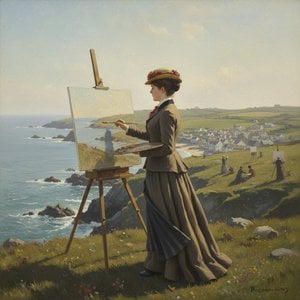
A Philadelphia Childhood & Artistic Awakening
Jessie Willcox Smith, born in the vibrant city of Philadelphia in 1863, emerged as a pivotal figure during the Golden Age of American Illustration. Her story begins not within an artist’s studio, but amidst the conventional expectations placed upon young women of her era. The daughter of Charles Henry Smith, a broker of investments, and Katherine Dewitt Willcox Smith, Jessie initially pursued a path toward becoming a teacher, attending private elementary schools before continuing her education in Cincinnati. However, this pragmatic direction soon gave way to a burgeoning artistic talent that could no longer be contained. A pivotal moment arrived when she discovered her innate skill for sketching, encouraged by an artist friend during her time in Ohio. This realization prompted a return to Philadelphia and formal training at the Philadelphia School of Design for Women, followed by rigorous study at the Pennsylvania Academy of the Fine Arts (PAFA) under the tutelage of Thomas Eakins and Thomas Anshutz. It was at PAFA that Smith began incorporating photography into her artistic process—a forward-thinking technique for an illustrator seeking accuracy and realism in her work. The use of photographs allowed her to meticulously capture details and create a sense of depth, adding a layer of authenticity to her illustrations.The Red Rose Girls & A Blossoming Career
Smith’s artistic journey took a defining turn when she joined the class of Howard Pyle at Drexel University. Pyle, a celebrated illustrator himself, profoundly shaped Smith's style and instilled within her a commitment to professional illustration. It was here that she forged an extraordinary bond with fellow artists Elizabeth Shippen Green and Violet Oakley, forming a collective known as “The Red Rose Girls.” This remarkable trio shared not only artistic sensibilities but also a unique living arrangement, establishing a studio and residence at the idyllic Red Rose Inn in Villanova, Pennsylvania, where they lived and collaborated for four years. The atmosphere fostered within those walls was one of mutual inspiration and creative exchange, allowing each artist to flourish while contributing to a distinctive aesthetic that would come to define their work. Smith’s early career saw her illustrating for popular magazines like *St. Nicholas*, gaining valuable experience before securing an entry-level position at the influential *Ladies’ Home Journal*. This role provided exposure to the world of advertising art and honed her skills in visual communication. The Red Rose Inn became a sanctuary where these talented women could freely explore their artistic visions, free from the constraints often imposed upon female artists during that era.Illustrating a Golden Age: Style & Subject Matter
Jessie Willcox Smith quickly distinguished herself through her sentimental and deeply evocative depictions of childhood, family life, and idyllic scenes. Her style was characterized by soft, harmonious colors, delicate details, and an exceptional ability to capture fleeting emotional moments. She possessed a remarkable gift for portraying the innocence and wonder of youth, often focusing on intimate interactions between children and their mothers. This focus resonated profoundly with audiences during a period marked by nostalgia and a yearning for traditional values. Smith’s illustrations weren't merely decorative; they were narratives imbued with warmth, tenderness, and a subtle psychological depth. She skillfully blended realism with a touch of romanticism, creating images that felt both familiar and enchanting. Her work graced the pages of prominent magazines such as *Century*, *Collier’s*, *Leslie’s Weekly*, *Harper’s*, *McClure’s*, and *Scribner’s*, bringing her art to a wide readership. Perhaps most notably, she became synonymous with *Good Housekeeping* magazine, creating all of the covers from December 1917 to 1933—a remarkable feat that included her beloved “Mother Goose” series. Iconic illustrations like “The Lily Pool,” “Mrs. Bedonebyasyoudid”, and “The Land of Counterpane” remain instantly recognizable symbols of a bygone era.Influences & Techniques
Smith’s artistic development was shaped by several key influences. Thomas Eakins, her mentor at PAFA, instilled in her a rigorous approach to drawing and composition, emphasizing anatomical accuracy and realistic portrayal. Howard Pyle's instruction at Drexel University fostered her storytelling abilities and encouraged her to capture the essence of human emotion through visual narrative. Furthermore, Smith’s use of photography was revolutionary for an illustrator of her time. She meticulously studied photographs to ensure accurate details in her illustrations, particularly when depicting children or complex scenes. This technique allowed her to create a sense of depth and realism that elevated her work beyond simple decorative images. The influence of the Red Rose Girls—Green, Oakley, and Smith—also played a significant role, as they shared ideas, techniques, and a commitment to artistic excellence. Their collaborative spirit fostered a dynamic creative environment where each artist could push their boundaries and develop their unique style.Legacy & Enduring Influence
Jessie Willcox Smith’s contributions to American art extend far beyond her technical skill and aesthetic appeal. She is rightfully regarded as one of the greatest illustrators of the Golden Age, a period celebrated for its artistic innovation and narrative power. Her success also served as an inspiration and paved the way for other women artists navigating a male-dominated field. Smith’s sentimental and idealized depictions of family life had a lasting impact on American culture, shaping perceptions of childhood and domesticity for generations to come. She illustrated numerous classic books, including *Little Women* by Louisa May Alcott, *Evangeline* by Henry Wadsworth Longfellow, and *A Child's Garden of Verses* by Robert Louis Stevenson—works that continue to be cherished today. Even as health challenges arose later in life, including back problems, Smith remained dedicated to her craft, maintaining a high level of quality and popularity until her death in 1935. Her legacy endures not only through the beauty and emotional resonance of her artwork but also as a testament to the power of artistic vision and the enduring appeal of heartfelt storytelling. *She was truly a master of capturing the essence of childhood, leaving behind a body of work that continues to inspire and delight audiences worldwide.*Întrebări și răspunsuri
De unde este Jessie Willcox Smith?
Jessie Willcox Smith s-a născut în Statele Unite ale Americii.
În ce oraș și țară s-a născut Jessie Willcox Smith?
Jessie Willcox Smith s-a născut în Philadelphia, în Statele Unite ale Americii.
Unde pot vedea operele lui Jessie Willcox Smith în ordine cronologică?
Operele lui Jessie Willcox Smith pot fi vizualizate în ordine cronologică pe pagina Cronologia operelor de artă a artistului.