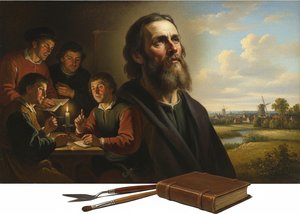
Joannes Echarius Carolus Alberti (1777 – Present)
Joannes Echarius Carolus Alberti, often referred to as Jean Eugène Charles Alberti, was a Dutch-Italian painter who established himself as a prominent figure in Parisian artistic circles during the early 19th century. Born in Rotterdam in 1777, his lineage blended Dutch pragmatism with Italian artistic heritage – a combination that profoundly shaped his creative vision. He continued to live until his death, leaving behind a legacy of impactful artwork and scholarly study.
Early Life and Training
Alberti’s formative years were spent absorbing the artistic traditions of both Rotterdam and Naples. He received instruction from Johann Friedrich Ludwig Försterling, a German painter who championed neoclassical ideals, fostering an appreciation for classical forms and harmonious compositions. This grounding in Fürsterling's teachings would prove instrumental in defining his stylistic trajectory. Försterling instilled within Alberti a deep respect for proportion and balance—principles that underpinned his artistic endeavors throughout his career. He diligently studied the works of Michelangelo and Raphael, meticulously analyzing their techniques to refine his own approach to painting.
Parisian Career
Alberti’s relocation to Paris around 1803 marked the beginning of a prolific artistic career. He quickly gained recognition for his depictions of warriors, particularly those inspired by Homeric epics and Roman history. His canvases captured heroic figures in dynamic poses, conveying strength and nobility with meticulous attention to anatomical detail – characteristics that resonated deeply with the aesthetic sensibilities of the era. Alberti’s Parisian studio became a hub for artistic discourse and collaboration, attracting fellow artists eager to engage in discussions about style and technique. He was particularly celebrated for his monumental canvases depicting scenes from classical mythology and history, demonstrating an unparalleled command of chiaroscuro—the dramatic interplay of light and shadow—to heighten emotional impact and imbue his subjects with palpable energy. Marius among the Ruins of Carthage (1805) secured him a gold medal at the Salon of Paris, cementing his reputation as one of the foremost neoclassical painters of his time.
Notable Works
Alberti’s artistic output included celebrated pieces like “Proculeius Preventing Cleopatra from Stabbing herself” (1810) and “Warrior with Lance and Shield” (1808). These paintings exemplify his mastery of neoclassical technique, utilizing chiaroscuro—the dramatic interplay of light and shadow—to heighten emotional impact and imbue his subjects with palpable energy. The meticulous rendering of musculature and drapery demonstrates a dedication to realism that distinguishes him from more sentimental Romantic artists. Alberti’s unwavering commitment to anatomical accuracy ensured that his figures possessed an undeniable sense of physicality, mirroring the sculptural ideals championed by Antonio Canova—a connection that profoundly influenced his artistic vision. His canvases stand as testaments to the enduring power of classical art to inspire awe and contemplation.
Influences
Alberti’s artistic sensibilities were undeniably influenced by the monumental sculptures of Antonio Canova, whose idealized figures served as models for Alberti's own compositions. Furthermore, he drew inspiration from classical literature and mythology, translating epic narratives into visually compelling paintings that celebrated human virtue and courage. He meticulously studied the works of Guido Reni and Anthony van Dyck, absorbing their stylistic nuances and mastering their techniques—a testament to his intellectual curiosity and artistic diligence. Alberti’s dedication to preserving the grandeur and beauty of classical art ensured that his oeuvre remained firmly rooted in tradition while simultaneously embracing innovation.
Legacy
Though Alberti’s artistic output may not have achieved the widespread fame of some contemporaries, his contribution to neoclassical painting remains significant. His unwavering commitment to anatomical accuracy and dramatic composition solidified his reputation as a respected artist within Parisian salons and cemented his place in art history as a champion of classical ideals during a period marked by burgeoning Romantic fervor. He continued to be studied and admired for his ability to convey timeless themes of heroism and moral fortitude, inspiring generations of artists who sought to emulate his masterful technique and profound artistic vision. Alberti’s legacy persists today—a reminder that true artistry transcends temporal boundaries and speaks across cultures with enduring resonance.