Henry Joseph Wood: Bridging the Gap Between Concert Hall and Canvas
Henry Joseph Wood, a name perhaps less familiar to the general public than many of his contemporaries, stands as a pivotal figure in bridging the gap between the burgeoning world of orchestral music and the rise of Impressionist painting. Born in London in 1869, Wood’s life was inextricably linked to both musical innovation and artistic vision, shaping not only the soundscape of British culture but also influencing the aesthetic sensibilities of a generation of artists.
Initially trained as an organist, Wood's early career focused on the sacred music of Bach and Mendelssohn. However, his true passion lay in popularizing orchestral music – a relatively niche pursuit at the time – through innovative concert series. Recognizing that audiences were often intimidated by the formality and perceived complexity of classical performance, he pioneered the “Promenade Concerts” at the Queen’s Hall in 1895. These concerts weren't simply recitals; they were carefully curated experiences designed to introduce a wider range of listeners – from seasoned music lovers to those entirely new to orchestral sound – to the glories of the repertoire. Wood meticulously selected pieces, often incorporating popular tunes and familiar melodies alongside works by composers like Wagner, Brahms, and Dvořák, creating an accessible and engaging listening experience.
Crucially, Wood’s success wasn't solely based on programming; he was a skilled promoter and organizer. He understood the power of visual presentation, collaborating with stage designers to create immersive environments that enhanced the musical performance. This approach mirrored his later artistic pursuits – specifically, his foray into painting. Wood began exhibiting his work in the late 1890s, embracing the tenets of Impressionism, a movement characterized by its focus on capturing fleeting moments and subjective impressions rather than precise representation. His paintings, often depicting coastal scenes, landscapes, and portraits, are imbued with a similar spirit to his musical endeavors – an emphasis on atmosphere, light, and emotion.
The Palette of Light: Wood’s Artistic Style
Wood's artistic style is immediately recognizable for its shimmering surfaces and evocative use of color. He was deeply influenced by the Impressionist masters, particularly Monet and Pissarro, but he developed a distinctive approach rooted in his understanding of light and sound. Like capturing a fleeting musical moment, Wood sought to distill the essence of a scene – not through detailed realism, but through carefully layered brushstrokes and subtle shifts in hue. His paintings are often described as “atmospheric,” conveying a sense of mood and feeling rather than precise visual accuracy.
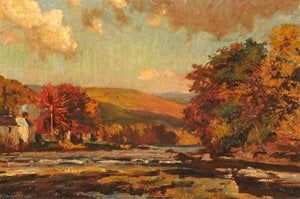
A prime example is "The Sandy Shallows at Parkstone near Bournemouth" (1907), a captivating depiction of the Dorset coastline. The painting isn’t a literal rendering of the beach; instead, it's an exploration of light and shadow, texture and color. Thick impasto – a technique involving applying paint in thick layers – creates a tactile surface that seems to shimmer with reflected sunlight. The colors are muted yet vibrant, evoking the hazy atmosphere of a coastal morning. The composition is deceptively simple, drawing the viewer into the scene’s tranquil beauty.
Musical Legacy and Artistic Connections
Wood's impact on British musical culture is undeniable. He transformed the Promenade Concerts from a niche event into a national institution, establishing them as a cornerstone of orchestral music programming. His championing of contemporary composers like Tchaikovsky – he was instrumental in the premiere of his Sixth Symphony in London – broadened the repertoire available to British audiences and helped to solidify England’s position as a center for musical innovation.
Interestingly, Wood's artistic sensibilities were not entirely isolated from his musical pursuits. He frequently sought inspiration from nature, mirroring the Impressionist painters’ fascination with capturing fleeting moments of beauty. His paintings often reflect the same sense of tranquility and contemplation found in his music. Furthermore, he collaborated with artists like Joseph Henry Sharp, a prominent member of the Taos Society of Artists, exchanging ideas and insights about capturing the essence of their respective subjects – musical sound and visual landscapes.
A Lasting Impression
Henry Joseph Wood died in 1944, leaving behind a legacy that extends far beyond his contributions to orchestral music. His pioneering work in popularizing classical music paved the way for future generations of conductors and music educators. His artistic style, characterized by its atmospheric quality and evocative use of color, continues to resonate with viewers today. Wood’s life serves as a testament to the power of cross-disciplinary inspiration – a reminder that art forms can enrich and inform one another in profound ways.
Întrebări și răspunsuri
Pot explora operele lui Henry Joseph Wood în funcție de spectrul de culori?
Indice Spectral lui Henry Joseph Wood este o pagină care organizează operele de artă ale artistului în funcție de culorile acestora.
Pot explora operele lui Henry Joseph Wood pe baza unor cuvinte cheie?
Pagina După cuvinte cheie a lui Henry Joseph Wood grupează operele de artă ale artistului în funcție de cuvintele cheie.
Unde pot fi găsite operele lui Henry Joseph Wood, grupate pe mișcări artistice?
Operele lui Henry Joseph Wood pot fi vizualizate pe baza stilului artistic în pagina Toate mișcările a artistului.