Henri Georges Dupetit: A Quiet Master of Rural Impressionism
Henri Georges Dupetit (1903–1989) remains a relatively obscure figure in the annals of French art history, despite producing an impressive body of work characterized by a distinctive blend of rural landscapes and intimate portraits imbued with subtle realism. Born in Java, Indonesia, Dupetit’s artistic journey began early, nurtured by his Dutch Indonesian parents who instilled in him a deep appreciation for observation and craftsmanship—qualities that would define his lifelong dedication to painting. His formative years in Holland saw him honing his skills at the Faculdade delle Belle Arti and encountering influential artists like Sidney Nolan and Fred Williams, experiences which undoubtedly shaped his artistic sensibilities.
Early Career & Influences: Dupetit initially pursued careers as a decorator, painter, and marquetry artist, notably collaborating with renowned furniture maker Ruhlmann. This exposure to avant-garde design principles fostered an interest in experimentation and innovation that would permeate his subsequent artistic endeavors.
Ceramic Artistry: Recognizing the transformative potential of ceramics, Dupetit shifted his focus to this medium in the early 1940s, creating sculptural pieces inspired by natural forms—particularly plants and minerals—that reflect a profound connection with the surrounding environment. His studio productions included decorative wall panels and landscapes that showcased his meticulous attention to detail and textural exploration.
Notable Exhibitions & Recognition: Dupetit’s artistic reputation grew steadily throughout his life, culminating in numerous solo exhibitions and participation in group shows alongside fellow artists like Michael Salmon and Ken Taber. He gained recognition for his evocative depictions of rural French countryside and his captivating portraits capturing fleeting moments of human emotion.
Achievements & Legacy: Dupetit’s enduring legacy lies in his unwavering commitment to artistic integrity and his ability to convey a sense of tranquility and beauty through understated compositions. His work exemplifies the core tenets of Impressionism—capturing light and atmosphere—while simultaneously honoring the traditions of rural craftsmanship.
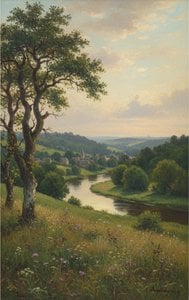
Dupetit's artistic style is instantly recognizable for its serene landscapes rendered in muted tones, capturing the subtle nuances of twilight or dawn. He skillfully employed brushstrokes to convey texture and luminosity—a technique honed during his time with James Mollison at The Australian National Gallery—resulting in paintings that evoke a palpable sense of place. Simultaneously, Dupetit excelled at portraiture, producing intimate portraits characterized by remarkable sensitivity and psychological insight. His subjects were often depicted in natural settings, reinforcing the artist’s fascination with the interplay between human experience and the natural world. He was particularly adept at portraying women—a recurring motif in his oeuvre—capturing their grace and vulnerability with understated elegance.
Color Palette: Dupetit favored a restrained color palette dominated by earthy hues—ochres, browns, greens—creating harmonious compositions that prioritize tonal subtlety over bold chromatic contrasts.
Brushwork Technique: His brushstrokes were loose and expressive, conveying movement and atmosphere while simultaneously capturing the tactile qualities of his subjects’ skin or clothing.
Compositional Considerations: Dupetit meticulously crafted his paintings—often incorporating elements of plein air painting—to maximize visual impact and evoke a profound emotional response in the viewer.
Dupetit's Influence & Place in Art History
Despite remaining largely outside the mainstream narrative of 20th-century art, Henri Georges Dupetit’s work holds considerable significance within the context of Impressionism and rural landscape painting. His dedication to capturing the beauty of everyday life—particularly the rhythms of rural existence—anticipates certain tendencies found in later artists such as Cézanne and Picasso. Furthermore, his meticulous attention to detail and textural exploration aligns with the broader artistic currents of his time, demonstrating a profound understanding of both formal aesthetics and psychological nuance. Dupetit’s enduring appeal stems from his ability to convey a timeless sense of serenity and contemplation—qualities that continue to resonate with audiences today.
Notable Museums Exhibiting Dupetit's Paintings
St George's Chapel
Chelsea And Westminster Hospital
Musée Thomas-Henry
De către echipa editorială WahooArt.com
Chestionar de artă
Fiecare întrebare are un singur răspuns corect.
Întrebare 1:
Q1: Where was Henri Georges Dupetit born?
Întrebare 2:
Q2: What type of art did Dupetit initially practice before focusing on ceramics?
Întrebare 3:
Q3: Which workshop was Dupetit associated with early in his career?
Întrebare 4:
Q4: What is a distinctive feature of Dupetit's ceramic style?
Întrebare 5:
Q5: Where did Dupetit spend time to open his exhibition?
Explore the serene landscapes of Henri-Joseph Harpignies, a master of the Barbizon School. Discover his atmospheric paintings, recurring themes & enduring legacy in 19th-century French art. Learn more at WahooArt.
Descoperă cele mai frumoase 25 de picturi ale lui Georges Seurat! Explorează arta Pointillismului, culorile vibrante și stilul unic al acestui maestru impresionist. Reproduceri de calitate superioară pentru decor interior rafinat pe WahooArt.com.
Descoperă cele mai frumoase 25 de picturi ale lui John Constable, maestru al peisajului englezesc! Explorează stilul romantic, Dedham Vale și capodopere precum The Hay Wain. Reproduceri artă clasică pentru decorul casei tale – WahooArt.com.