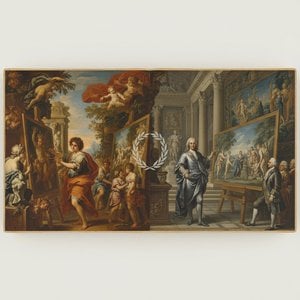
Guillaume Postel: A Renaissance Polymath Bridging East and West
Born in the quiet Normandy village of Barenton in 1510, Guillaume Postel’s life was a remarkable tapestry woven from threads of linguistics, astronomy, diplomacy, and a profound fascination with the Orient. He wasn't merely a scholar; he was a pioneer who sought to synthesize disparate knowledge systems, bridging the gap between Europe and the burgeoning civilizations of the East. His legacy extends beyond his individual achievements, offering a unique window into the intellectual ferment of the 16th century – a time of both cautious exploration and fervent belief.
Postel’s early education at the Collège Sainte-Barbe in Paris laid the foundation for his diverse pursuits. He quickly distinguished himself as a polyglot, mastering Arabic, Hebrew, Syriac, Greek, and Latin—languages crucial to his later work with ancient texts and Eastern cultures. This linguistic prowess led him into the orbit of Ignatius of Loyola and the Society of Jesus, though he ultimately chose not to take formal vows, maintaining a lifelong affiliation with these influential figures while charting his own intellectual course. His departure from the Jesuit order wasn’t marked by conflict but rather by a divergence in their approaches – Postel's expansive, universalist vision clashed with the more rigidly defined doctrines of the Society.
The Exodus Map and Kabbalistic Studies
Perhaps Postel’s most enduring contribution is undoubtedly the “Exodus Map,” created in 1562. This intricate woodcut, meticulously rendered on a large sheet of parchment, depicts the Israelites' journey through the wilderness according to the biblical narrative. It’s far more than a simple illustration; it’s a complex cartographic and symbolic work, incorporating astronomical observations, Kabbalistic interpretations, and geographical knowledge gleaned from his extensive travels. The map demonstrates Postel’s deep engagement with both religious texts and scientific inquiry – he sought to ground the biblical story in observable reality.
Simultaneously, Postel immersed himself in the study of Kabbalah, the mystical Jewish tradition. He meticulously examined ancient Hebrew inscriptions on Judean coins, arguing that they represented a form of Hebrew predating the established script and offering insights into the origins of the language itself. This work was groundbreaking, challenging conventional understandings of linguistic history and demonstrating Postel’s willingness to question established dogma.
A Diplomat in the Ottoman Court
Postel's intellectual curiosity led him to a pivotal role as an interpreter for the French embassy to the Ottoman Empire in 1536. This was a period of intense diplomatic maneuvering, with Francis I seeking an alliance with Suleiman the Magnificent. Postel’s linguistic skills were invaluable, facilitating communication and fostering a degree of understanding between the two cultures. His time in Constantinople wasn't just about translating words; he actively sought out Eastern manuscripts, amassing a collection that would later enrich the Bibliothèque Nationale in Paris – a testament to his dedication to preserving and disseminating knowledge.
His subsequent work, “De la République des Turcs,” reveals a surprisingly nuanced perspective on Ottoman society. While acknowledging certain aspects of their culture, he advocated for a universalist religion encompassing all faiths, reflecting his core belief that the foundations of religious truth were shared across diverse traditions. This progressive stance was unusual for its time and highlights Postel’s commitment to tolerance and intellectual openness.
Cartography and Cosmological Theories
Beyond his diplomatic and scholarly pursuits, Postel developed a keen interest in cartography and cosmology. He produced detailed maps of the world, incorporating both established knowledge and his own observations and interpretations. His “Cosmographicae Disciplinae Compendium,” published in 1561, presented a complex system for understanding the Earth’s geography and its relationship to the heavens. It showcased his belief that the world was not flat but rather a sphere surrounded by a dome-shaped firmament – a perspective aligning with contemporary scientific thought.
Postel's work represents a fascinating intersection of religion, science, and diplomacy during the Renaissance. He wasn’t simply a recorder of existing knowledge; he actively synthesized information from diverse sources, offering innovative interpretations and challenging conventional wisdom. Guillaume Postel’s legacy endures not only through his remarkable maps and scholarly treatises but also as a symbol of intellectual curiosity, cross-cultural understanding, and the pursuit of knowledge in an era defined by both exploration and profound belief.
Întrebări și răspunsuri
Cum s-a evoluat creația lui Guillaume Postel de-a lungul timpului?
Pagina Cronologie a lui Guillaume Postel este o cronologie interactivă, bazată pe derularea paginii, care prezintă lucrările artistului în ordine cronologică, grupate pe perioade reprezentative ale carierei sale.
Cum pot găsi lucrările lui Guillaume Postel pe o temă specifică?
Pagina După cuvinte cheie a lui Guillaume Postel grupează operele de artă ale artistului în funcție de cuvintele cheie.
Unde pot fi găsite operele lui Guillaume Postel grupate pe palete de culori?
Pagina După paletă de culori grupează operele lui Guillaume Postel în funcție de paletele de culori.