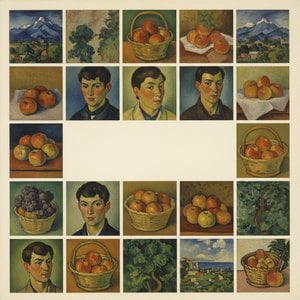
A Life Painted in the Heart of Switzerland
Giovanni Ulrico Giacometti, born on March 7th, 1868, in Stampa, a small village nestled within the Bergell region of Switzerland, was more than just a painter; he was a son of his land, inextricably linked to its dramatic landscapes and profound beauty. His early life unfolded amidst the rhythms of rural existence – his father, Alberto Giacometti, balanced the demands of a bustling café with the comforting routine of baking, while Giovanni’s cousin, Augusto Giacometti, also an artist, ignited within him a nascent passion for capturing the world around him. This familial connection, coupled with the inspiring presence of local artisans and craftsmen, laid the groundwork for a lifelong dedication to art, shaping not only his artistic vision but also his deep appreciation for the natural world. His formal training began at the Kunstgewerbeschule in Munich in 1886, an institution known for its emphasis on craftsmanship and design. However, Giovanni soon found the school’s rigid structure stifling his creative spirit, yearning for a more expressive and liberated approach to art.The Seeds of Inspiration: Segantini and Divisionism
A pivotal moment arrived in 1894 when Giovanni encountered Giovanni Segantini, a master painter renowned for his evocative depictions of the Swiss Alps. Segantini wasn’t merely an acquaintance; he became a mentor, opening Giovanni's eyes to the sublime beauty of the Bergell region and introducing him to the revolutionary techniques of Divisionism. This technique, pioneered by Georges Seurat and Paul Signac, involved applying small, distinct dots or strokes of color – rather than blending them – to create vibrant, luminous effects. Segantini’s influence was transformative, profoundly shaping Giovanni's artistic style and his ability to capture the fleeting qualities of light and atmosphere in the mountains. The dramatic peaks, shimmering glaciers, and expansive vistas of the Bergell region became a constant source of inspiration, fueling Giovanni’s desire to translate their grandeur onto canvas. He began experimenting with Divisionism, meticulously layering small brushstrokes to mimic the dappled sunlight filtering through the alpine foliage, creating an illusion of depth and movement that was both captivating and remarkably realistic.Parisian Encounters and Artistic Evolution
In 1891, seeking a more stimulating artistic environment, Giovanni moved to Paris, a city teeming with avant-garde ideas and artistic innovation. There, he enrolled at the Académie Julian under the tutelage of William Adolphe Bouguereau and Joseph Nicolas Robert-Fleury, traditionalist painters who emphasized classical techniques and idealized forms. However, Giovanni quickly found himself drawn to the burgeoning currents of modern art – Impressionism, Post-Impressionism, and Symbolism – seeking a way to express his unique vision within these evolving movements. He began exhibiting at the Salon des Tuileries, showcasing works that reflected his growing interest in capturing not just the visual appearance of the world but also its emotional essence. This period marked a crucial stage in Giovanni’s artistic development, as he wrestled with the challenge of reconciling traditional techniques with modern sensibilities.A Family Legacy and the Embrace of Expressionism
Giovanni's life was deeply intertwined with his family – his father, Alberto, provided a stable foundation, while his brother, Diego, became a loyal assistant and collaborator. His marriage to Annetta Stampa in 1900 brought him joy and companionship, and together they raised four children, fostering an environment rich in creativity and artistic exchange. In the early 20th century, Giovanni’s work began to shift towards a more expressive style, influenced by the German Expressionist movement. He explored themes of isolation, anxiety, and the human condition, employing bold colors, distorted forms, and emotionally charged compositions. This period saw him experimenting with new techniques, pushing the boundaries of traditional painting and forging his own distinctive artistic voice. Notable works from this era include “In the Goat Barn,” a poignant depiction of rural life, and "Capolago in Winter," which captures the ethereal beauty of the Swiss Alps under a blanket of snow.A Lasting Impact on Swiss Art
Giovanni Giacometti’s legacy extends far beyond his individual artistic achievements. He played a vital role in bridging the gap between traditional and modern art in Switzerland, fostering a vibrant artistic community that nurtured the talents of future generations. His influence can be seen in the work of his son, Alberto Giacometti, one of the most celebrated sculptors of the 20th century, as well as Diego Giacometti, a prominent painter and designer. Giovanni’s commitment to supporting the arts within Switzerland is further evidenced by his service on the Eidgenössische Kunstkommission (Swiss Federal Art Commission) from 1918-1921 and again from 1931-1932. He died in Glion, Switzerland, on June 25th, 1933, leaving behind a rich body of work that continues to captivate audiences with its evocative beauty and profound emotional depth. Giovanni Giacometti’s life and art stand as a testament to the enduring power of observation, imagination, and the unwavering pursuit of artistic expression—a true son of Switzerland who painted his heart onto the canvas.Întrebări și răspunsuri
În ce perioadă istorică a activat Giovanni Giacometti?
Giovanni Giacometti a activat în perioada Secolul al XIX-lea. Această perioadă situează activitatea artistului în istorie.
Câte opere de artă ale lui Giovanni Giacometti pot fi vizualizate?
Puteți vizualiza 83 opere de artă de opere ale lui Giovanni Giacometti pe pagina Toate operele de artă.
De unde este Giovanni Giacometti?
Giovanni Giacometti s-a născut în Elveția.
Care sunt locul și anul nașterii lui Giovanni Giacometti?
Giovanni Giacometti s-a născut în Stampa, în anul 1868.
Există o relatare cronologică a carierei lui Giovanni Giacometti?
O relatare cronologică a creației lui Giovanni Giacometti este disponibilă pe pagina Cronica a artistului, unde operele de artă se succed în ordinea creației lor, capitol cu capitol.
În ce oraș și țară s-a născut Giovanni Giacometti?
Giovanni Giacometti s-a născut în Stampa, în Elveția.
În ce mișcări artistice a activat Giovanni Giacometti?
Operele lui Giovanni Giacometti pot fi vizualizate pe baza stilului artistic în pagina Toate mișcările a artistului.