Gerrit Lundens: A Dutch Master of Genre and Light
Gerrit Lundens, a name perhaps less familiar than Rembrandt’s or Vermeer’s, nevertheless represents a significant chapter in 17th-century Dutch art. Born in Amsterdam in 1622, Lundens carved out a distinctive career as a painter primarily focused on genre scenes – intimate depictions of everyday life, often portraying the pleasures and labors of ordinary people. His work offers a captivating glimpse into the social fabric of his time, imbued with a subtle realism and an appreciation for light that set him apart from many of his contemporaries. While he didn’t achieve the same level of widespread fame as some of his peers, Lundens left behind a body of paintings that reveal considerable skill and artistic sensitivity.Early Life and Artistic Training
Lundens's early life remains somewhat shrouded in mystery, though we know he was born into a family with roots in Antwerp – his father, Berend Lunden, was a laundry bleacher. This connection to the Flemish tradition undoubtedly influenced his artistic development. He received training likely under Abraham van den Hecken the Younger, his brother-in-law and a prominent painter of the period. Van den Hecken’s influence is readily apparent in Lundens's early works, particularly in their shared focus on genre scenes and their use of naturalistic detail. The stylistic similarities suggest a close apprenticeship, allowing Lundens to build upon established techniques while developing his own unique voice. His sister, Catharina, married the painter Christoffel van Sichem, further cementing his connection to the artistic community of Amsterdam.A Life Beyond Painting: Innkeeping and Commerce
Lundens’s life wasn't solely dedicated to painting; he also engaged in business ventures. He operated an inn, a common occupation for artists at the time, providing lodging and sustenance to travelers and fellow creatives. More significantly, he became involved in the wine trade, a lucrative but risky undertaking. This dual existence – artist and merchant – shaped his perspective and likely influenced some of the subjects he chose to depict. The scenes of convivial gatherings, bustling marketplaces, and everyday activities reflect not only artistic observation but also a keen awareness of the social dynamics of Amsterdam’s commercial life. His business dealings ultimately proved unstable, leading to bankruptcy in 1671, a difficult period that may have contributed to his eventual cessation of painting.The Style and Themes of Lundens's Work
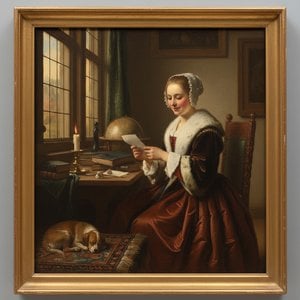
Lundens is best known for his genre scenes, which are characterized by their intimate scale and realistic portrayal of human interaction. He frequently depicted peasants enjoying themselves in taverns, celebrating weddings, or engaging in simple domestic activities. These scenes aren’t idealized; they capture the rough edges and unvarnished realities of peasant life with a remarkable degree of honesty. His use of light is particularly noteworthy – he masterfully employed chiaroscuro, creating dramatic contrasts between light and shadow to draw attention to key figures and enhance the emotional impact of his compositions. This technique, borrowed from Caravaggio, adds depth and atmosphere to his paintings. He also produced portraits, often featuring members of the merchant class, and a single vanitas painting, demonstrating versatility within his chosen genres. Notably, he created a copy of Rembrandt’s “The Night Watch,” a testament to his skill and an intriguing study in comparison with the original masterpiece.Legacy and Significance
Gerrit Lundens may not be as widely celebrated as some of his contemporaries, but his work holds considerable artistic merit. His genre scenes offer valuable insights into 17th-century Dutch society, capturing the everyday lives of ordinary people with a keen eye for detail and a subtle understanding of human psychology. His skillful use of light and his ability to create intimate and engaging compositions distinguish him as a significant figure in the development of Dutch painting. His copy of “The Night Watch,” now housed in the National Gallery in London, stands as a remarkable achievement and provides a fascinating point of comparison with Rembrandt’s original. Lundens's legacy lies not only in his individual paintings but also in his contribution to the rich tapestry of Dutch art history – a testament to the enduring power of genre painting and the artist's ability to capture the essence of human experience.Întrebări și răspunsuri
În ce perioade este împărțită cariera lui Gerrit Lundens?
Cariera lui Gerrit Lundens se desfășoară etapă cu etapă pe pagina Cronologie a artistului: o cronologie orizontală a operelor de artă, grupate în capitole reprezentative ale perioadelor de activitate.
Există o listă completă a operelor lui Gerrit Lundens?
Toate lucrările lui Gerrit Lundens de pe acest site web pot fi explorate în pagina Toate operele de artă a artistului.
Unde pot vedea profilul cromatic al lucrărilor lui Gerrit Lundens?
Genoma Paletei lui Gerrit Lundens este o pagină care prezintă profilul cromatic al întregii creații a artistului.