George Hyde Chambers (1803–1840): A Pioneer of Maritime Impressionism
George Hyde Chambers was born on June 14, 1803, in Whitby, Yorkshire—a town steeped in seafaring tradition and renowned for its rich artistic heritage. He descended from a family with deep roots in the maritime world; his father, George Chambers senior (1803–1840), was a seaman who had travelled extensively throughout Europe and America, fostering within young George an early fascination for the ocean and its dramatic landscapes. Despite facing considerable hardship during his formative years—growing up in a poverty-stricken sharecropping household—Chambers possessed an unwavering determination to pursue artistic excellence, fueled by a lifelong passion for drawing and painting.
Early Training & Influences
Chambers’s artistic education began informally at home, where he honed his skills under the tutelage of his father, who instilled in him a meticulous attention to detail and an appreciation for capturing the essence of natural beauty. He was particularly drawn to the works of Eugène Delacroix and JMW Turner—artists whose bold brushstrokes and expressive use of color profoundly impacted Chambers’s artistic vision. These masters championed spontaneity and emotional intensity—principles that would become central to Chambers's own creative approach. The turbulent seascapes of Turner served as a constant reminder of the sublime power of nature—inspiring him to translate its grandeur onto canvas with unparalleled skill.
Whitby & The Rise of Impressionism
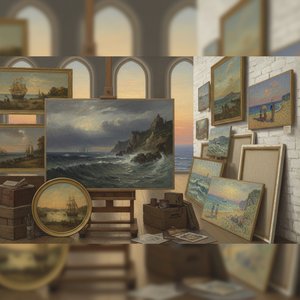
Whitby became Chambers’s artistic epicenter, providing him with an inexhaustible supply of inspiration for his paintings. He meticulously documented the rugged coastline, capturing the turbulent seascapes and atmospheric conditions that characterized the region—a stylistic hallmark that would foreshadow the burgeoning movement of Impressionism. Whitby's windswept cliffs and crashing waves—rendered in luminous color palettes and loose brushwork—became synonymous with Chambers’s distinctive artistic style. He sought to convey not merely what he saw but also how he felt—embracing the subjective experience as a cornerstone of artistic expression.
Career Highlights
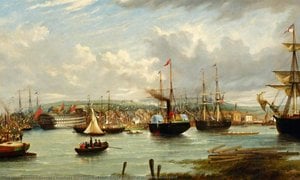
Chambers’s artistic career gained momentum in 1827 when he moved to Wapping, London, where he secured a position as a house painter—allowing him to supplement his income while simultaneously pursuing his artistic ambitions. He quickly established himself as a respected artist, attracting commissions from prominent patrons and exhibiting his work at the Royal Academy and the British Institution. His early paintings—often depicting naval scenes—demonstrated his mastery of composition and perspective—reflecting the influence of Turner’s dramatic landscapes. Furthermore, he served as a scene-painter for Thomas Hornor’s *Panorama of London* at Regent's Park—a challenging undertaking that honed his technical skills and broadened his artistic horizons.
Notable Paintings & Artistic Style
Among Chambers’s most celebrated achievements were his monumental depictions of naval battles—particularly “The Bombardment of Algiers” (1816)—which showcased his ability to convey the drama and intensity of a historical event with remarkable precision. This canvas exemplifies Chambers’s meticulous attention to detail—capturing every nuance of light and shadow—demonstrating his unwavering commitment to portraying reality with unflinching honesty. His landscapes—characterized by luminous color palettes and loose brushwork—captured the sublime grandeur of the Yorkshire countryside—reflecting his profound understanding of atmospheric phenomena and their influence on visual perception. Alan Russett eloquently summarized Chambers’s contribution to British art—observing “George Jnr’s are usually larger and his handling of the paint more free, the attention to detail and figures being less rigorous. His watercolours can be of sufficient quality to be confused with those of his father but the subject matter or other non-stylistic criteria usually provide the key.”
Legacy & Recognition
George Hyde Chambers Junior stands as a pivotal figure in the transition from Romanticism to Impressionism—embodiment of innovation and artistic experimentation that defined the era—leaving behind a legacy of evocative landscapes and masterful depictions of naval battles that continue to inspire admiration and scholarly inquiry. His paintings—characterized by luminous color palettes and loose brushwork—represented a decisive departure from Romantic conventions—embracing the principles of spontaneity, immediacy, and subjective perception that underpinned the Impressionist movement. Chambers’s enduring influence on British art is undeniable—his unwavering dedication to capturing the beauty and grandeur of the natural world cementing his place among Britain’s most revered painters. He achieved renown for his artistic output spanning a diverse range of subjects—from maritime scenes to landscapes—reflecting his unwavering commitment to portraying natural beauty with poetic sensitivity.