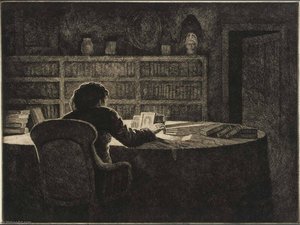
The Etched Soul of New Jersey: The Life and Legacy of George A. Bradshaw
Emerging from the industrial heart of Trenton, New Jersey, George A. Bradshaw (1880-1968) dedicated his life to capturing the profound interplay between light, shadow, and the American landscape. His journey was one of meticulous observation, shaped by a deep-seated reverence for the natural world and a technical mastery of the demanding medium of etching. Born into an era of rapid transformation, Bradshaw’s artistic vision became a poignant vessel for the spirit of the Depression era, weaving together the quiet beauty of the countryside with the gritty, unyielding reality of industrial life. His work does not merely depict scenes; it breathes life into the textures of the earth and the atmosphere of a changing nation.
Bradshaw’s artistic foundation was laid at Rutgers University, where his studies in Fine Arts allowed him to encounter the transformative power of Impressionism and Post-Impressionism. The ethereal explorations of light by masters like Claude Monet left an indelible mark on his sensibilities, instilling in him a lifelong desire to translate fleeting visual sensations onto paper with unparalleled precision. Upon graduating in 1906, he established himself in Trenton, a city that would serve as both his subject and his sanctuary. It was here that he refined the laborious process of etching, mastering the use of zinc plates and acid solutions to create works characterized by remarkable tonal gradations and intricate textures.
Mastery of Medium and Subject
The true brilliance of Bradshaw lies in his ability to navigate between vastly different scales of existence, from the expansive topography of New Jersey’s rugged mountains to the intimate, quiet corners of urban life. As an etcher, he possessed a rare patience, navigating the chemical complexities of printmaking to produce landscapes that felt both permanent and ephemeral. His series depicting Trenton's industrial waterfront stands as a significant historical achievement, offering unflinching portraits of working-class life that capture the rhythmic pulse of the era’s manufacturing strength.
Beyond the industrial, his work often retreated into moments of profound serenity and symbolic depth:
- Urban Stillness: In pieces such as "Ludlow Street" (1935), Bradshaw captures the quietude of city life through empty streets and parked cars, using a monochrome palette to evoke a sense of timeless nostalgia.
- Narrative Symbolism: His 1936 etching "The Raven" demonstrates his ability to engage with literary themes, drawing inspiration from Edgar Allan Poe to explore motifs of mortality, melancholy, and intellectual introspection through the masterful use of light and shadow.
- Coastal Realism: Works like "Frozen Harbor" showcase his skill in maritime detail, rendering winter coastal scenes with a linear precision that conveys the biting chill of the Atlantic landscape.
A Lasting Impression on American Art
Bradshaw’s contribution to the art world extended far beyond the confines of his own studio. For several decades, he served as an instructor at Rutgers University, where he acted as a bridge between generations, imparting the technical secrets of printmaking and fostering a new era of American talent. His dual role as a creator and educator ensured that his dedication to precision and observation would endure long after his passing.
Today, the legacy of George A. Bradshaw is preserved in prestigious institutions such as the Smithsonian American Art Museum. His oeuvre remains a vital historical record, serving as a window into the resilience and beauty of the early 20th-century American experience. Through his etchings, we are invited to witness a world where the industrial and the natural coexist, captured with a technical grace that continues to resonate with art lovers and historians alike.