CONSULTAȚIE GRATUITĂ ÎN ARTE VIZUALE

x

Detalii rapide

  • Also known as: Frank Cowper
  • Lifespan: 81 years
  • Top 3 works:
    • Lucretia Borgia Reigns in the Vatican in the Absence of Pope Alexander VI
    • Untitled (591)
    • La belle dam sans merci
  • Copyright status: Under copyright
  • Art period: Modernism
  • Movements: pre-raphaelite

Test de cunoștințe despre artă

Fiecare întrebare are un singur răspuns corect.

Întrebare 1:
Frank Cadogan Cowper este adesea numit ce?
Întrebare 2:
Unde a primit Frank Cadogan Cowper educația sa formală de artă?
Întrebare 3:
Care artist l-a îndrumat pe Cowper timp de șase luni în 1902?
Întrebare 4:
Ce proiect important a contribuit Cowper în Palatul Westminster?
Întrebare 5:
Care este tema dominantă în picturile lui Cowper?

A Lingering Echo of Romanticism: The Life and Art of Frank Cadogan Cowper

Frank Cadogan Cowper, a name often whispered among art enthusiasts as “The Last Pre-Raphaelite,” wasn’t merely an artist; he was a custodian of a bygone era, a steadfast guardian of the principles that defined the Pre-Raphaelite Brotherhood. Born in 1877 in the serene village of Wickham, Northamptonshire, his life unfolded against a backdrop of profound artistic shifts, yet he remained resolutely devoted to the pursuit of beauty, narrative depth, and the romantic spirit championed by those revolutionary artists who dared to challenge the conventions of their time. His father, Frank Cowper – a celebrated author and an intrepid pioneer of yacht cruising – instilled within him not only a love for adventure and keen observation but also a deep appreciation for storytelling and the power of visual narratives. Furthermore, his lineage—descending from the Rector of Wicken—rooted him in a tradition of intellectual curiosity and spiritual contemplation, shaping both his personal values and his artistic sensibilities. From an early age, Cowper exhibited a remarkable aptitude for art, demonstrating a natural talent that led to formal training at St John’s Wood Art School in 1896, followed by further studies at the prestigious Royal Academy Schools until 1902. These formative years provided him with a solid foundation in technique and an intimate understanding of artistic history—a knowledge he would later skillfully integrate into his own distinctive style.

Forging a Path Between Tradition and Modernity

Cowper’s early career was marked by remarkable success, swiftly establishing him as a significant figure within the British art scene. His debut at the Royal Academy in 1899 immediately garnered attention, but it was “An Aristocrat Answering the Summons to Execution, Paris 1791” (1901) that truly cemented his reputation. This dramatic and meticulously rendered depiction of a pivotal moment from the French Revolution showcased not only Cowper’s technical mastery—his ability to capture light, shadow, and emotion with breathtaking precision—but also his profound understanding of composition and narrative storytelling. The painting's impact was immediate, opening doors for further opportunities and solidifying his position as an artist deeply committed to the Pre-Raphaelite ideals. Recognizing the value of artistic immersion, Cowper embarked on a transformative journey to Italy in 1902, spending six months under the tutelage of Edwin Austin Abbey – a renowned American illustrator and painter known for his dramatic historical scenes. This experience proved invaluable, providing him with insights into narrative painting techniques, decorative arts, and the importance of creating visually compelling stories. Abbey’s influence was particularly significant in shaping Cowper's approach to composition and color, elements that would become hallmarks of his distinctive style. The Italian sojourn also fostered a deeper appreciation for Renaissance art, further informing his artistic vision and solidifying his commitment to classical principles of beauty and form.

Themes of History, Literature, and the Human Condition

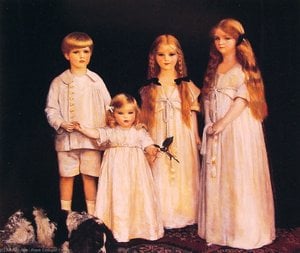
Cowper’s artistic output was characterized by a consistent focus on themes deeply rooted in history, literature, and mythology—subjects that resonated with the Pre-Raphaelite fascination for medieval chivalry, Arthurian legends, and the complexities of human nature. His paintings weren't simply illustrations; they were carefully constructed narratives designed to evoke emotion, stimulate contemplation, and transport viewers to different times and places. Works such as “Lucretia Borgia Reigns in the Vatican,” “La Belle Dame Sans Merci,” and “The Golden Bowl” exemplify this approach, revealing a profound understanding of his subjects’ psychology and motivations. He possessed an uncanny ability to imbue even the most historical or mythological scenes with a sense of immediacy and emotional resonance, capturing not just the outward appearance but also the inner lives of his characters. Cowper's commitment to narrative painting set him apart from many of his contemporaries who were increasingly drawn towards abstraction and experimentation—a testament to his unwavering dedication to traditional artistic values. The meticulous detail evident in his work—from the texture of fabrics to the subtle nuances of facial expressions—demonstrates a profound respect for craftsmanship and a desire to create images that are both visually stunning and intellectually stimulating.

The Last Bastion of Pre-Raphaelite Ideals

Cowper’s artistic style is instantly recognizable, characterized by an extraordinary attention to detail, luminous colors, and a romantic sensibility deeply influenced by the Pre-Raphaelites. He earned the title “The Last Pre-Raphaelite” not merely because he painted in a similar style but because he remained steadfastly committed to the movement’s core principles—truth to nature, moral seriousness, and an emphasis on beauty—long after they had faded from mainstream popularity. His work represents a bridge between Victorian Romanticism and early 20th-century art, preserving a tradition of narrative painting and detailed realism in an era increasingly dominated by abstraction and modernism. He wasn’t simply imitating the Pre-Raphaelites; he was carrying their torch, adapting their techniques to his own unique vision and ensuring that their legacy would endure. His dedication to meticulous research—evident in his extensive studies of historical settings, costumes, and characters—further solidified his position as a true heir to the Pre-Raphaelite tradition.

A Legacy of Beauty and Narrative

Frank Cadogan Cowper’s artistic journey culminated in numerous exhibitions at the Royal Academy and other prestigious venues throughout his career. His paintings were celebrated for their technical brilliance, imaginative quality, and emotional depth, earning him recognition from critics and collectors alike. In 1907, he achieved a significant milestone when “Vanity” was acquired by the National Collection through the Chantrey Bequest—a testament to its artistic merit and enduring appeal. Later in his career, Cowper contributed to a monumental mural project in the Houses of Parliament alongside other prominent artists, further cementing his place within the established art world. Despite facing challenges as modern art trends shifted, Cowper remained true to his artistic convictions, producing works that continue to captivate audiences with their intricate detail, evocative storytelling, and profound emotional resonance. His paintings serve as a poignant reminder of a bygone era—an era of romanticism, craftsmanship, and a deep appreciation for the beauty of the world around us. His final works, painted in his Gloucestershire retreat, retain the same technical skill, narrative power, and romantic sensibility that defined his entire career, ensuring that his legacy will continue to inspire and delight generations to come.