CONSULTAȚIE GRATUITĂ ÎN ARTE VIZUALE

x

Detalii rapide

  • Also known as: Giuseppe Lavagna (Relative)
  • Top-ranked work: Two floral still lifes
  • Copyright status: Under copyright
  • Top 3 works: Two floral still lifes
  • Works on APS: 1

Test de cunoștințe despre artă

Fiecare întrebare are un singur răspuns corect.

Întrebare 1:
Francesco Lavagna was primarily known for painting what type of subjects?
Întrebare 2:
In which city did Francesco Lavagna primarily work?
Întrebare 3:
What is known about Francesco Lavagna's biographical details and career?
Întrebare 4:
Who was Giuseppe Lavagna?
Întrebare 5:
What century did Francesco Lavagna work in?

A Neapolitan Bloom: The Life and Art of Francesco Lavagna

Francesco Lavagna, a name whispered among connoisseurs of 18th-century Italian painting, remains an elusive figure despite the enduring beauty of his floral still lifes. Born in Naples around 1684 and passing away circa 1724, Lavagna’s life is shrouded in mystery, documented more through the surviving canvases than biographical accounts. What we do know paints a picture of a gifted artist deeply embedded within the vibrant artistic milieu of his city, contributing significantly to the flourishing Neapolitan school of still life painting. He was first noted by Bernardo De Dominici, an important art historian of the period, who recognized Lavagna’s talent and importance early on. While details of his formal training are scarce, it is believed he may have studied under Gasparo Lopez, a prominent painter in Naples at the time. However, a strong familial connection to Giuseppe Lavagna, also a still life artist, suggests a close collaborative relationship and shared artistic lineage—perhaps even a workshop environment where styles were honed and techniques exchanged.

The Language of Flowers: Style and Technique

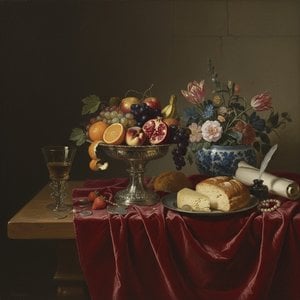
Lavagna’s paintings are characterized by their exquisite detail, luminous color palettes, and dynamic compositions. He specialized in lush arrangements of flowers, often set against dark, neutral backgrounds that heighten the vibrancy of his subjects. Unlike some of his contemporaries who favored a more formal, symmetrical approach, Lavagna embraced a sense of naturalism, capturing the delicate curves of petals, the subtle variations in hue, and the fleeting beauty of blossoms at various stages of bloom and decay. His work isn’t merely representational; it's an exploration of texture, light, and form. He masterfully employed oil paints to create a remarkable illusion of depth and volume, giving his flowers a tangible presence that draws the viewer in. The compositions are often exuberant, overflowing with blooms—roses, carnations, lilies, and other varieties arranged in opulent vases or spilling onto draped surfaces. This abundance wasn’t simply decorative; it reflected the prosperity and refined taste of Naples' aristocratic patrons.

Influences and Artistic Context

The Neapolitan still life tradition in which Lavagna worked was itself a product of broader European artistic currents. The Dutch Masters, particularly those renowned for their *vanitas* paintings—works that used symbolic objects to meditate on the transience of life—exerted a significant influence. While Lavagna’s work doesn't typically carry the overt moralizing tone of Northern European *vanitas*, there is an underlying awareness of mortality in the depiction of fading flowers, a subtle reminder of time’s relentless passage. The Italian Baroque tradition, with its emphasis on drama and emotional intensity, also played a role, evident in Lavagna’s use of light and shadow to create a sense of atmosphere and depth. However, he distinguished himself through his uniquely Neapolitan sensibility—a celebration of color, abundance, and the sheer joy of visual beauty.

Patronage and Legacy

Lavagna's clientele consisted primarily of wealthy Neapolitan families who commissioned paintings to adorn their palazzi and villas. These were not merely decorative objects; they were statements of status, reflecting the patrons’ appreciation for art and their refined aesthetic sensibilities. The artist frequently collaborated with his relative Giuseppe Lavagna on these commissions, decorating interiors with lavish floral arrangements that transformed spaces into havens of beauty. While Francesco Lavagna's life was tragically cut short at the age of forty, succumbing to blindness in 1724, his artistic legacy endures through the surviving paintings. Though relatively unknown for centuries, recent scholarship has brought renewed attention to his work, recognizing him as a key figure in the development of Neapolitan still life painting and a master of capturing the ephemeral beauty of the natural world. His canvases offer a glimpse into the opulent lifestyle of 18th-century Naples and stand as testaments to his exceptional skill and artistic vision.