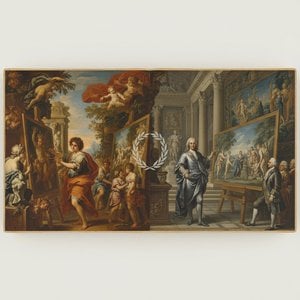
André Gueslin: Weaver of Royal Shadows and Symbolic Realism
André Gueslin, born in Rouvres-en-Xaintois, France in 1950, wasn’t merely a painter; he was a meticulous historian, a scholar deeply immersed in the social and economic currents of his time. His artistic practice emerged from this intellectual foundation, resulting in portraits that transcend simple likenesses – they are windows into the anxieties, ambitions, and complexities of 18th-century France, particularly during the reign of Louis XIV. Gueslin’s unique approach blended rigorous historical research with a distinctly symbolic style, creating images that resonate far beyond their surface beauty. He wasn't interested in simply replicating appearances; he sought to capture the *essence* of his subjects, imbuing them with layers of meaning rooted in the social and political landscape of their era.
Early Life and Academic Foundations
Gueslin’s early life instilled a deep appreciation for history and a methodical approach to understanding the past. He was an *agrégé d'histoire* (a highly competitive French academic qualification), demonstrating exceptional abilities in research and analysis from a young age. His doctoral work, focused on the origins of the Crédit agricole, showcased his talent for uncovering hidden connections between economic institutions and broader social forces. This early specialization laid the groundwork for his later explorations into themes of power, wealth, and social exclusion. He continued his academic pursuits, holding professorships at Nancy-II and Clermont-Ferrand-II universities before becoming a professor emeritus at Sorbonne-Paris-Cité in 1993, dedicating himself fully to both teaching and research. His intellectual journey shaped him not just as an artist but as a deeply informed interpreter of the past.
The Development of a Distinctive Style
Gueslin’s artistic style evolved over time, reflecting his growing understanding of historical context and his increasing mastery of technique. Initially influenced by traditional portraiture, he gradually developed a distinctive approach characterized by meticulous detail, subtle symbolism, and a muted color palette. He wasn't drawn to the bright, celebratory tones often associated with royal portraits; instead, he favored earthier hues – browns, ochres, and grays – that evoked a sense of gravitas and introspection. His compositions are frequently complex, incorporating architectural elements, symbolic objects, and carefully rendered details that all contribute to a larger narrative. A key element of his style is the use of *chiaroscuro*, creating dramatic contrasts between light and shadow which adds depth and emotional intensity to his subjects.
Iconic Portraits: Louis XIV and Beyond
Perhaps Gueslin’s most celebrated works are his portraits of Louis XIV, particularly “Portrait de Louis XIV” (also known as *d'après Geuslain*). These paintings aren’t straightforward depictions of the Sun King; they are carefully constructed allegories that explore themes of power, authority, and the burdens of leadership. The painting is replete with symbolic details: a meticulously rendered tapestry depicting scenes from French history, a partially obscured view of the palace at Versailles, and the king's own hand resting on a globe – all elements designed to convey a complex message about Louis XIV’s reign. Beyond Louis XIV, Gueslin also produced portraits of other significant figures of the era, each imbued with similar layers of historical and symbolic meaning. His ability to capture not just physical likeness but also the psychological state of his subjects is what truly sets his work apart.
Legacy and Historical Significance
André Gueslin’s artistic legacy extends beyond the realm of fine art. He was a dedicated historian, whose research illuminated critical aspects of French economic and social history. His later works delved into themes of poverty, marginalization, and the representation of wealth – subjects often overlooked in traditional historical narratives. His exploration of anxieties surrounding money and the poor, particularly his 2013 book *D'ailleurs et de nulle part*, offers a poignant reflection on the enduring challenges of social inequality. Gueslin’s work serves as a powerful reminder that art can be both a window into the past and a tool for understanding the present. His meticulous research, combined with his distinctive artistic style, has cemented his place as one of the most important portrait artists of the late 20th and early 21st centuries, offering invaluable insights into the complexities of French history and culture.