Early Life and Training
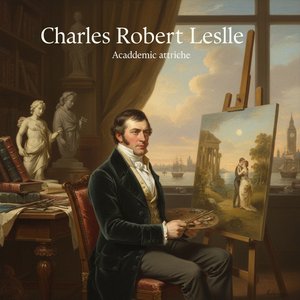
Charles Robert Leslie, a name now synonymous with charming depictions of everyday life in 19th-century Britain, was born on October 19, 1794, in the bustling heart of London. His lineage traced back to American parents – Robert Charles, an American merchant, and Lydia Leslie, a woman of considerable social standing. At just five years old, the family embarked on a transatlantic journey, settling in Philadelphia, Pennsylvania, where young Charles received his initial education. However, it wasn’t long before the call of art proved too strong to resist. Initially apprenticed to a bookseller – a practical step for a young man of that era – Leslie's true passion lay in capturing the world around him through brush and paint. This early experience, grounding him in observation and detail, would prove invaluable as he later sought his fortune in London’s vibrant artistic scene.Arrival in London and Royal Academy Recognition
In 1811, a pivotal moment arrived: Leslie secured letters of recommendation and journeyed to London, eager to immerse himself in the city's renowned art world. His arrival coincided with a period of considerable opportunity, thanks to the support of established artists like Benjamin West – a figure whose influence extended across generations of British painters – and Washington Allston. These connections paved the way for his enrollment at the prestigious Royal Academy Schools in 1813. It was here that Leslie truly began to hone his skills, quickly demonstrating an aptitude for both historical painting and, crucially, genre scenes—a shift that would define his later career. His talent was immediately recognized, culminating in two silver medals awarded to him at the Academy’s annual exhibitions – a remarkable achievement for a young artist just beginning his journey. The influence of West and Allston is evident in his early works, particularly in their grand compositions and dramatic use of light, but it wasn't long before Leslie developed his own distinctive style.A Shift to Genre Painting and Notable Works
Leslie’s artistic trajectory took a significant turn as he moved away from the imposing scale of historical painting towards the more intimate and relatable subjects of genre scenes. This decision proved remarkably prescient, aligning with a growing trend in 19th-century art that celebrated everyday life and human character. Among his most celebrated works are “The Murder of Rutland by Lord Clifford,” an early piece that showcased his ability to emulate the dramatic style of historical painting, and "Londoners Gypsying," a lighthearted depiction of London street life—a scene brimming with energy and capturing the spirit of the city. His portraiture also gained recognition, exemplified by his captivating portrayal of Sir Walter Scott, a celebrated Scottish author and poet. These works, alongside others like “Sir Walter Scott’s Portrait,” demonstrated Leslie's skill in capturing the likeness and personality of his subjects.Museum Involvement and Legacy
Leslie’s career was inextricably linked to the Royal Academy, where he served as an associate in 1821 and achieved full membership in 1826. His legacy extends beyond his own paintings; he is also remembered for his insightful biography of John Constable, a fellow artist and close friend, published in 1843 – a work considered a seminal text in the history of art criticism. The archives of Charles Robert Leslie’s work are preserved at the Centre d'art britannique de Yale, offering scholars and enthusiasts alike access to a rich collection of his paintings and sketches. Leslie’s life and career reflect the evolving artistic landscape of 19th-century Britain, bridging the gap between grand historical narratives and the intimate portrayal of human experience—a testament to his versatility and enduring appeal as an artist. He passed away on May 5, 1859, leaving behind a body of work that continues to captivate audiences today.Întrebări și răspunsuri
Există o cronologie a operelor lui Charles Robert Leslie?
Operele lui Charles Robert Leslie pot fi vizualizate în ordine cronologică pe pagina Cronologia operelor de artă a artistului.
De unde este Charles Robert Leslie?
Charles Robert Leslie s-a născut în Regatul Unit.
Cum s-a evoluat creația lui Charles Robert Leslie de-a lungul timpului?
Pagina Cronologie a lui Charles Robert Leslie este o cronologie interactivă, bazată pe derularea paginii, care prezintă lucrările artistului în ordine cronologică, grupate pe perioade reprezentative ale carierei sale.