Charles Burton Barber (1845 – 1894): Beloved Victorian Painter of Heartwarming Scenes Featuring Children & Their Animal Companions
Charles Burton Barber, a name synonymous with Victorian sentimentality and heartwarming depictions of domestic life, flourished during a period captivated by the bonds between humans and animals. Born in Great Yarmouth in 1845, Barber’s artistic journey unfolded against the backdrop of a rapidly changing Britain, yet his work consistently offered a comforting glimpse into an idealized world of innocence and affection. While details surrounding his formal training remain somewhat elusive, it is clear that Barber possessed an innate talent nurtured through dedicated practice and keen observation. He first exhibited at the prestigious Royal Academy in 1866, marking a pivotal moment in establishing his career within the London art scene, and continued to showcase his work there consistently until 1893. This sustained presence solidified his reputation and allowed him to cultivate a loyal following among collectors who appreciated his ability to evoke genuine emotion through paint.Early Life and Artistic Beginnings
Barber’s formative years were spent in Great Yarmouth, where he was born into a family of printers and booksellers—a profession that instilled in him an appreciation for craftsmanship and visual communication from a young age. His father, also a painter, undoubtedly nurtured his artistic inclinations, providing him with invaluable experience and guidance. Although biographical information about Barber’s early education is scarce, it’s evident that he possessed a natural aptitude for drawing and painting—skills honed through diligent self-study and observation of the natural world. Recognizing this talent, he embarked on his artistic studies at the Royal Academy in London in 1864, immersing himself in the traditions of British art history and mastering techniques essential to capturing realistic detail. This formative period established a foundation for his subsequent career as a celebrated genre painter—a style characterized by its focus on everyday life and domestic scenes.Royal Recognition and Artistic Style
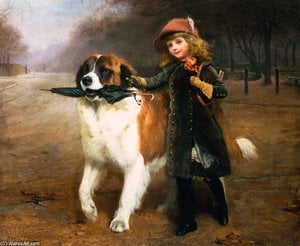
Barber’s artistic versatility was notable; he moved with ease between highly detailed, almost photographic realism and more spontaneous, sketch-like compositions. However, it is for his sentimental portrayals of children interacting with their animal companions—particularly dogs—that he remains best known today. His paintings aren't merely representations of scenes but rather carefully constructed narratives brimming with warmth, tenderness, and a palpable sense of emotional connection. He possessed an exceptional skill in capturing the subtle nuances of expression, both human and canine, imbuing his subjects with personality and charm. Suspense, Off to School, and A Special Pleader are prime examples of this ability, each painting telling a silent story that resonates deeply with viewers. The artist’s technique often involved layering glazes to achieve rich colors and textures, enhancing the overall sense of realism and inviting the viewer into the intimate world he created. He wasn't simply painting pets; he was portraying cherished members of the family, capturing the unique relationship between children and their beloved animals. Barber defied convention by keeping his animals with their own features but in doing so carved out a niche for himself—a distinctive approach that distinguished him from many of his contemporaries.The Influence of Sir Edwin Landseer and Victorian Genre Painting
Barber’s artistic sensibilities were profoundly shaped by the work of Sir Edwin Landseer, a Scottish landscape painter who championed the depiction of animals in emotive narratives. Like Landseer, Barber admired Landseer’s ability to convey profound emotion through his paintings—particularly scenes featuring dogs—and he began his career emulating Landseer’s style. This admiration for Landseer’s oeuvre instilled in Barber a deep appreciation for capturing the beauty and dignity of the natural world, as well as conveying complex psychological states within his subjects. Barber's stylistic choices aligned seamlessly with broader trends prevalent during the Victorian era—namely Victorian genre painting and *animalier* art. Genre painters sought to depict scenes from everyday life, reflecting social customs and moral values, while *animalier* artists specialized in portraying animals with remarkable realism and expressive detail—often imbued with human-like qualities. Barber’s commitment to these artistic traditions cemented his reputation as one of Britain’s foremost practitioners of sentimental painting—a genre that prioritized emotional resonance over strict adherence to photographic accuracy.A Legacy of Charming Portraits and Royal Patronage
Barber achieved considerable success during his lifetime, securing commissions from prominent figures including Queen Victoria herself. Notably, Queen Victoria and her daughter Beatrice had a particular fondness for animals. The Queen had a number of collies, dachshunds and Pomeranians. In the 1870′s, the Queen commissioned Barber to paint a series of portraits of her dogs to honor and memorialize her beloved pets. One of the more famous pieces is of the Queen, Beatrice, three collies and a dachshund at Windsor. He painted portraits of a number of the Royal family pets including Marco, Noble and others belonging to the Queen; Watts, Spot and Oswald for Beatrice; and for the prince, who would later become King Edward VII, Barber painted the portraits of Queen Victoria sitting upon her horse with John Brown holding the reins. Barber’s last painting was for the Queen. It was a portrait in which she is shown seated in her pony carriage with several of Prince and Princess Henry of Battenberg's children and surrounded by dogs. Clark, John Brown’s replacement, appears along with an Indian servant as well. Some of Barber’s friends and family admitted after his death that they had believed it would be either his last painting or the last one painted for the Queen. His paintings are now to be seen on notelets, trinkets, greeting cards, tee-shirts etc. In the Victorian age his pictures were used for advertising products, especially by Lever Brothers for soap etc. Charles Burton Barber painted John Brown, at Queen Victoria’s request, as a gift from the Queen to Mr. Brown, on Brown’s birthday in 1876. He received his final commission in 1894 to paint Queen Victoria, with her grandchildren in her pony-carriage. He died in London soon afterwards. Many of Barber’s paintings were made into prints, usually in the medium of photogravure. Much of his art is at the Lady Lever Art Gallery in Port Sunlight. His world famous prints were then sold in the early 80s in The British home store Woolworths at sale price, soon there after nearly everyone had barbers pictures hanging on their living room walls. At least five of his works remain in The Royal Collection, where they are held in trust. Unfortunately, under English law, photographs of these paintings, which would be considered in public domain in the rest of the world, remain licensed by the Royal Collection and therefore will not be included on The Famous Artists collection of works by Charles Burton Barber.Întrebări și răspunsuri
Unde pot vedea operele lui Charles Burton Barber organizate după atmosferă?
Operele lui Charles Burton Barber pot fi explorate în funcție de starea de spirit pe pagina Spațiu pe stări de spirit a artistului, care organizează lucrările după stările lor de spirit regăsite.
Există o prezentare generală a tuturor subiectelor pictate de Charles Burton Barber?
Operele lui Charles Burton Barber pot fi explorate pe temă pe pagina Atlas pe subiecte a artistului.
Câte opere de artă ale lui Charles Burton Barber pot fi vizualizate?
Puteți vizualiza 25 opere de artă de opere ale lui Charles Burton Barber pe pagina Toate operele de artă.
What other names is Charles Burton Barber known by?
Charles Burton Barber is also known as Charles Alfred Barber, Charles Arnold Barber, Charles Burton (Cricketer), Charles Barton, Charles E. Burton.
În ce perioade este împărțită cariera lui Charles Burton Barber?
Cariera lui Charles Burton Barber se desfășoară perioadă cu perioadă pe pagina Cronica a artistului: o cronologie orizontală a operelor de artă, grupate în capitole reprezentative ale etapelor carierei.
De unde este Charles Burton Barber?
Charles Burton Barber s-a născut în Regatul Unit.
În ce perioadă istorică a activat Charles Burton Barber?
Charles Burton Barber a activat în perioada Secolul al XIX-lea. Această perioadă situează activitatea artistului în istorie.
Care sunt locul și anul nașterii lui Charles Burton Barber?
Charles Burton Barber s-a născut în Giurgiu, în anul 1845.