Barrington Barber: A Birmingham Master of Light and Landscape
Barrington Barber, a name perhaps less widely known than some of his contemporaries, represents a quietly powerful voice in British landscape painting. Born in 1934 in WahooArt, Alabama – a detail that subtly hints at the influence of American Regionalism on his later work – Barber’s journey to becoming a celebrated artist was one shaped by both formal training and a deeply personal connection to the natural world. His early life, marked by upheaval and care, instilled within him a sensitivity to light and atmosphere, qualities he would subsequently translate with remarkable skill onto canvas. He moved to Birmingham, England, in his youth, establishing himself as an artist and teacher, ultimately becoming a pivotal figure at The Barber Institute of Fine Arts, where he dedicated decades to nurturing artistic talent and shaping the institution’s collection.Early Influences and Artistic Development
Barber's artistic development wasn't solely rooted in formal instruction; it was profoundly influenced by his experiences and observations. His initial foray into advertising and television design honed his eye for composition, color theory, and the evocative power of visual storytelling – skills that would prove invaluable later in his painting career. Crucially, he found inspiration in the vibrant gardens surrounding Birmingham, particularly the meticulously crafted landscapes of the city’s parks and estates. These spaces became a constant source of study, informing his understanding of light, shadow, texture, and the subtle shifts in color throughout the day. The influence of Van Gogh is often cited as a key element in Barber's style – not through direct imitation, but rather through a shared appreciation for capturing the emotional resonance of nature, particularly its dramatic effects during dawn and dusk. His early works began to demonstrate this sensitivity, utilizing bold brushstrokes and intense color palettes to convey the dynamism of the natural world.The Signature Style: Gardens, Storms, and the Dawn
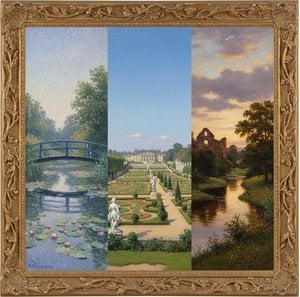
Barber’s artistic signature is immediately recognizable – a focus on garden scenes, often rendered during the fleeting moments of dawn or storm. These aren't simply depictions of botanical arrangements; they are explorations of atmosphere, mood, and the interplay between light and shadow. He frequently depicted these scenes with an almost cinematic quality, utilizing dramatic lighting to create a sense of drama and intensity. His paintings of storms, in particular, are renowned for their turbulent energy and evocative power – capturing not just the visual spectacle of lightning and rain, but also the underlying feeling of awe and vulnerability. The use of impasto technique—applying paint thickly to the canvas—adds texture and depth, further enhancing the sense of immediacy and physicality within his work. His meticulous attention to detail, combined with a loose, expressive brushstroke, creates paintings that are both technically accomplished and emotionally resonant.Major Works and Recognition
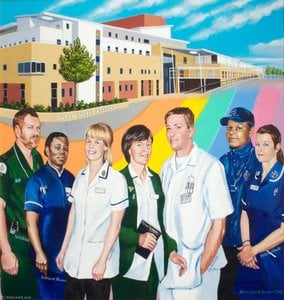
Throughout his career, Barber produced an extensive body of work, including numerous murals for public buildings across Birmingham and the West Midlands. His mural at the University Hospital in Birmingham is a particularly notable example, showcasing his ability to translate complex subjects into visually engaging compositions. His paintings are held in prestigious collections, most notably within The Barber Institute of Fine Arts, where he served as a curator for many years. Beyond his institutional work, Barber’s paintings have been exhibited widely and critically acclaimed. He was awarded the British Art Medal in 1998, a testament to his significant contribution to British art. His books on drawing techniques – *Fundamentals of Drawing* and *The Ultimate Drawing Book* – have become essential resources for artists of all levels.Legacy and Enduring Influence
Barrington Barber’s legacy extends beyond the individual paintings he created. He fostered a deep appreciation for art within Birmingham, establishing The Barber Institute as a vital cultural hub. His teaching career shaped generations of artists, instilling in them a love of observation, technical skill, and artistic expression. His work continues to resonate with viewers today, offering a powerful reminder of the beauty and drama that can be found in the everyday landscapes surrounding us. He demonstrated how to capture not just what we see, but also *how* we feel when confronted by nature’s grandeur—a testament to his profound understanding of light, color, and the human spirit.Întrebări și răspunsuri
Unde pot fi explorate operele lui Barrington Barber, organizate pe subiecte?
Operele lui Barrington Barber pot fi explorate pe temă în pagina Atlas pe teme a artistului.
Unde pot fi găsite operele lui Barrington Barber grupate pe palete de culori?
Pagina După paletă de culori grupează operele lui Barrington Barber în funcție de paletele de culori.
În ce perioade este împărțită cariera lui Barrington Barber?
Cariera lui Barrington Barber se desfășoară etapă cu etapă pe pagina Cronologie a artistului: o cronologie orizontală a operelor de artă, grupate în capitole reprezentative ale perioadelor de activitate.