Early Life and Artistic Foundations
Altoon Sultan, born in Brooklyn, New York, in 1948, emerged from a borough steeped in artistic energy. Her formative years were profoundly shaped by her education at Brooklyn College, where she immersed herself in the study of painting under the guidance of influential figures like Philip Pearlstein and Lois Dodd. These mentors instilled within her a rigorous approach to realism—not merely as replication, but as a vibrant, precise interpretation of perceived reality. Summer programs at Tanglewood and Skowhegan further solidified her commitment to art-making, providing crucial opportunities for experimentation and growth. This early training laid the groundwork for Sultan’s distinctive style, characterized by its meticulous detail and unwavering focus on form.
A Dedication to Landscape and Machinery
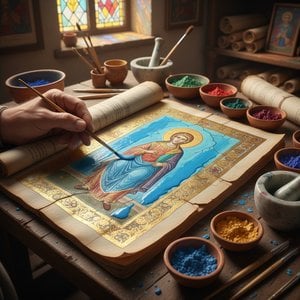
Sultan's artistic journey led her toward a fascination with rural landscapes, specifically those of agricultural settings. Initially, she explored Victorian architecture, but gradually shifted her attention to the often-overlooked beauty of farming implements and machinery. This wasn’t simply a change in subject matter; it represented a deeper engagement with themes of production, labor, and the interplay between humanity and the natural world. Her technique is remarkable for its use of egg tempera on calfskin parchment—an ancient medium that demands patience and precision. The resulting paintings possess an almost jewel-like luminosity, drawing viewers into their intimate details. Sultan’s work isn't about grand narratives or sweeping vistas; it’s about the quiet dignity of everyday objects and the subtle poetry of rural life.
Formalism, Abstraction, and a Unique Scale
What sets Sultan apart is her unwavering commitment to formalism—a focus on composition, color, spatial relationships, and light. While rooted in realism, her paintings transcend mere representation, treating their subjects as found abstractions. She isolates structural features, organizing them into harmonious arrangements that emphasize form over narrative content. This approach has been likened to the work of Ellsworth Kelly, suggesting a modernist sensibility that prioritizes visual purity. Equally significant is Sultan’s deliberate choice of scale. Her paintings are intentionally small—never exceeding 13 inches in height or width—a decision that forces viewers to engage with the details on an intimate level and imbues the industrial components with a tangible presence reminiscent of illuminated manuscripts.
Exhibitions, Recognition, and Lasting Influence
Over a career spanning several decades, Sultan has exhibited extensively throughout the United States and internationally. Her work has been featured at prominent galleries such as Marlborough Gallery and Tibor de Nagy in New York, as well as Chris Sharp Gallery in Los Angeles and Hollybush Gardens in London. She’s received two National Endowment for the Arts grants, an Academy Award in Art from the American Academy of Arts and Letters, and a medal for painting from the National Academy of Design—testaments to her enduring impact on the art world. Sultan's paintings are held in esteemed collections including those of the Metropolitan Museum of Art, the Museum of Fine Arts, Boston, and the Yale University Art Gallery.
Studio and Garden: A Reflection of Process and Perspective
Beyond her painting practice, Sultan maintains a popular blog titled *Studio and Garden*. This online space offers a glimpse into her creative process, featuring photographs of her home in Groton, Vermont, her land and garden, and reflections on art exhibitions she visits. The blog reveals a deep connection to nature—a source of inspiration that permeates her work. It also provides insight into her thoughtful approach to color, materials, and the broader cultural landscape. *Studio and Garden* is more than just a personal diary; it’s a testament to Sultan's dedication to observation, contemplation, and the enduring power of artistic inquiry. Her ability to find beauty in the mundane, coupled with her masterful technique, has established her as a significant voice in contemporary American painting—an artist who invites us to see the world anew through a lens of precision, intimacy, and quiet reverence.