A Life Rooted in Syrian Soil: The Art of Ali Mukawwas
Born in 1955 in the coastal city of Latakia, Syria, Ali Mukawwas emerged as a significant voice in contemporary Arab art. His journey began with formal training at the Faculty of Fine Arts at Damascus University, graduating in 1978—a period marked by both political and artistic ferment across the region. This foundation proved crucial, providing him not only with technical skill but also an environment to cultivate his unique perspective. Mukawwas didn’t simply absorb techniques; he began a lifelong exploration of how art could reflect collective memory, human connection, and the enduring power of nature. He quickly distinguished himself as a painter deeply attuned to the subtleties of line, color, and form, establishing a style that would become instantly recognizable.
The Etching-Like Aesthetic: A Visual Language of Line and Light
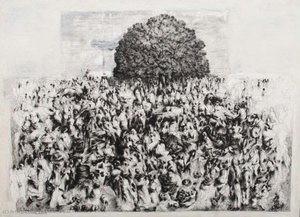
Mukawwas’s paintings are often described as resembling etchings—a comparison rooted in his masterful use of line work and limited palettes. He doesn't employ broad, sweeping gestures but rather builds images through a delicate network of interwoven lines, creating textures that evoke both depth and fragility. This technique isn’t merely stylistic; it reflects a deliberate attempt to capture the ephemeral nature of memory and experience. His color choices are equally restrained, favoring earthy tones punctuated by subtle contrasts. These aren't vibrant explosions of hue but carefully considered modulations that draw the eye inward, encouraging contemplation rather than immediate spectacle. The overall effect is one of quiet intensity—a visual whisper that resonates long after initial viewing. He has been described as a master of expressionism, yet his work transcends easy categorization, blending figurative representation with an almost abstract sensibility.
Trees and Gatherings: Symbolism at the Heart of His Work
The most striking feature of Mukawwas’s oeuvre is undoubtedly the recurring motif of people gathered around trees. These aren't idyllic pastoral scenes but complex meditations on the collective nature of humanity, the rituals that bind us together, and our relationship with the natural world. The figures themselves are often rendered ambiguously—faces indistinct, identities blurred—emphasizing their role as representatives of a larger whole rather than individual portraits. The trees, in contrast, possess a powerful allegorical weight. Mukawwas himself has spoken of them as “an unusual but an epic legend that has to do with the rural man: his rituals, the collective imagination, the cosmic void and the existentialism of the artist.” They become symbols of resilience, interconnectedness, and the enduring power of life itself. The gatherings suggest a shared history, a communal spirit—a poignant reminder of our common humanity in an increasingly fragmented world.
Recognition and Representation: A Leading Voice on the Arab Art Scene
Mukawwas’s talent didn't remain confined to Syria for long. He has represented his country in numerous exhibitions organized by the Ministry of Culture, gaining national recognition as a leading artist. His participation in prestigious art fairs such as the Sharjah and Cairo biennials further cemented his position on the Arab art scene. Beyond these formal venues, he’s exhibited extensively throughout the region—in Damascus, Amman, Beirut, Tunis, Doha, Dubai—and has also brought his work to European audiences, showcasing the power of Syrian art on an international stage. He is not only a practicing artist but also a dedicated educator, having taught visual arts in Algeria, the UAE, and Oman, nurturing the next generation of artistic talent. His works have been acquired by significant collections including the British Museum and the Doha Museum, solidifying his legacy as a major figure in contemporary art.
A Lasting Legacy: Exploring Collective Memory Through Art
Ali Mukawwas’s contribution to contemporary art lies not simply in his distinctive style or compelling subject matter but in his ability to evoke profound emotions and philosophical questions through subtle yet powerful imagery. His paintings are a testament to the enduring power of human connection, the importance of collective memory, and our inherent relationship with nature. He invites viewers to contemplate their own place within this larger narrative—to reflect on the rituals that bind us together, the histories that shape us, and the fragile beauty of the world around us. His work is a quiet rebellion against the consumerist world, a return to fundamental values, and a celebration of the human spirit. He continues to paint and teach, inspiring artists and audiences alike with his unwavering commitment to artistic expression and his profound understanding of the human condition.