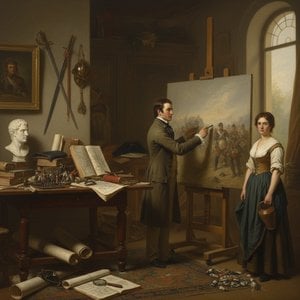
Alcide Joseph Lorentz: A Chronicler of Napoleonic Glory
Alcide Joseph Lorentz (1813-1889) stands as a significant figure in French art history, primarily recognized for his meticulous depictions of Napoleon Bonaparte’s military campaigns and his masterful execution of lithograph prints—a medium that allowed him to disseminate his artistic vision widely. Born in Paris, Lorentz possessed an innate talent for drawing and painting from a young age, embarking on a career that blended historical scholarship with artistic skill.
- Early Life & Artistic Training:
- Lorentz’s formative years were marked by rigorous training under Jean-Baptiste Camille Corot, one of the foremost landscape painters of his time. This exposure to Corot instilled in Lorentz a profound appreciation for tonal subtlety and atmospheric perspective—elements that would become hallmarks of his artistic style.
The Napoleonic Canvas: Lorents’s Historical Output
Lorentz's fame ascended during the Second Empire, fueled by his prolific output of paintings commemorating Napoleon’s triumphs. He captured pivotal moments from battles like Austerlitz and Borodino with remarkable accuracy and dramatic flair, prioritizing historical detail alongside expressive brushwork. His canvases weren’t merely representations; they were carefully constructed narratives designed to glorify Napoleon's leadership and inspire patriotic fervor. Notably, his painting “The Battle of Austerlitz” remains a celebrated example of Napoleonic art, showcasing Lorentz’s ability to convey both grandeur and visceral emotion.
- Technique & Style:
- Lorentz favored a tonalist approach—characterized by muted colors and gradual shading—that mirrored the aesthetic sensibilities of Corot and emphasized realism. He meticulously studied topographical maps and military reports to ensure his depictions were faithful to historical accounts.
Beyond Painting: Lithography & Political Commentary
While Lorentz’s paintings cemented his reputation as a historian, he achieved considerable renown as a lithographer and caricaturist. He skillfully employed the technique of stone etching to produce stunningly detailed prints that captured scenes from daily life and political discourse—often offering biting critiques of contemporary figures and events. His engraving “Caricature engraving of George Sand” exemplifies his talent for capturing personality and conveying social commentary with precision and humor. This dual artistic practice demonstrated Lorentz’s versatility and cemented his position as a voice of his era.
- Influence & Legacy:
- Lorentz's work profoundly impacted the visual culture of the Second Empire, shaping perceptions of Napoleon and contributing to the broader artistic landscape. His meticulous observation and masterful technique served as an inspiration for subsequent generations of artists—particularly those interested in portraying historical subjects with psychological depth.
A Lasting Impression
Alcide Joseph Lorentz passed away in 1889, leaving behind a legacy of accomplished paintings and influential lithographs. His dedication to capturing the spirit of his time—particularly the grandeur of Napoleon’s reign—continues to resonate with art historians today, securing his place as an artist who skillfully blended artistic skill with historical awareness.