The Genesis of Abstraction: Mondrian’s Early Influences
 Wikipedia: Abstract art
Abstract art uses visual language of shape, form, color and line to create a composition which may exist with a degree of independence from visual references in the world. Abstract art, non-figurative art, non-objective art, and non-representational ...
Piet Mondrian, a name synonymous with geometric abstraction, didn't emerge from a vacuum. His radical departure from representational painting was the culmination of a deliberate and evolving artistic journey rooted in the Dutch landscape tradition and a growing fascination with spiritualism and philosophical inquiry. Born in 1872, young Piet initially gravitated towards naturalistic depictions – windmills, fields, and water scenes reflecting his upbringing near Amsterdam. However, these early works reveal an underlying concern for structure and form that would foreshadow his later style. He wasn’t merely *recording* nature; he was already seeking its essential components, simplifying shapes and reducing palettes. This nascent tendency was further fueled by his exposure to the Theosophical Society in 1892, a movement emphasizing universal truths hidden beneath surface appearances. The search for these underlying principles became central to Mondrian’s artistic quest, pushing him beyond Impressionism's fleeting moments of light and color towards a more profound, abstract expression.
His early engagement with the Barbizon school and Dutch Realism provided a crucial foundation – a mastery of technique and observation that he would later consciously dismantle. He absorbed lessons in composition and tonal values, skills he’d later employ to create dynamic balance within his increasingly non-figurative works. The influence of Jan Toorop, a Symbolist painter, also proved significant, introducing Mondrian to the power of stylized forms and evocative color combinations. These early explorations weren't simply stylistic experiments; they were steps in a deliberate process of purification, stripping away the superfluous to reveal what Mondrian believed was the fundamental essence of reality.
De Stijl: A Collective Pursuit of Pure Aesthetics
 Wikipedia: De Stijl
De Stijl (, Dutch: [də ˈstɛil]; 'The Style') was a Dutch art movement founded in 1917 by a group of artists and architects based in Leiden (Theo van Doesburg, J.J.P. Oud), Voorburg (Vilmos Huszár, Jan Wils) and Laren (Piet Mondrian, Bart van der Leck...
By 1917, this pursuit led Mondrian to co-found *De Stijl* (The Style) in Leiden, a journal and artistic movement that would become inextricably linked with his name. More than just a group of artists, De Stijl was an intellectual collective driven by a shared utopian vision – the belief that art could be a catalyst for social transformation. Led alongside Theo van Doesburg, the movement sought to establish a new visual language based on pure abstraction, rejecting ornamentation and embracing geometric forms as expressions of universal harmony. The journal served as a platform for disseminating their theories, advocating for a radical simplification of form and color in all aspects of design – from painting and sculpture to architecture and typography.
De Stijl’s core principles revolved around the use of horizontal and vertical lines representing opposing forces, balanced by primary colors (red, yellow, blue) and non-colors (black, white, grey). This wasn't arbitrary; it was a deliberate attempt to create an objective visual language free from subjective interpretation. The movement’s influence extended beyond painting, impacting architecture with figures like J.J.P. Oud, who translated De Stijl’s principles into functional and aesthetically rigorous buildings. While Mondrian was the most prominent figure associated with Neo-Plasticism – the theoretical underpinning of De Stijl – the collective energy and shared ideals were crucial to its development.
Neo-Plasticism Defined: Principles of Composition & Color
Mondrian formally articulated his artistic philosophy as Neo-Plasticism (Nieuwe Beelding in Dutch), a term reflecting his desire for a “new plastic art” divorced from the imitation of nature. He believed that true art should not represent the visible world but rather express underlying spiritual realities through pure abstraction. This involved a rigorous reduction of visual elements to their most fundamental components: straight lines, rectangular planes, and primary colors. The horizontal line symbolized stillness and passivity, while the vertical represented dynamism and activity; their interplay created a sense of balanced tension.
The choice of primary colors wasn’t accidental either. Mondrian saw them as embodying universal energies – red representing vitality, yellow signifying intellect, and blue evoking spirituality. Black and white served as neutral forces, defining the boundaries and enhancing the impact of the primary hues. Crucially, Neo-Plasticism rejected symmetry in favor of asymmetrical balance, believing that perfect equilibrium was unattainable and undesirable. The goal wasn’t to create static perfection but rather a dynamic interplay of opposing forces reflecting the inherent complexities of life. This emphasis on pure form and color aimed to transcend individual expression, creating artworks that resonated with universal truths.
Beyond the Canvas: The Utopian Vision of Neo-Plasticism
For Mondrian, Neo-Plasticism wasn’t merely an aesthetic style; it was a philosophical system with profound social implications. He envisioned a world transformed by its principles – architecture and design harmonized with nature, creating environments that fostered spiritual well-being. He believed that the rigid order of his paintings could serve as a blueprint for a more balanced and harmonious society, free from the chaos and fragmentation of modern life. This utopian ambition fueled his exploration of three-dimensional constructions and furniture designs, attempting to extend Neo-Plastic principles beyond the confines of the canvas.
His vision extended even further, influencing discussions about urban planning and social organization. He saw art as a means of achieving collective consciousness, believing that exposure to pure abstraction could elevate human perception and foster a sense of unity. While his architectural projects remained largely unrealized during his lifetime, the underlying principles – simplicity, functionality, and harmony – continue to inspire architects and designers today. The ambition wasn’t simply to create beautiful objects but to fundamentally reshape the world through aesthetic transformation.
Composition with Red, Yellow and Blue: An Iconic Masterpiece Analyzed
 Composition with Red, Yellow and Blue
This JSON response fulfills your request for a detailed analysis of the artwork, including its stylistic elements, historical context, biographical information about Piet Mondrian, and relevant links to online resources. It adheres strictly to your f...
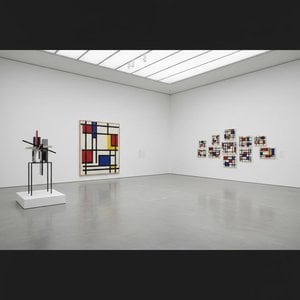
Perhaps no artwork embodies the essence of Neo-Plasticism more powerfully than “Composition with Red, Yellow and Blue” (1930). This deceptively simple painting – a grid of black lines intersecting to create rectangular planes filled with primary colors – represents the culmination of Mondrian’s artistic evolution. The composition is deliberately asymmetrical, yet achieves a remarkable sense of balance through the careful placement and proportioning of its elements. The vibrant red rectangle commands attention, counterbalanced by the cooler blues and yellows.
The painting isn't about depicting objects; it’s about exploring relationships – the tension between horizontal and vertical lines, the interplay of primary colors, the dynamic equilibrium achieved through careful composition. The black grid serves as a structural framework, defining the boundaries and enhancing the impact of the colored planes. It is important to note that even the white spaces are not merely empty areas but active elements contributing to the overall balance. “Composition with Red, Yellow and Blue” isn’t just a painting; it's a visual manifestation of Mondrian’s philosophical beliefs – a testament to his search for universal harmony through pure abstraction.
Mondrian’s Legacy: Impact on Art, Architecture, and Design
Piet Mondrian’s influence extends far beyond the realm of abstract art. His radical simplification of form and color profoundly impacted subsequent generations of artists, architects, and designers. From Minimalism to Post-Painterly Abstraction, his legacy can be seen in countless works that embrace geometric abstraction and pure visual expression. The Bauhaus school, with its emphasis on functional design and geometric forms, drew heavily from De Stijl’s principles, further disseminating Mondrian’s ideas across the globe.
Today, Mondrian’s aesthetic continues to resonate in fashion, graphic design, and interior decoration. His iconic compositions have been adapted for everything from clothing patterns to furniture designs, demonstrating the enduring power of his visual language. More than just a stylistic influence, Mondrian’s work challenges us to reconsider our relationship with form, color, and space – to see beyond surface appearances and appreciate the underlying structures that shape our world. At WahooArt.com, we celebrate this legacy by offering high-quality reproductions of Mondrian’s masterpieces, allowing you to experience the transformative power of Neo-Plasticism in your own home.