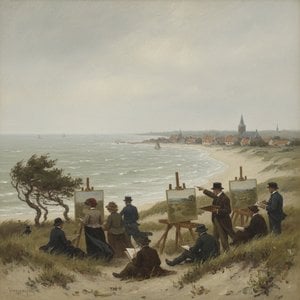
The Quiet Master of the Dutch Countryside
Théophile Emile Achille de Bock (1851–1904) remains one of the most evocative, if understated, voices of the Hague School. Born in The Hague, Netherlands, De Bock’s early life was far removed from the bohemian studios of the art world; he initially pursued a pragmatic career as a clerk for the Dutch Railway Company. However, an innate passion for drawing and a profound sensitivity to the natural world eventually pulled him away from the ledger books and toward the easel. This transition marked the beginning of a lifelong devotion to capturing the atmospheric soul of the Dutch landscape, a pursuit that would define his legacy.
His artistic journey was shaped by rigorous training under some of the most significant figures of the era. By studying under masters such as J.W. van Borselen, J.H. Weissenbruch, and Jacob Maris, De Bock became deeply immersed in the principles of Tonalism. These mentors taught him to look beyond mere topographical accuracy, encouraging instead a focus on light, moisture, and the subtle gradations of color that define the Low Countries. His association with Willem Maris further enriched his palette, fostering a collaborative spirit that allowed him to refine his ability to translate the heavy, damp air of the Netherlands onto canvas.
A Vision of Atmospheric Tonalism
De Bock’s work is characterized by a distinctive, often somber temperament. While some contemporary critics occasionally dismissed his style as overly subdued or sketch-like, modern admirers recognize this as a deliberate and masterful choice. He possessed an unparalleled ability to evoke the quietude of the Dutch polders, often utilizing a dark, moody palette to create scenes of profound contemplation. His landscapes are rarely about dramatic action; rather, they are studies in stillness, where the interplay of shadow and soft light suggests the fleeting moments of dusk or the heavy presence of an approaching storm.
The influence of the French Barbizon School played a transformative role in his development. During his frequent travels to Paris and the forests of Barbizon in 1880, De Bock encountered the works of Gustave Courbet and Jean-François Millet. This exposure to French Realism deepened his commitment to depicting rural life and natural landscapes with an unvarnished, honest eye. He sought to capture the essence of the earth—the texture of the soil, the weight of the clouds, and the solitary beauty of a farmstead at twilight—blending the Dutch tonalist tradition with a newfound French-inspired realism.
Legacy and Historical Significance
The historical significance of De Bock lies in his unwavering commitment to his artistic vision. Even when faced with pressure to diversify his subject matter, he remained steadfastly dedicated to the pastoral scenes that resonated most deeply with his spirit. This dedication was noted even by Vincent van Gogh, who recognized De Bock’s inherent talent and temperament, though Van Gogh famously attempted to persuade him to explore more dynamic and varied themes. This interaction serves as a testament to the respect De Bock commanded among his peers.
Today, the works of Théophile de Bock are celebrated for their emotional depth and technical mastery of atmosphere. His paintings serve as windows into a vanished era of the Dutch landscape, offering a sense of peace and melancholy that continues to captivate collectors and historians alike. Through his meticulous observation and devotion to the subtle nuances of nature, De Bock secured his place as a vital contributor to the Hague School, leaving behind a body of work that remains as evocative and timeless as the landscapes he so lovingly depicted.


 Previzualizare
 Trimite prin felicitare
 Distribuie
 Detalii despre lucrare
 Ghid
Ghid

 Descarcă imaginea
 Produse similare
 Radiografie
 Galerie foto
 Întrebări și răspunsuri
 Statistici


 Vezi mai mult
 Comută pe versiunea Print





































 Opțiunea cu sticlă este disponibilă doar pentru dimensiuni de sub 110 cm